Most homes here run on electric heat
Electricity heats 69.4% of homes in Washington Parish, far ahead of gas. A mini split fits right into that setup since it runs on electricity too, with no gas line to account for.
Takes about a minute. No obligation.
Electricity heats 69.4% of homes in Washington Parish, far ahead of gas. A mini split fits right into that setup since it runs on electricity too, with no gas line to account for.
Where a gas furnace needs venting and a gas supply checked, a mini split just needs power and a spot for the line set between the outdoor unit and the indoor head. For most homes here, that's a more straightforward job.
NOAA nClimDiv, 1991–2020 normals
Half the homes in Washington Parish were built in 1982 or later, and mobile homes make up about a quarter of the housing stock.
A mini split sized to the room handles both cases, no special equipment needed.



A mini split installed here runs cooling six months straight, May through October. June through August, it's working against a 91°F afternoon on a regular day, not an occasional spike. That's the load the sizing has to match. Too big and it short cycles, cooling the room fast but never running long enough to pull the moisture out of the air. Too small and it runs flat out all summer trying to catch up. Get the size right for the room and the unit settles into a steady run instead of fighting the heat all season.
Washington Parish falls in climate zone 2A, where cooling carries most of the year. A ductless mini split counts as a split system under the federal standard, so one installed now has to meet 14.3 SEER2 for cooling and 7.5 HSPF2 for heating. A federal tax credit is available on qualifying equipment. A contractor can walk you through which units meet both.
Find a contractor
Cooling runs May through October here, six months straight. That's the stretch the unit has to get through once it's in. Putting the installation in during April means the first time it kicks on, it's easing into a mild day, not catching up on a system already behind. Anything that needs adjusting gets caught then too, instead of mid heat wave. Wait until the first hot week and you're choosing between no cooling for days or whatever crew can fit you in.
A single outdoor unit can run more than one indoor head, each one controlling its own room. Ask whether the quote is one zone or several, and which rooms share a head versus get their own. A room that runs hot or cold on its own, or stays shut off most of the time, usually does better with its own zone instead of sharing one sized for a bigger space.
The line set carries refrigerant between the outdoor unit and each indoor head, and the condensate line has to drain somewhere that won't pool against the foundation or run across a walkway. Ask where both are routed before the holes get drilled. Moving a line set after the fact means patching wall or siding that didn't need to be touched the first time.
Sizing a mini split comes down to how much heat the room gains and loses, not how big the room looks. A contractor works that out room by room, counting windows, exterior walls, insulation and what's on the other side of each wall, then matches it to a unit rated for that load. Bigger isn't a safety margin here. An oversized head cools the air fast, satisfies the thermostat, and shuts off before it's pulled the humidity out, so the room feels cold and damp instead of just comfortable. An undersized one never gets ahead of the load and runs constantly without catching up. Either way shows up in the first few weeks, not years later.
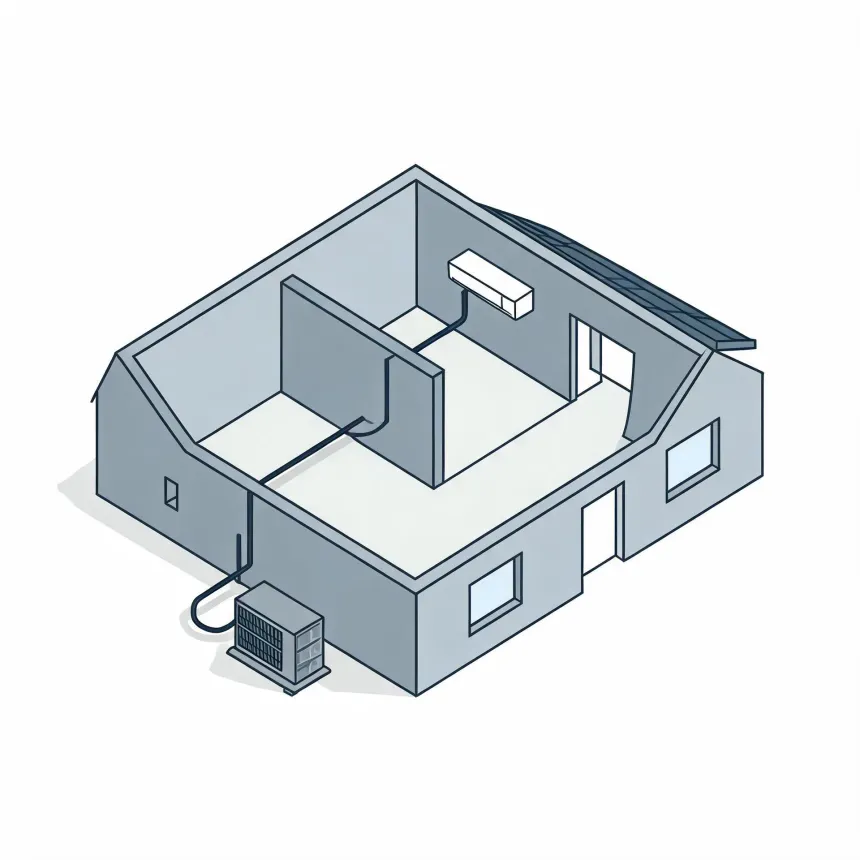
Install day starts with the outdoor unit and the indoor head going up, usually in that order. The outdoor unit sits on a pad or wall brackets, somewhere with clear airflow on all sides. Inside, the head gets mounted high on the wall it was measured for, then the crew cuts a small hole through to the outside for the line set. That line set, the refrigerant lines, the condensate drain, and the power cable all run through that one opening and get connected on both ends. Once everything's joined, the line gets pressure tested and pulled down to vacuum before any refrigerant moves through it, which is what catches a bad connection before the system ever runs. Last step is powering it up and checking that it's actually pulling the temperature down and draining where it should.