Electricity here runs cheap
Denham Springs homes paid 12.41 cents per kilowatt-hour in 2025, lower than most US counties. A mini-split that heats and cools with electricity starts from a good position here.
Takes about a minute. No obligation.
Denham Springs homes paid 12.41 cents per kilowatt-hour in 2025, lower than most US counties. A mini-split that heats and cools with electricity starts from a good position here.
A mini-split installed here will cycle on through long stretches of heat and humidity, then again on cold mornings in winter. How much electricity it pulls to do that job shows up on every bill it touches.
NOAA nClimDiv, 1991–2020 normals
Livingston Parish saw 89 severe weather events between 2015 and 2024, including 59 with damaging wind and 17 with hail.
The outdoor unit sits outside in that path, so where it goes and what shields it matters as much as the install itself.




Livingston Parish falls in climate zone 2A, a hot and humid zone under the energy code. Cooling is the heavier load here, and the federal standard accounts for that. Any mini-split installed here, since it's a split system, has to clear 14.3 Btu of heat moved per watt-hour of electricity over summer and 7.5 Btu per watt-hour over winter, if it was built on or after January 1, 2023. That standard doesn't carve out a lower bar for ductless systems. It narrows what can legally go on the wall or outside your home, and it sets the floor for how little waste you're stuck paying for.
That efficiency rating on the unit is not a sticker you forget about once it's installed. Power here is cheap, but a mini-split still runs most of the year in this climate, and the difference between a system that meets the minimum and one that beats it shows up on every bill it touches. Get the sizing and installation right from the start.
Find a contractor
Seven months of cooling, April through October. Afternoon highs average 91°F across June, July and August, and the dew point runs 73°F those same months, higher than most of the country ever sees. That's the air a new mini-split has to wring moisture out of, day after day, most of the year it's running. A unit working that hard, that often, shows wear sooner than one in a milder climate. The parts that go first, a capacitor, a contactor, tend to go earlier here, not because the equipment is bad but because the job never really lets up.
Every mini-split for sale carries two ratings, one for cooling and one for heat. A contractor should tell you both numbers for the exact model going on your wall, not a range for the product line. Two units that look the same on the showroom floor can sit far apart on these ratings, and that gap is what you're buying.
The right size comes from a load calculation on the actual room or home, not a guess based on square footage. A unit sized too big short cycles and never pulls the moisture out of the air before it shuts off. A unit sized too small runs flat out and still can't keep up. Either way you paid for capacity you're not getting the use of.
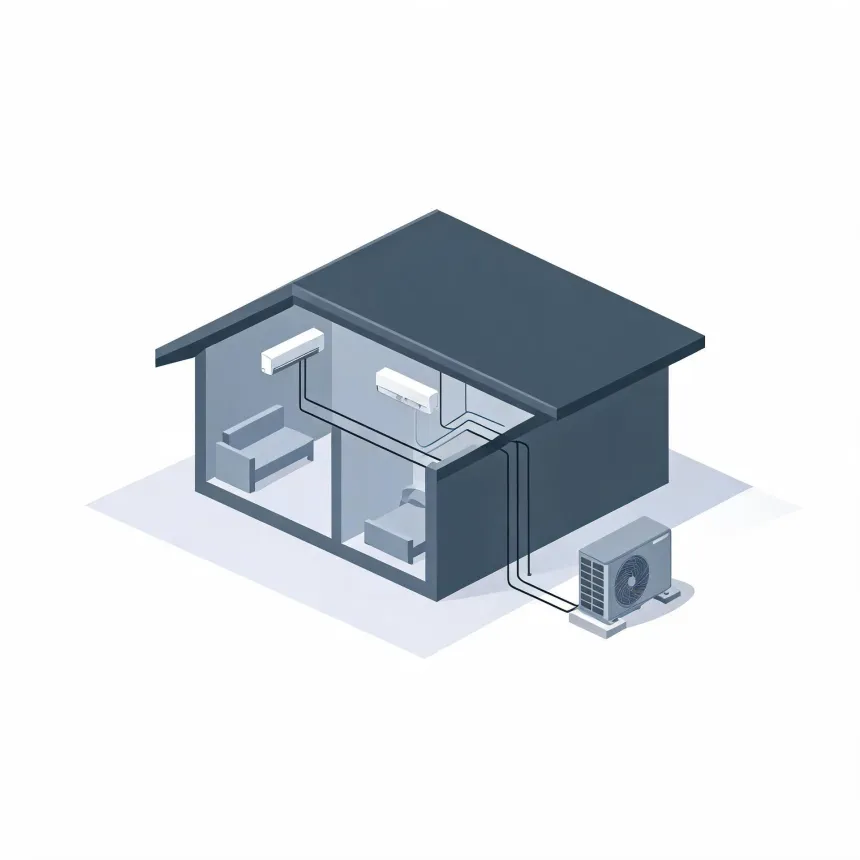
The installation itself is what decides how that rating performs once the system runs. A line set that's too long, too short, or bent too sharply changes how much refrigerant the system needs and how hard the compressor works to move it. Every joint in that line set has to hold a vacuum, and a weak seal bleeds refrigerant out slowly, long before anyone notices a problem. The indoor head has to sit where air can pull across the coil freely and reach the room it's meant to condition, not just the wall it's easiest to mount on. Refrigerant lines need the right charge for their length, checked with gauges, not assumed from a chart. None of this shows up on the spec sheet, and none of it shows up the day the system goes in. It shows up a year later, in how often the unit cycles and how long it takes to do its job.
Seven months of cooling a year means a mini-split here is sized for the job it will actually do, not the job a square footage chart says it should do. Buying on price alone usually means buying on the sticker price, and that number doesn't tell you how the unit handles a Denham Springs summer. A contractor running a real load calculation on your home will land on a size that can pull moisture out of the air through a long, heavy summer without short cycling or straining. That calculation costs nothing extra to ask for. Skipping it is how homeowners end up with a unit that's either too big to dehumidify properly or too small to keep up, and both mistakes get expensive the same way: on every bill, every month it runs.