




A illuminated white antebellum-style house with a wraparound porch, white columns, and Spanish-moss-draped oak trees, photographed at dusk.

Mini Split Installation in Farmerville, LA

Tell us about the job

Takes about a minute. No obligation.

New system or replacementMini-splitUnion Parish, LA
Step 1 of 2

What ZIP code is the job in?

Union Parish saw 174 severe weather events between 2015 and 2024. Most of that was damaging wind, 112 times in that span, with 37 hail events and 15 tornadoes mixed in. A mini split's outdoor unit sits outside through all of it, exposed to wind-blown debris and hail in a way a furnace or a water heater tucked indoors never is. Power loss matters just as much. Close to half of Louisiana households went at least a day without power in 2024. A mini split won't heat or cool through an outage any more than a central system will, so where the unit goes and how it's installed are worth getting right from the start.

5 months
November through March, your system heats
5 months
May through September, it cools
37°F
the average winter night it heats against
92°F
the average summer afternoon it cools against
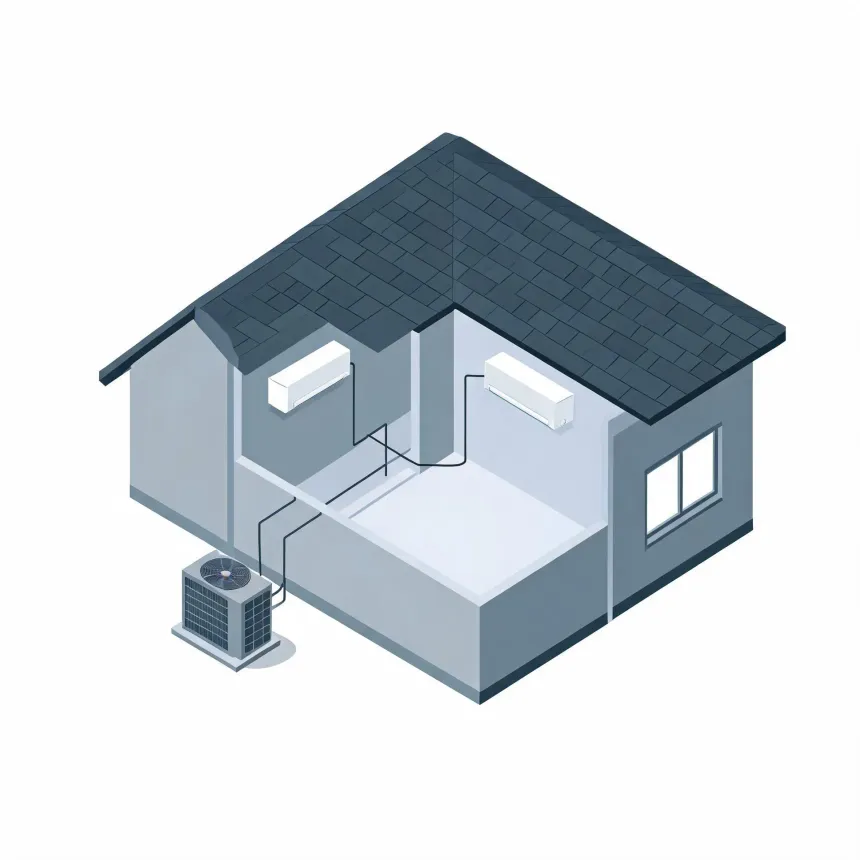
Isometric illustration of a cutaway gray house with a dark shingled roof, showing two wall-mounted indoor air conditioning units connected by lines to an outdoor condenser unit on the ground outside.
Your system heats November through March and cools May through September.

NOAA nClimDiv, 1991–2020 normals

Electricity heats 64.5% of homes in Union Parish, more than any other fuel.

A mini split runs on electricity too, so it fits into a house already wired for the load.

May starts cooling season here, so get it installed before then

Cooling runs May through September
Climate zone 3A
Power here costs 12.10 cents per kilowatt-hour

Union Parish falls in climate zone 3A under the energy code, which the federal government ranks as warm and humid. Any mini-split heat pump installed here has to meet the same federal minimum either way, built into the equipment rather than chosen on site. For cooling, it has to pull at least 14.3 Btu of heat out for every watt-hour of electricity it uses. For heating, at least 7.5 Btu for every watt-hour. That standard applies to units manufactured from January 1, 2023 on, so an older unit pulled out of a warehouse may not clear it. It narrows what a contractor can legally install, which is worth asking about before settling on a model.

Plan for the outdoor unit and the outage before either happens

Ask the installer where the outdoor unit will sit and what will shield it. Ask what happens to heat and hot water if the power goes down for a day. Those are install-day decisions, not afterthoughts.

Find a contractor
A white mini-split air conditioner outdoor condenser unit mounted on metal brackets against a beige stucco exterior wall, with a blue sky and scattered clouds in the background.

Five months of heavy air, every year

Five months of cooling here, May through September, with afternoon highs averaging 92°F in June, July and August. The dew point runs 69°F those same months, higher than most of the country sees, so the air stays heavy even after the temperature drops in the evening. A mini split has to pull that moisture out as well as cool the air, and it does both at once for five straight months straight. That is long enough for a unit sized wrong to show it, either short cycling because it is too big for the room or running flat out because it is too small. Get the sizing right at install and the system settles into a steady rhythm instead of fighting the air all summer.

The old unit doesn't just get hauled off

Taking out a window unit or a central system means disconnecting wiring, capping or removing old refrigerant lines, and patching whatever hole or wall sleeve it used. If a central system is coming out, the ductwork either gets sealed off or reused, and the old refrigerant has to be recovered into a tank rather than vented, since it's against the law to release it into the air.
What's left behind shapes where the new one goes

An old line set or electrical run doesn't always land where a mini split needs it, so a contractor may run new line sets rather than reuse what's there. The condensate drain is worth checking too. An old unit's drain path may not suit a wall-mounted head, and standing water from a bad slope will damage the wall over time.

The efficiency number on a mini split's label, usually written as SEER2 for cooling and HSPF2 for heating, tells you how much heat it moves per unit of electricity, not how much power it uses outright. A higher number means the system gets more cooling or heating out of the same draw of electricity than a lower-rated one. It's a ratio, not a size. Two units can carry the same rating and still be different capacities, built for different room sizes. The rating also comes from lab testing at fixed conditions, so it describes the equipment, not how it will perform in any one room, against any one wall, in any one house. It matters most when you're comparing models against each other, less as a promise of exactly what you'll see day to day.

Half the homes in Union Parish were built in 1987 or earlier, and mobile homes make up about a third of the housing stock here. Neither of those facts says what's behind any one wall, but they matter for where a mini split's lines and wiring can run and what the outdoor unit gets mounted to. An older house may still have the electrical panel or wiring from when it was built, and a contractor needs to check that before adding the load of a new system. A mobile home needs its own kind of mounting for the outdoor unit, since the skirting and underside don't take a bracket the way a poured foundation does. None of this is a problem a mini split can't handle. It just means the installer has to look at the house in front of them, not a generic one.