A modern bedroom with dark furnishings, a wall-mounted air conditioning unit, and a cat resting on a large bed.

Mini Split Installation in Gonzales, LA

Tell us about the job

Takes about a minute. No obligation.

New system or replacementMini-splitAscension Parish, LA
Step 1 of 2

What ZIP code is the job in?

Electricity here runs cheaper than most places

Ascension Parish homes paid an average of 12.36 cents per kilowatt-hour in 2025, lower than most US counties. A mini split here still costs less per hour to run than it would somewhere with pricier power.

A mini split that runs often adds it all up anyway

Low rates help, but a mini split in Gonzales works for stretches most systems elsewhere don't see. How efficiently it moves heat decides what those hours turn into on the bill.

5 months
November through March, your system heats
7 months
April through October, it cools
44°F
the average winter night it heats against
91°F
the average summer afternoon it cools against
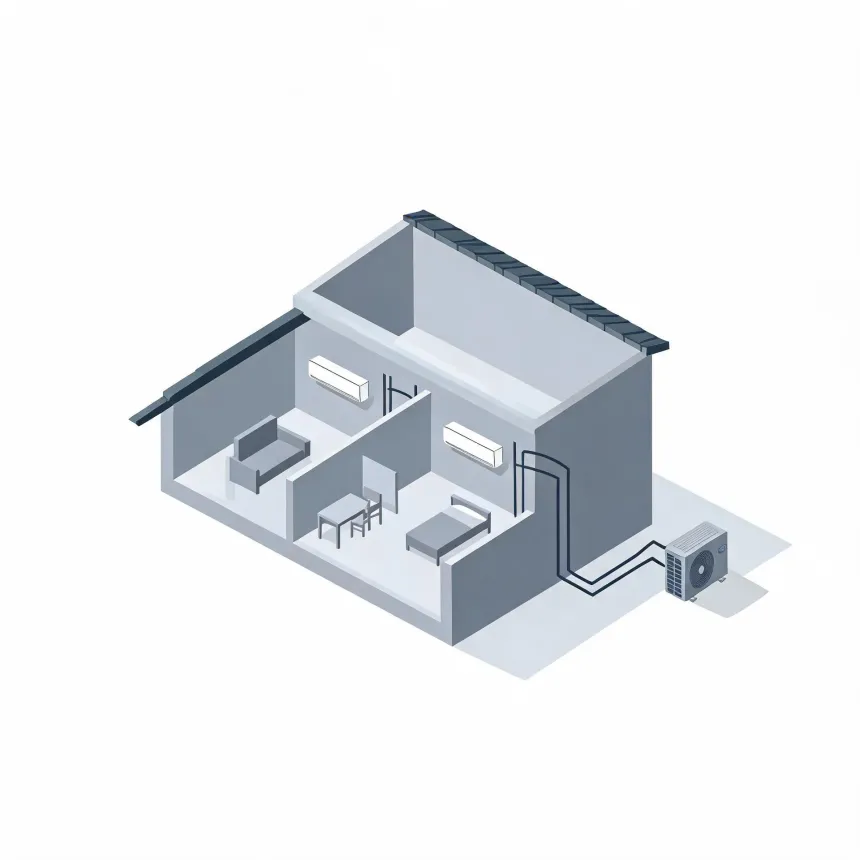
Isometric cutaway illustration of a gray house showing two wall-mounted indoor air conditioning units in separate rooms with furniture, connected by line sets to an outdoor condenser unit on a pad outside.
Your system heats November through March and cools April through October.

NOAA nClimDiv, 1991–2020 normals

Ascension Parish logged 54 severe weather events between 2015 and 2024, including 14 hail storms and 7 tornadoes.

The outdoor unit sits outside through all of it, so where it goes and what shields it are part of the install.

March is the month to get this done, before April asks the mini split to work

Cooling runs April through October
Climate zone 2A
Power here costs 12.36 cents per kilowatt-hour
Most homes here already run on electric heatElectricity heats 63.1% of homes in Ascension Parish, a mini split fits right into that.

Ascension Parish falls under zone 2A, a hot and humid climate zone, with cooling as the main job a system does here. A mini split installed now has to meet the federal minimum for that: at least 14.3 Btu of heat moved per watt-hour of electricity over summer, and at least 7.5 over winter. That rules out the weakest units before a contractor ever gets to picking a size for your home. It also means what gets installed in Gonzales already has to clear a bar set for places that run their cooling hard, not a mild one. Units built on or after January 1, 2023 meet it by law, so the question worth asking is how far past that minimum a given system goes.

The install decides what every bill after it looks like

Get the install done with a system sized and set up right, and the efficiency you paid for shows up on every bill after. Power here is cheap, but a mini split that runs long stretches all summer still turns watts into dollars. The one worth installing is the one that moves the most heat per watt it draws.

Find a contractor
A white outdoor air conditioner condenser unit mounted on metal wall brackets against gray horizontal siding, with a blue sky and white clouds behind it.

Seven months of summer is more hours than most of the country ever asks of this system

Seven months of cooling a year is a long stretch for any mini split to run. April through October, this one doesn't get much of a break. June, July and August push afternoons to 91°F, and the dew point sits around 73°F, which is higher than most of the country ever sees. Air that heavy takes more work to pull moisture out of, hour after hour, all summer. A mini split here is doing more each time it cycles on than the same unit would in a drier climate. That load falls hardest on the compressor and the fan motors, since those are the parts running the most. Sizing it right for this house matters more in a place that asks this much of it every year.

Ask what the unit does at partial load, not just full load

A mini split spends most of its life running below full capacity, easing up once a room gets close to the set temperature. The rating that matters for that is how well it performs at partial load, not the single number measured at full blast. Two systems with the same top-end rating can behave very differently once they throttle down, and that difference is where most of the running hours actually happen.

Ask who is sizing it and how

The right size comes from a load calculation on the room or home, not a guess based on square footage alone. Oversized, a mini split cools fast but shuts off before it pulls the moisture out of the air, leaving the room cold and damp. Undersized, it runs constantly and still doesn't reach the set point. Ask what method the contractor used to land on the size they're proposing.

The efficiency rating on a mini split is a ratio, not a grade. It tells you how much heat the unit moves for every watt of electricity it draws, so a higher number means more cooling out of the same power. That number is measured over a full season of cycling on and off, not at one moment, because a mini split spends most of its time adjusting rather than running flat out. Two units can carry the same rating and still perform differently once installed, since ductwork isn't a factor here but refrigerant charge, line length and how well the indoor and outdoor units are matched all affect what the rating actually delivers. The number on the label is the ceiling. What the system reaches depends on the install underneath it.

Seven months of cooling a year means this unit earns its keep on size, not price. Two systems can carry the same rating on paper and still land differently in a room, because the smaller one strains through August and the oversized one short cycles without pulling the moisture out. Either way the compressor pays for it. A load calculation on this house, not a guess from square footage, is what decides whether this mini split spends the next several summers running at a reasonable pace or working too hard every time it kicks on. That calculation costs nothing to ask for. A contractor who skips it is guessing at the one number that matters most here.