Single-story brick and cream-sided houses with covered porches behind a trimmed hedge and lawn, shaded by large oak trees draped with Spanish moss under an overcast sky.

Mini Split Installation in Lafayette, LA

Tell us about the job

Takes about a minute. No obligation.

New system or replacementMini-splitLafayette Parish, LA
Step 1 of 2

What ZIP code is the job in?

Lafayette runs electricity cheap

Electricity in Lafayette Parish averaged 11.87 cents per kilowatt-hour in 2025, lower than most US counties. That gives a mini-split room to work in its favor here, since every kilowatt it uses costs less than it would almost anywhere else.

Your runtime is what matters now

A mini-split installed here is going to run most of the year between the heat and the humidity. With a rate this low, how efficiently the unit does that work decides what you notice on your power bill more than the rate itself does.

5 months
November through March, your system heats
7 months
April through October, it cools
44°F
the average winter night it heats against
91°F
the average summer afternoon it cools against
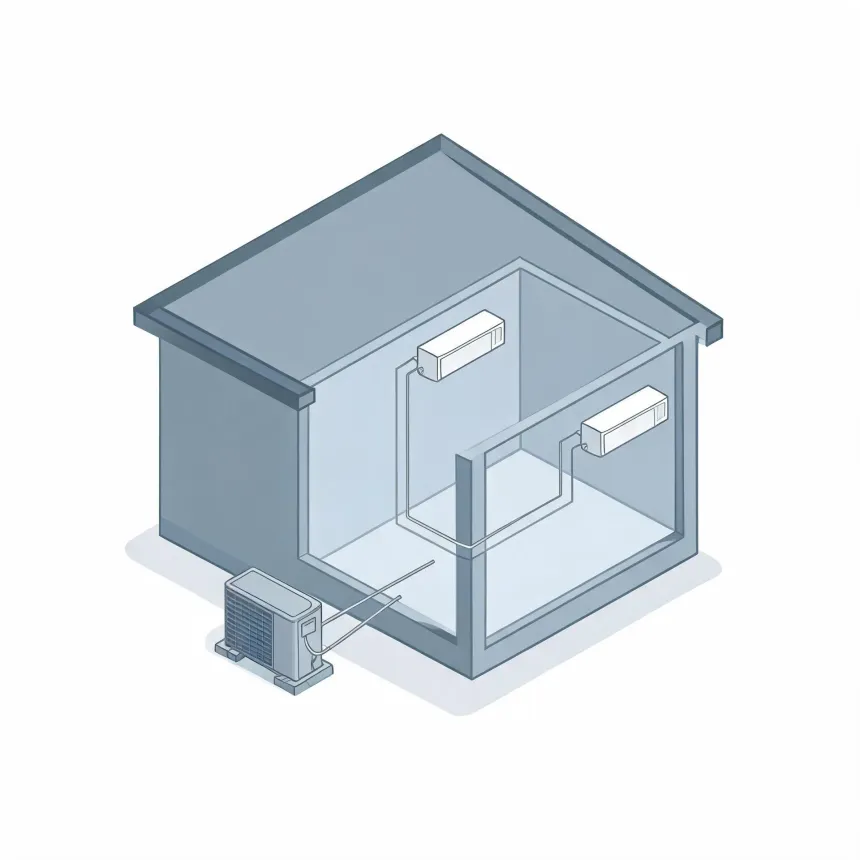
Isometric line illustration of a cutaway building interior with two wall-mounted indoor air conditioning units connected by piping to an outdoor condenser unit on the ground outside.
Your system heats November through March and cools April through October.

NOAA nClimDiv, 1991–2020 normals

A mini-split in Lafayette Parish runs cooling about seven months a year, with afternoon highs averaging 91°F and a dew point near 74°F all summer.

That load calls for a system sized and installed to handle it, not just one priced to win the quote.

Lafayette sees its share of storms, and the power doesn't always hold

68 severe weather events from 2015 to 2024
49% of homes statewide lost power a day or more in 2024
39 damaging wind events from 2015 to 2024

Electricity heats 77.4% of the homes in Lafayette Parish, and gas heat is uncommon here, at 21.5%. A mini-split fits a home already wired for electric heat without adding a gas line or venting to work around. That's one reason they're a common swap when an electric furnace or baseboard heat is on the way out. Since the parish already runs mostly on electric heat, installing a mini-split keeps the home on the same fuel it's used all along, and the cheap power rate applies to the whole job, heating included, not just summer cooling.

The install decides what you pay to run it

Get the sizing and installation right and that low electric rate works for you on every bill, winter and summer. A unit that is undersized, oversized, or poorly installed will cost you more to run no matter what you pay per kilowatt-hour.

Find a contractor
A beige split-system air conditioner outdoor condenser unit mounted on metal wall brackets atop a stucco wall.

Installed in March, it's ready for April

Cooling runs April through October here, about seven months a year. The other months are mild, with overnight lows averaging 44 degrees across December, January and February, so a mini-split isn't working hard to keep up with heat either. That's most of the year spent running in one direction or the other, which leaves little downtime to absorb a bad install. Getting it sized and set up right before March, ahead of the first warm stretch, means it's ready when the load shows up instead of going in under pressure once the heat already has.

Sizing comes from a room by room calculation

A mini-split is sized by working out how much heat each room gains in summer and loses in winter, counting windows, walls, insulation and which way the room faces. That number sets the capacity of the unit and, if it's a multi-zone system, how much goes to each head. Guessing off square footage alone skips over the actual load the room has to deal with.

Wrong either way costs you

An oversized unit cools the air fast and shuts off before it pulls the moisture out, so the room feels cold and damp at once. An undersized one runs flat out and still can't hold the temperature on the hottest or coldest days. Both wear the compressor down faster than a unit that's matched to the load and allowed to run in steady, longer cycles.

The price of a mini-split installation comes down to more than the equipment on the truck. Running the right size line set and routing it cleanly through the wall takes time, and that labor costs the same whether the unit is a good match for the room or not. The indoor head and outdoor condenser have to be placed where airflow isn't blocked and service access stays open, which sometimes means more structural work than a straight shot through the nearest wall. A multi-zone system adds cost for each additional indoor head and the extra refrigerant line needed to reach it. The electrical work matters too: a dedicated circuit sized to the unit's draw, run from the panel, is part of the job, not an extra. None of that shows up in a quote that's priced off square footage alone.

Lafayette sits in climate zone 2A, a hot and humid zone under the 2021 energy code, with cooling as the main load on the system all year. The federal standard sets the floor for what can be installed here. A split system heat pump manufactured from 2023 onward has to deliver at least 14.3 Btu of cooling for every watt-hour it draws, and at least 7.5 Btu of heat the same way. A mini-split is a split system under that standard, so it has to clear both numbers before it ever goes in a wall. There's no separate, lower bar for ductless equipment. That rating is what the unit has to hit. Whether it actually runs that well in your house still comes down to sizing and install.