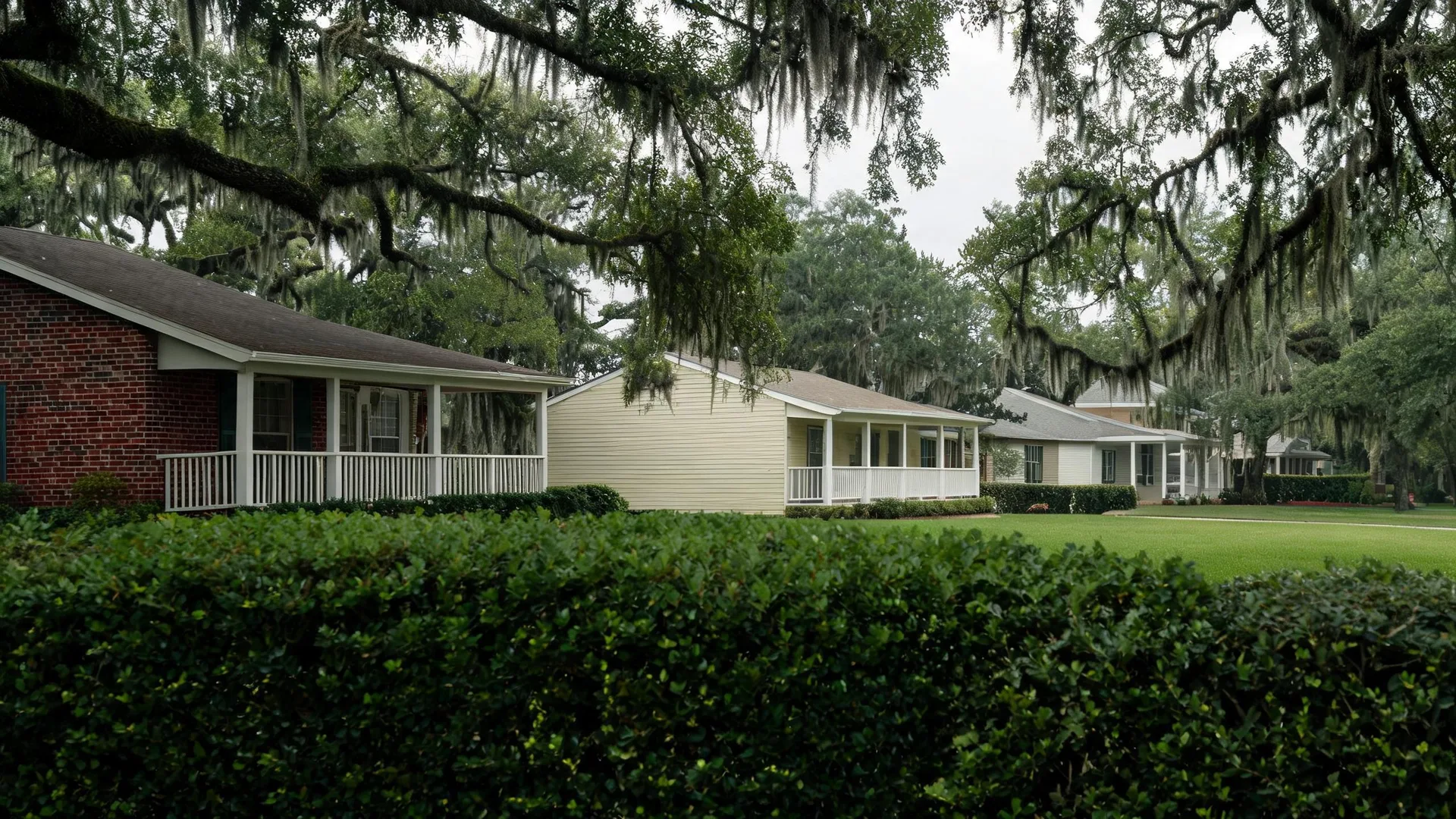






A row of single-story houses with porches, one brick and others with pale siding, behind a trimmed hedge and lawn, under oak branches draped with Spanish moss.

Mini Split Installation in Mansfield, LA

Tell us about the job

Takes about a minute. No obligation.

New system or replacementMini-splitDe Soto Parish, LA
Step 1 of 2

What ZIP code is the job in?

De Soto Parish saw 118 severe weather events between 2015 and 2024. Most of that was wind, 65 events, with 30 tornadoes and 18 hail events in the same stretch. A mini-split's outdoor unit sits outside through all of it, exposed to hail and flying debris in a way a furnace or a water heater in a closet never is. Power is the other half of it. Nearly half of Louisiana households went at least a day without electricity in 2024, and a mini-split with no backup plan is just dead weight until the lines are back up.

5 months
November through March, your system heats
6 months
May through October, it cools
38°F
the average winter night it heats against
92°F
the average summer afternoon it cools against
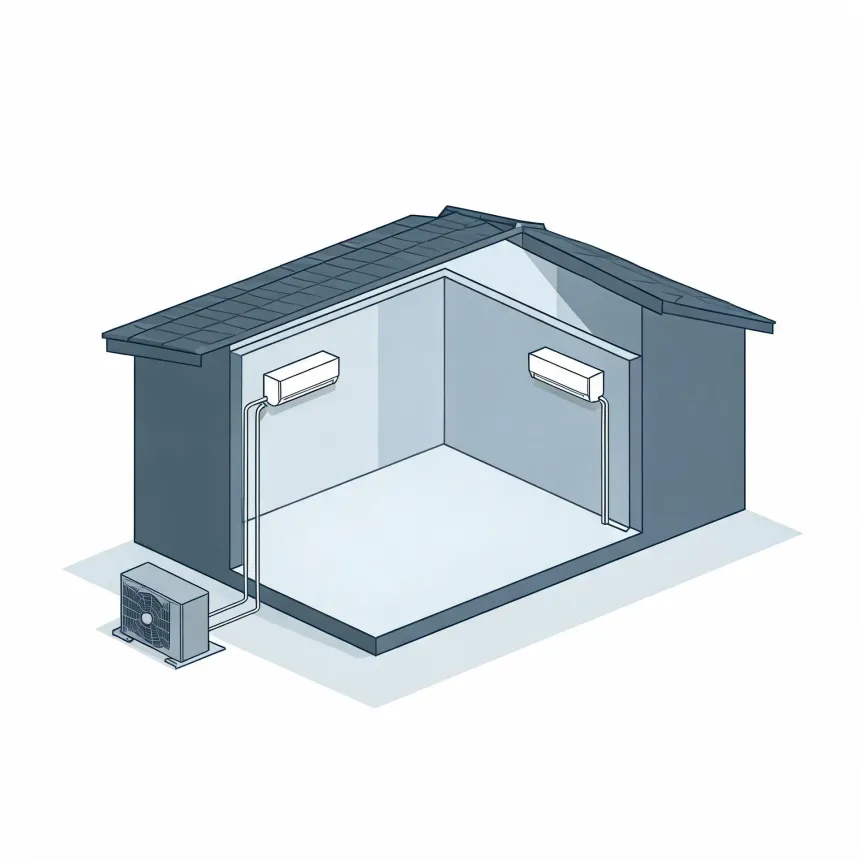
Cutaway isometric illustration of a small building interior showing two wall-mounted indoor air conditioning units connected by line sets running down to a single outdoor condenser unit on the ground outside.
Your system heats November through March and cools May through October.

NOAA nClimDiv, 1991–2020 normals

The outdoor unit runs through six months of afternoon heat, most days near 92 degrees.

A mini-split sized for a mild climate will struggle here every summer it's in the ground.

Cooling starts in May. April is when you want this done.

Cooling runs May through October
Summer afternoons average 92°F
Power here costs 13.87 cents per kilowatt-hour
Efficiency Here Pays You BackElectricity here runs 13.87 cents a kilowatt-hour, and a mini-split that's sized and installed right earns that back every month.

De Soto Parish falls under zone 3A in the 2021 energy code, a warm, humid zone with a long cooling season and a short, mild winter. Any mini-split heat pump installed here has to meet the federal minimum for that kind of system if it was built on or after January 1, 2023: at least 14.3 Btu of cooling for every watt-hour it draws over the summer, and at least 7.5 Btu of heat for every watt-hour over the winter. That standard doesn't carve out a lower bar for ductless systems. It's the same number a central heat pump has to hit. A federal tax credit is available for systems that meet efficiency requirements set by the Consortium for Energy Efficiency, worth asking about before the unit is chosen.

Plan the Install Around the Weather, Not Just the Heat

Where the outdoor unit goes matters as much as which one you buy. Keep it clear of fence lines and anything that can blow into it, and ask the contractor about a cover or guard for hail. If the house has a generator or battery setup, this is the point to talk about tying the mini-split into it, so a day without power doesn't mean a day without heat or cooling.

Find a contractor
A man in a cap, dark long-sleeve shirt and tan work pants carries a leather tool bag up porch steps toward a green front door, with a potted flowering plant beside him.
A white outdoor air conditioner condenser unit mounted on metal wall brackets against gray horizontal siding, with a blue sky and white clouds behind it.

Built for the House You Have

Half the homes in De Soto Parish were built in 1990 or earlier. A house that age may still have its original electrical panel, and a mini-split install usually means running a new dedicated circuit for the outdoor unit. That's a question for the contractor before install day, not after. Mobile homes make up over a third of the housing here too, and mounting a mini-split on one takes different anchoring than a stick-built wall. The unit itself doesn't care how old the house is. Where it goes and how it ties in does.

Line Set Length and Path

The indoor and outdoor units connect through a line set carrying refrigerant between them, run through a wall penetration. A short, straight run costs less in labor and material than one that has to snake through an attic or around the outside of a house. Every extra foot of line set, every bend, and every rise in elevation between the two units adds to the labor and can call for extra refrigerant beyond what the system ships with.
Electrical Work Behind the Wall

A mini-split draws power from its own dedicated circuit, separate from household outlets. If the electrical panel has an open slot and enough capacity, running that circuit is a smaller job. If the panel is already full or undersized for the new load, a subpanel or panel upgrade has to happen first, and that work sits outside the mini-split installation itself.

If this is replacing a window unit or a central system, something has to happen to what's already there. A window unit just comes out of the frame. A central system is a bigger job: the old indoor air handler or furnace coil gets disconnected, the outdoor condenser gets hauled off, and the ductwork either gets capped or reused if the new setup still needs it for part of the house. Refrigerant in the old outdoor unit has to be recovered, not vented, and that's work a licensed contractor handles as part of the teardown. None of it can run alongside the new mini-split during a transition. Once the old system is disconnected, the house has no heat or cooling until the new one is in and charged.

Electricity heats 66.3% of homes in De Soto Parish, more than gas and propane combined. That's why a mini-split fits in so easily here. It runs on electricity already, so there's no fuel conversion to think about and no gas line to plan around. Utility gas serves about a quarter of homes and LP gas a smaller share still, which means most of the neighborhood is already wired the way this system needs to be. The main question isn't fuel type. It's whether the panel has the capacity for the new circuit.