Weather here is rough on equipment
Sabine Parish recorded 90 severe weather events between 2015 and 2024, including 38 damaging wind events, 30 hail events and 15 tornadoes. An outdoor condenser sits outside through all of it.
Takes about a minute. No obligation.
Sabine Parish recorded 90 severe weather events between 2015 and 2024, including 38 damaging wind events, 30 hail events and 15 tornadoes. An outdoor condenser sits outside through all of it.
Nearly half of Louisiana households went at least 24 hours without power in 2024. A mini split won't run without electricity, so an outage means no heat and no cooling until the power comes back.
NOAA nClimDiv, 1991–2020 normals
April is the month before cooling starts in Sabine Parish.
Install before then and the system is proven out before it has to work.



Sabine Parish falls under climate zone 3A, the code's warm, humid category, with long summers and a short winter. Any ductless heat pump installed here has to meet the federal minimum for that kind of system: at least 14.3 Btu of cooling for every watt-hour of electricity it uses, and at least 7.5 Btu of heat for every watt-hour in winter. That standard applies to units built from January 1, 2023 on, and it holds whether the system is ducted or ductless. It sets the floor. A contractor can size and spec above it, but nothing sold here can fall short of it.
Where the contractor puts the outdoor unit and how it's mounted matters here. So does having a plan for heat and hot water when the power drops, since the mini split stops working the moment it does. Walk through both with the contractor before the job starts.
Find a contractor
Half the homes in Sabine Parish were built in 1986 or earlier. A mini split going into a house that age is going into walls and a layout it wasn't designed around, not a blank slate. Mobile homes make up close to half the housing here too, and mounting and line set runs work differently on those than on a stick-built house. None of that rules out a mini split. It just means the sizing and the placement have to match the house in front of the contractor, not a standard floor plan.
If there's an existing system, a contractor has to recover the refrigerant from it before anything gets disconnected. That refrigerant can't be vented into the air, it has to be pulled into a recovery tank and handled separately. Then the line set, the old indoor unit and the outdoor unit come out, and any wall penetration they used either gets reused or has to be patched.
A mini split runs on a different line set and electrical setup than a window unit or a central system, so the old wiring and old line set usually can't just be reused. The contractor has to run new refrigerant lines and often a new dedicated circuit to the outdoor unit, which means some of the removal work is really prep work for the new install, not just clearing space.
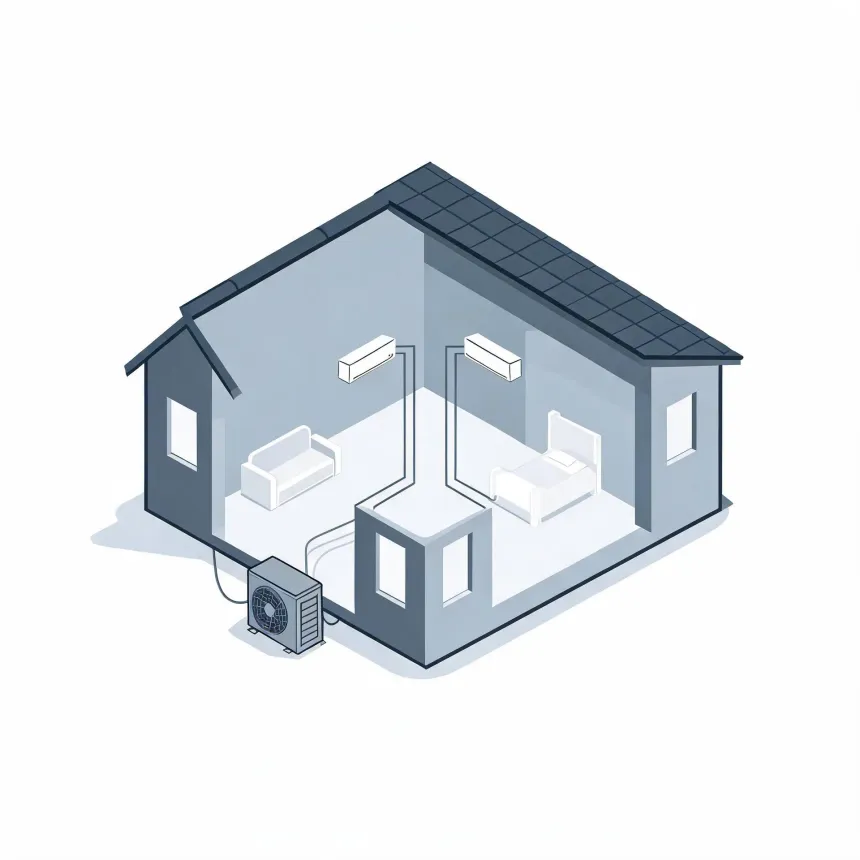
The cost of a mini split job comes down to how much new infrastructure it needs, not just the equipment hanging on the wall. A single zone with a short line set run and an easy spot for the outdoor unit is the simplest version of this job. Add zones and the price moves with them, since each indoor head needs its own line set run back to the outdoor unit and its own refrigerant connections made and pressure tested. Electrical work adds to it too. Most mini splits need a dedicated circuit, and if the panel doesn't have room or the run to the outdoor unit is long, that's more wire and more labor before the system ever turns on. Where the line set has to travel matters as much as how far. A straight shot through an exterior wall costs less to run than a path that has to go through framing, around obstructions, or up through multiple floors. The mounting bracket for the outdoor unit is part of it too, since a unit going on a concrete pad is a different job than one going on a wall bracket or an elevated stand.
Electricity in Sabine Parish runs 13.43 cents per kilowatt-hour, cheaper than most of the county pays. That helps, but a mini split here still earns its keep or wastes money depending on how it's sized and installed. The air that makes summer feel heavy, with a dew point averaging 71°F in June, July and August, is also what makes the system work harder, since it's pulling moisture out of the air as much as it's cooling it. A unit that's undersized or poorly matched to the house runs longer to do the same job, and that shows up on the bill every month it runs. Cheap power buys some room here. It doesn't make up for a system working harder than it should.