White plantation-style houses with wraparound porches lit at night, surrounded by Spanish moss-draped live oak trees.

Mini Split Installation in Natchitoches, LA

Tell us about the job

Takes about a minute. No obligation.

New system or replacementMini-splitNatchitoches Parish, LA
Step 1 of 2

What ZIP code is the job in?

This county sees real storm activity

Natchitoches Parish recorded 173 severe weather events between 2015 and 2024, including 107 damaging wind events, 42 hail events and 18 tornadoes. An outdoor condenser sits exposed to all of it, through wind-blown debris and hail.

Power doesn't always come right back

Nearly half of Louisiana households, 49%, went at least 24 hours without power in 2024. A mini split installed here needs a plan for what happens to heat and hot water when the outage runs longer than a few hours.

5 months
November through March, your system heats
6 months
May through October, it cools
39°F
the average winter night it heats against
92°F
the average summer afternoon it cools against
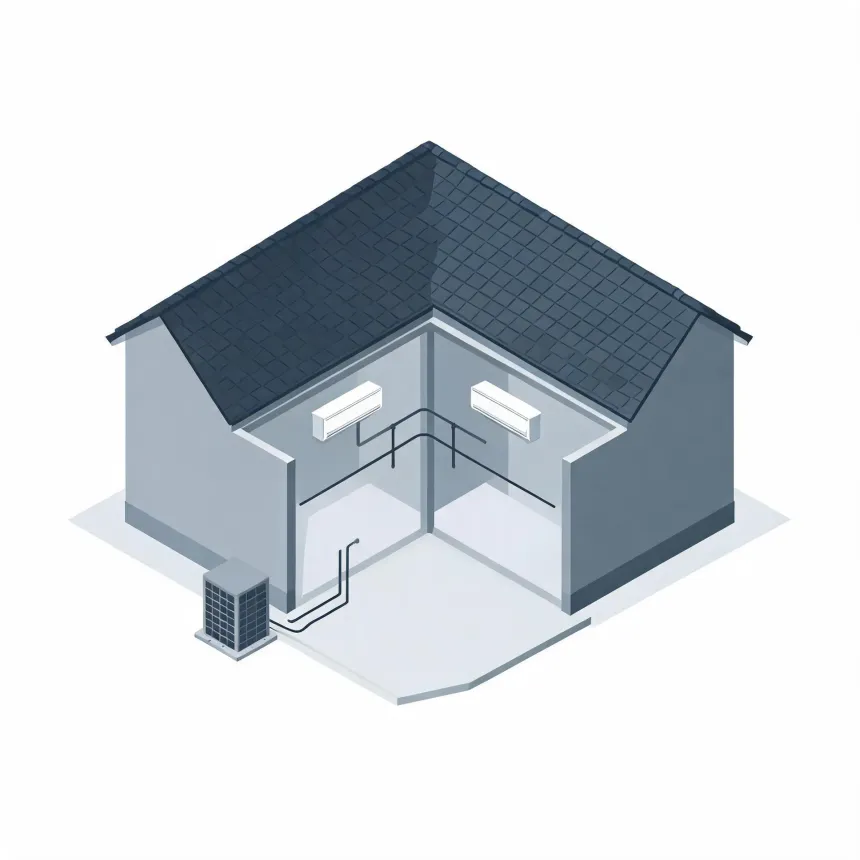
Isometric illustration of a cutaway gray house with a dark shingled roof, showing two wall-mounted indoor air conditioning units connected by piping to an outdoor condenser unit on the ground outside.
Your system heats November through March and cools May through October.

NOAA nClimDiv, 1991–2020 normals

Electricity heats 67% of homes in Natchitoches Parish.

A mini split fits into that setup without asking the house to change how it's heated.

Six months of cooling, run hard

Cooling runs May through October
Summer afternoons average 92°F
Power here costs 12.21 cents per kilowatt-hour
Get it installed before MayCooling here runs May through October. April is when this gets done ahead of it, not during the first hot week.

Natchitoches Parish falls under climate zone 3A, warm and humid with a long cooling season. Any split-system heat pump sold new here, including a mini split, has to meet a federal minimum under that standard: at least 14.3 Btu of cooling for every watt-hour it uses, and at least 7.5 Btu of heat the same way, for units built from 2023 on. That floor applies whether the house is in town or out in the county. A unit that meets it is built for the load this climate puts on it, not just rated for cooler regions where it would run less.

Plan for where it sits and what happens when the power goes out

Installing a mini split here means picking a spot for the outdoor unit that keeps it clear of flying debris, and talking through what backs up heat and hot water if an outage runs long. Settle both before the install, not after the first storm.

Find a contractor
A man in a dark cap, navy long-sleeve shirt and tan work pants walks up porch steps toward a green front door, carrying a worn canvas tool bag in his right hand.
A white mini-split air conditioner outdoor condenser unit mounted on metal brackets against a beige stucco exterior wall, with a blue sky and scattered clouds in the background.

It runs this hard every summer. Size it for that.

Six months of that is the condenser sitting outside at 92 degrees most afternoons, pulling heat out of the house hour after hour. Ask the installer what size unit the room actually needs before you settle on one. An oversized mini split cycles on and off instead of running steady, and that short cycling wears the compressor faster than a properly sized unit running the long stretch it was built for.

A load calculation, not a room measurement

The right size comes from a Manual J calculation, not a rule of thumb based on square footage. It weighs window area and orientation, insulation, ceiling height, and what else generates heat in the room. Two rooms the same size can need different sized units once those factors are counted.

The wrong size fails in a specific way

A unit sized too big cools the air fast and shuts off before it pulls the moisture out, so the room feels cold and damp at once. A unit sized too small runs constantly and never quite catches up on the hottest afternoons. Either way the compressor is working against a mismatch that proper sizing avoids from the start.

What drives the cost of a mini split install is mostly labor, not the unit itself. Running the line set between the outdoor condenser and the indoor head takes time, more if it has to go through an exterior wall, up a chimney chase, or across a longer distance than a straight shot allows. A multi-zone system, where one outdoor unit feeds several indoor heads, costs more to install than a single-zone setup because each head needs its own line set, its own mounting, and its own spot in the electrical load. The electrical work matters too. Some installs need a new dedicated circuit, and that means running wire back to the panel, not just connecting to something already there. Mounting the outdoor unit on a wall bracket costs less than pouring a pad for it to sit on, and where it goes depends on the house, not preference. Whatever drives the number, it should trace back to the Manual J calculation and the physical path the system has to take, not to the brand on the unit.

Installation starts with the line set, the refrigerant lines and wiring that run between the outdoor condenser and the indoor head. A technician mounts the indoor unit first, level and far enough from the ceiling and walls to pull air evenly across the room. Then comes the hole through the exterior wall, just wide enough for the line set, drain line, and power wire to pass through together. Outside, the condenser gets set on its bracket or pad, the lines get connected, and the whole system gets evacuated with a vacuum pump to pull out moisture and air before any refrigerant goes in. That vacuum step matters more than it looks. Trapped air or moisture left in the lines causes the compressor to work harder and can shorten its life long before anything else goes wrong.