Electricity here runs cheaper than most places
Orleans Parish homes paid about 12.78 cents per kilowatt-hour in 2025, lower than most US counties. A mini-split here still runs on that rate every time it cycles on.
Takes about a minute. No obligation.
Orleans Parish homes paid about 12.78 cents per kilowatt-hour in 2025, lower than most US counties. A mini-split here still runs on that rate every time it cycles on.
A mini-split sized and installed right uses less power to move the same heat. With electricity as the only fuel in most homes here, how well the unit runs is what shows up on the bill.
NOAA nClimDiv, 1991–2020 normals
Orleans Parish saw 54 severe weather events between 2015 and 2024, including 35 with damaging wind.
An outdoor condenser needs a mounting spot that keeps it clear of flying debris and falling limbs.




Electricity heats most homes in Orleans Parish, close to two out of three. Gas heat is the other common setup, but it's a smaller share, and propane barely registers here. A mini-split fits the electric pattern already in place. It heats and cools from the same outdoor unit, so there's no separate furnace or gas line to plan around. For a home that already runs on electricity, adding a mini-split means the new equipment works like everything else on the meter, not against it.
Installed right, a mini-split uses less power to move the same heat, and that difference shows up on every bill it runs, not just the first one. Getting the sizing and setup right from the start is what makes that difference real.
Find a contractorHalf the houses in Orleans Parish were built in 1960 or earlier. A house that old was never built around a mini-split, so the wall space, the electrical panel, and the path for the line set all come down to what's actually there, not what a newer build would give an installer to work with. Running the lines usually means finding a route through or around walls that were framed before this kind of system existed. The panel is worth checking too. It has to carry the new load along with everything already on it.
A mini-split sized to the room cools or heats without long runtimes, and a compressor that isn't straining lasts longer. One sized too big short cycles, switching on and off before it pulls moisture out of the air. One sized too small runs constantly and still can't hold the temperature. Either way, the cost shows up in how much the compressor has to work to do the job.
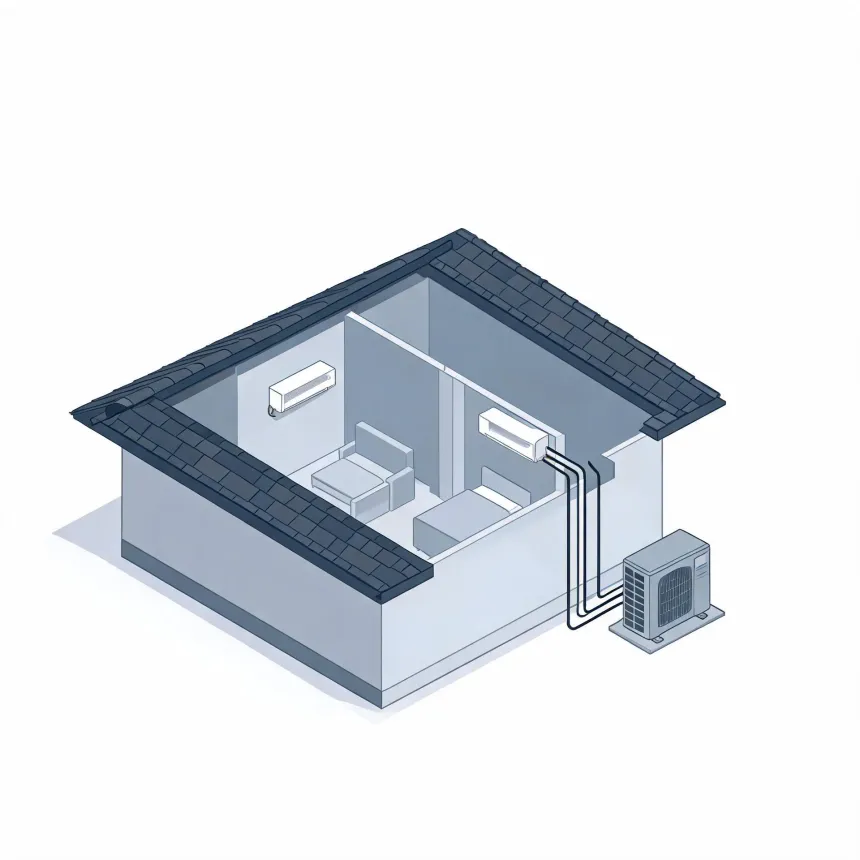
The indoor and outdoor units connect through a line set that carries refrigerant between them, and every bend or extra length adds to the work of running it. A short, straight path between the indoor head and the outdoor condenser takes less time to fit than one that has to cross framing or climb through tight space. The installer also has to find a route for the condensate drain, so the indoor unit can clear the water it pulls out of the air.
If the old system is a central setup, the ductwork usually stays, but it stops being part of the job a mini-split has to do. A mini-split runs its own line set to each indoor head, so the old ducts aren't carrying conditioned air anymore unless another system still uses them. The old outdoor condenser gets disconnected, and the refrigerant in it has to be recovered before it's removed, not vented. If there's an old line set in the walls, it's usually capped and left rather than pulled, since fishing it out can mean opening finished wall. A window unit or existing mini-split being replaced just comes out once the new indoor head is ready to mount in its place. Whatever comes down, the electrical circuit feeding it gets checked too, since the new system may draw differently than what it's replacing.
Orleans Parish falls in climate zone 2A under the 2021 energy code, a hot, humid zone where cooling is the load a system has to be built for. That's what sets the efficiency floor for anything installed here. A mini-split counts as a split-system heat pump under the federal standard, and any unit manufactured on or after January 1, 2023 has to remove at least 14.3 Btu of heat for every watt-hour it uses over the summer, and deliver at least 7.5 Btu for every watt-hour over the winter. Those numbers are the minimum, not a target. Nothing below that can legally go into a home here, so whatever gets compared starts above that line.