




A tabby cat sleeps curled up on a dark grey bed in a modern bedroom equipped with a wall-mounted air conditioning unit.

Mini Split Installation in Ruston, LA

Tell us about the job

Takes about a minute. No obligation.

New system or replacementMini-splitLincoln Parish, LA
Step 1 of 2

What ZIP code is the job in?

Lincoln Parish saw 80 severe weather events between 2015 and 2024. Most of that was damaging wind, 51 times in that span, with 16 hail events and 6 tornadoes mixed in. A mini split's outdoor unit sits outside in all of it, so where it goes and what shields it from flying debris matters as much as the model you pick. Power is part of the same picture. Close to half of Louisiana households went at least a day without power in 2024, and when the power's out, a mini split won't heat or cool regardless of how new it is.

5 months
November through March, your system heats
5 months
May through September, it cools
37°F
the average winter night it heats against
92°F
the average summer afternoon it cools against
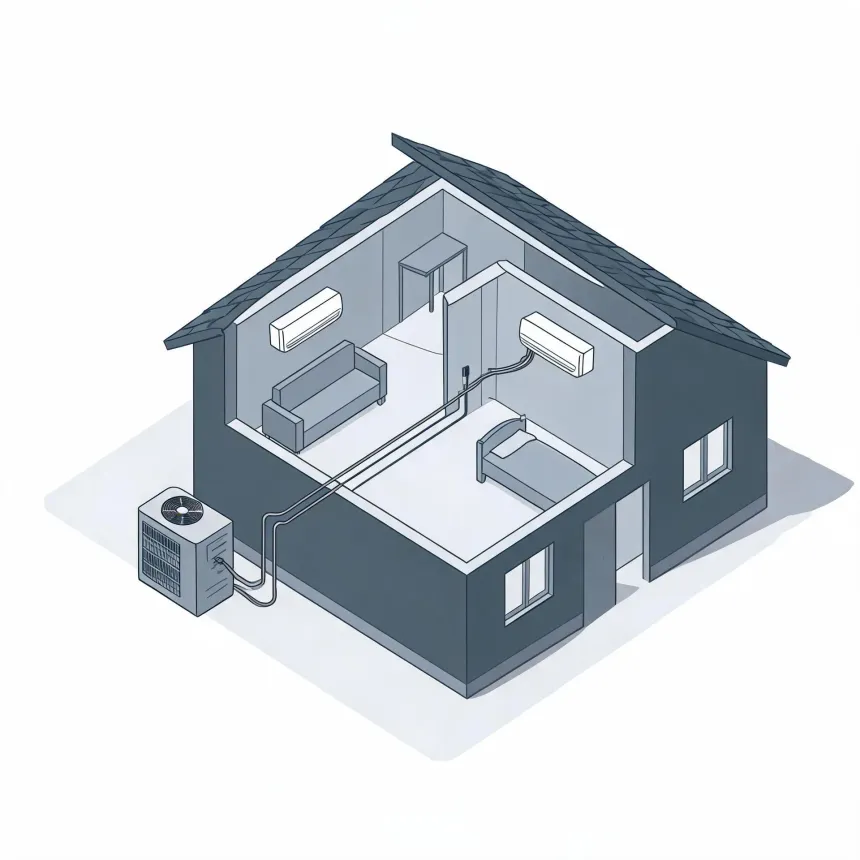
Isometric cutaway illustration of a small house showing two wall-mounted indoor air conditioning units connected by line sets to an outdoor condenser unit beside the exterior wall, with a sofa in one room and a bed in another.
Your system heats November through March and cools May through September.

NOAA nClimDiv, 1991–2020 normals

Electricity heats 52.6% of homes in Lincoln Parish, more than gas and propane combined.

A mini split is an electric system already, so it fits the way this parish heats without changing anything about the fuel line to the house.

Five months of 92 degree afternoons, every single year

Cooling runs May through September
Summer afternoons average 92°F
Climate zone 3A
Get it in before MayCooling runs May through September here, five months straight

Lincoln Parish falls in zone 3A, the warm humid band in the 2021 energy code. Any mini-split installed here has to meet the federal minimum for that kind of system: 14.3 Btu of cooling for every watt-hour of power, and 7.5 Btu of heat for every watt-hour on the heating side, if it's a split-system heat pump made from 2023 on. That's a floor, not a target set by the parish. A contractor sizing a system for this climate is already working within that limit before efficiency or price ever comes up. There's no separate, looser standard for ductless systems. Whatever gets installed has to clear the same bar as any other split-system heat pump sold today.

Place it to survive the weather it'll sit in

Plan the outdoor unit's spot before install day: away from the roof line, clear of anything that could come loose in high wind, with a mounting pad or bracket that holds it through a hard gust. Ask the contractor what backup options exist for the indoor head too, since a mini split needs power to run no matter how it's protected outside.

Find a contractor
A beige split-system air conditioner outdoor condenser unit mounted on metal wall brackets atop a stucco wall.

Five months of daily work, year after year

Run the clip forward and that outdoor unit is working from May to September without a break, five months straight at 92 degrees most afternoons. That's the stretch a mini split has to earn its keep here. A system sized right for this load keeps up on the hottest afternoon without running flat out all day to do it. One sized wrong either short cycles or never catches up, and either way something wears sooner than it should. Ask the contractor for a load calculation on this house, not a guess based on square footage.

The old unit doesn't come out first

A contractor pulls the refrigerant out of the old system and recovers it before any line gets cut. That line carries pressure, and opening it to open air isn't how it's done. Once it's recovered, the old indoor head, the old outdoor unit, and the line set between them all come out together.
New lines, not reused ones

A new mini split runs on its own line set, sized and sealed for the equipment going in. Old copper can carry debris or the wrong oil residue from the last refrigerant, so a contractor runs fresh lines rather than tying new equipment into old ones. The wall or soffit penetration from the old system may get reused once it's confirmed the right size for the new line set.

Comparing systems on price alone misses what makes one last and another struggle. Ask how many zones the system can run and whether the outdoor unit has enough capacity to serve all of them at once, not just one at a time. Ask what happens at the lowest and highest temperatures the system is rated for, since not every heat pump holds its output the same way as it gets colder outside. Look at the compressor type too. A variable-speed compressor adjusts its output to match the load, while a single-speed unit runs full blast or not at all, and that difference shows up in comfort and in how often the system cycles. Ask what the warranty actually covers, parts versus labor, and whether it depends on who installs it or how it gets maintained. A system that looks identical to another on paper can behave very differently once it's running in the wall.

Installation day starts with a walkthrough, not a drill in hand. The contractor checks where the indoor head will mount, where the line set will run, and where the outdoor unit will sit, and confirms all of that before cutting anything. A small hole goes through the wall for the conduit, the bundle that carries refrigerant lines, power, and a condensate drain together. The indoor head mounts to a plate fixed to studs, not just drywall, since it has to hold weight and stay level for the drain to work. Outside, the line set connects to the condenser, the system gets evacuated to pull out moisture and air, then charged with refrigerant to the manufacturer's spec. Once it's powered on, the contractor checks the temperature split between the air going in and the air coming out, which is how they confirm it's actually moving heat the way it should.