






Two illuminated white Southern-style houses with wraparound porches and staircases, framed by a Spanish moss-draped tree on a quiet street at night.

Mini Split Installation in Ville Platte, LA

Tell us about the job

Takes about a minute. No obligation.

New system or replacementMini-splitEvangeline Parish, LA
Step 1 of 2

What ZIP code is the job in?

Most homes in Evangeline Parish heat with electricity, 71.6% of them. A mini split fits right into that pattern since it runs on electricity too, no gas line to add or work around. Utility gas heats 23.8% of homes here, and in those houses a mini split still works fine for cooling or for shoulder season, running alongside whatever heats the rest of the year. Either way, the installer will size the unit to the room or the space it needs to cover, not to whatever was there before.

5 months
November through March, your system heats
7 months
April through October, it cools
42°F
the average winter night it heats against
92°F
the average summer afternoon it cools against
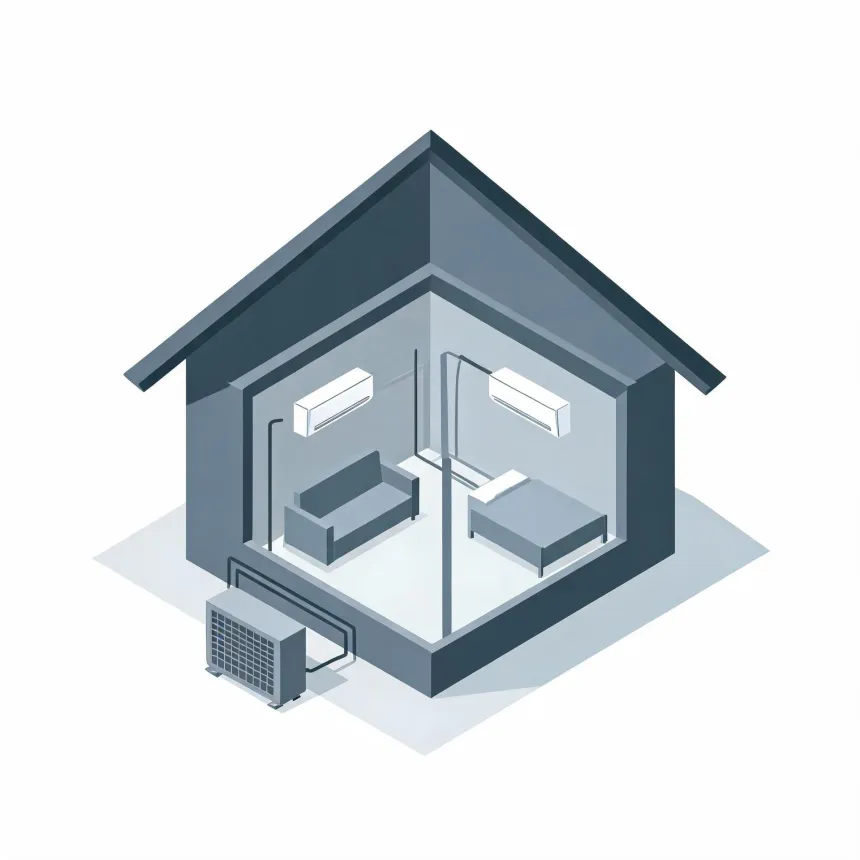
Isometric cutaway illustration of a small gray house showing two rooms, one with a sofa and one with a bed, each with a wall-mounted indoor air conditioning unit connected by line sets to an outdoor condenser unit on the ground outside.
Your system heats November through March and cools April through October.

NOAA nClimDiv, 1991–2020 normals

Evangeline Parish logged 18 damaging wind events and 11 tornadoes in the last ten years.

A mini split here needs a solid mount and a crew that accounts for wind, not a bigger unit.

Seven months of cooling start in April. Get it installed in March.

Cooling runs April through October
Summer afternoons average 92°F
Power costs 11.73 cents a kWh statewide
Seven months of workAfternoon highs average 92°F in June, July and August, and the system runs from April through October.

A mini split here doesn't need to be oversized or top of the line to do the job. Louisiana homes paid 11.73 cents per kilowatthour in 2024, and that rate applies whatever size unit goes in. A properly sized system costs less to run than one that's too big for the space, since an oversized unit cycles on and off instead of holding a steady temperature. The installer sizes it to the room it has to cool, not to the electric rate, but getting that size right is what keeps the power bill reasonable.

A new mini split here has to clear a set efficiency floor, and some units qualify for a federal credit

Any mini split installed here has to meet the federal minimum for this climate zone, 14.3 SEER2 for cooling and 7.5 HSPF2 for heating. That floor applies whether the unit covers one room or several. On top of that, a federal tax credit is available for qualifying heat pump installations. Worth asking the installer which units on the table qualify before deciding.

Find a contractor
A man in a dark long-sleeved shirt and olive pants carries a canvas tool bag as he walks up wooden porch steps toward a green front door, with a potted shrub to the left.
A white mini-split air conditioner outdoor condenser unit mounted on metal brackets against a beige stucco exterior wall, with a blue sky and scattered clouds in the background.

Seven months of load, every year

April through October, the compressor is running most days, and June through August it's working against a 92°F afternoon high. That's the stretch that wears a system down faster than one sitting in a milder climate. Sizing matters more here because of it. A unit too small runs flat out all season and never gets a break. One too large cycles on and off and still doesn't hold the room steady. Either way the parts see more stress than they should, and it shows up earlier than the warranty card would suggest.

The rating is an average, not a worst-case number

SEER2 and HSPF2 describe performance across a full range of conditions, mild days and harsh ones blended together. A unit with a high rating can still work hard on the roughest afternoon or the coldest night, because the label is describing the whole season, not that one hour.
Installation decides whether the rating holds up

A mini split earns its efficiency rating in lab conditions, with the refrigerant charge and airflow set exactly right. A mismatched indoor and outdoor unit, a line set that runs too long, or a charge that's off all pull the real performance below what the label promises. The number on the box is what the equipment can do, not what it will do once it's mounted and running.

When you're comparing systems, ask what's inside the box, not just the number on it. Mini splits can carry the same efficiency rating and still use different compressors, one a variable-speed type that adjusts output to match the room, another a single-stage unit that's only on or off. The variable-speed type holds temperature steadier and runs quieter at partial load. Ask how many indoor heads the outdoor unit can support, and whether this installation runs it near that limit or well under it, since a unit running near its max has less room to handle a rough day. Ask what refrigerant it uses too, since older refrigerants are being phased out and parts availability follows that. And ask about the warranty on the compressor specifically, not just the system as a whole, since that's the part most likely to be the expensive fix down the line.

Installation starts with the line set path, where the refrigerant lines and wiring run between the outdoor unit and each indoor head. The crew drills a single hole through the wall for that line set, then mounts the indoor head and sets the outdoor unit on a pad or bracket outside. Once both are in place, they pull a vacuum on the line set before opening it to refrigerant, which clears out moisture and air that would otherwise hurt performance. The charge gets weighed in or checked against the line length, since too little or too much refrigerant throws off how the unit runs. Last comes the test, cooling and heating both, checking that each head responds on its own if the system has more than one. A clean install shows up later as a unit that holds its temperature without short cycling.