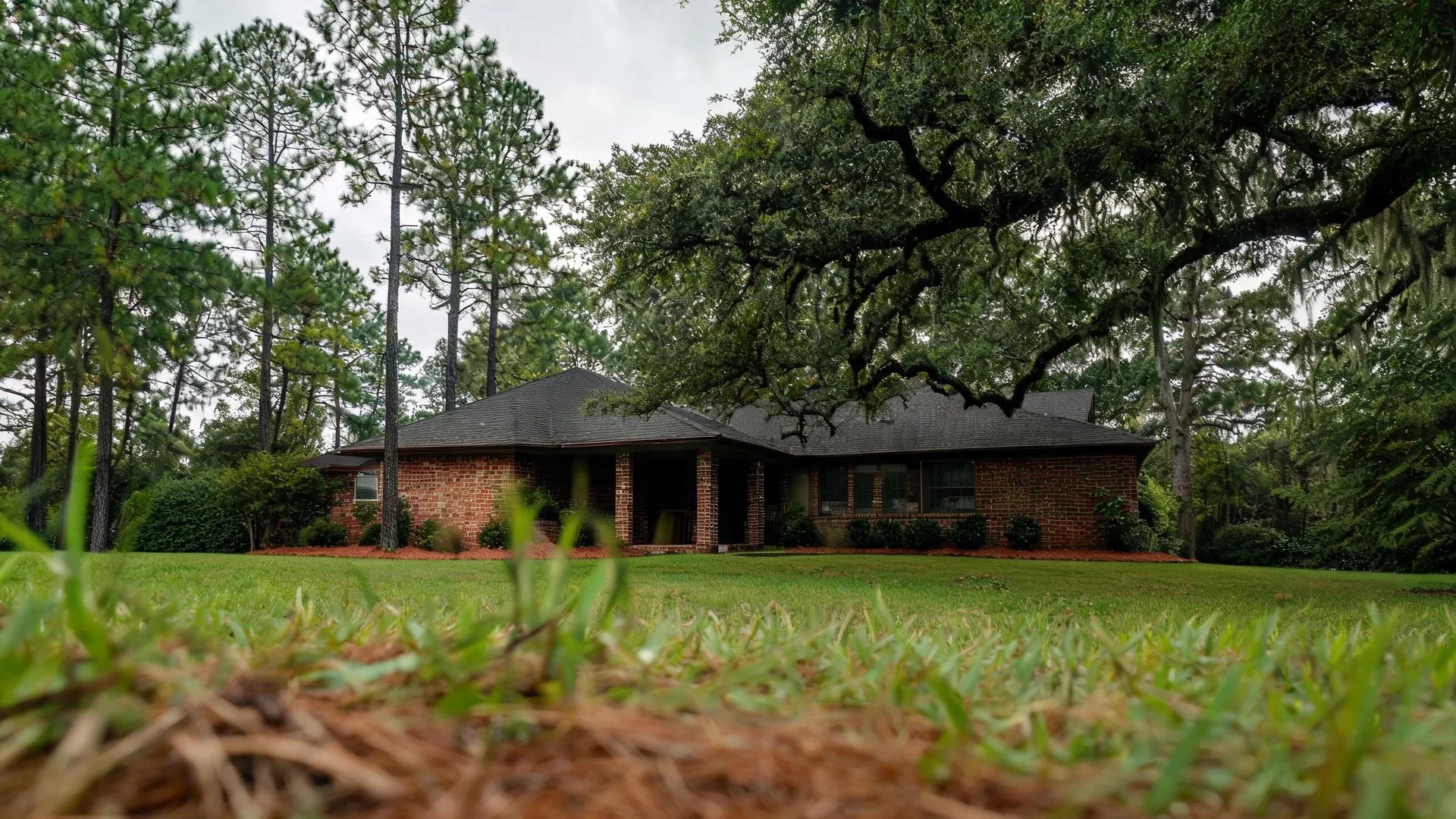
A single-story brick house with a dark shingled roof set behind a lawn, framed by pine trees and a large spreading oak, photographed from a low angle with blurred grass in the foreground.

AC Repair in Bastrop, LA

Tell us about the job

Takes about a minute. No obligation.

RepairCentral ACMorehouse Parish, LA
Step 1 of 2

What ZIP code is the job in?

Morehouse Parish gets hit often

Morehouse Parish recorded 113 severe weather events between 2015 and 2024. That includes 76 damaging wind events, 17 hail events, and 13 tornadoes. Almost half of Louisiana households lost power for a day or more in 2024.


Your outdoor unit takes the hit

Your condenser sits outside, exposed to wind and hail. A storm can bend its fins or crack its housing without stopping it from running. A unit that still turns on after a storm can be carrying damage you can't hear or see from the thermostat.

5 months
May through September, your air conditioner is on duty
92°F
the average summer afternoon it cools against
17 hail events
in ten years, and hail bends the fins on outdoor coils
76 wind events
in ten years, and wind drives debris into outdoor units
Isometric cutaway illustration of a house interior showing ducted air handling equipment, ceiling ducts, furniture in two rooms, and an outdoor condenser unit connected by lines outside the wall.
Your air conditioner works hardest from June through September.

NOAA nClimDiv, 1991–2020 normals

Warm air from the vents with the thermostat set low usually means the system is low on refrigerant or the compressor is wearing out.

Either one gets worse the longer you run it, so a warm house is the time to call, not wait and see.

Five months of 92 degree afternoons wear a system down

Cooling runs May through September
Summer afternoons average 92°F
Power here costs 12.01 cents per kilowatt-hour
The first hot week finds the weak partCooling starts in May here, and April is when a system that limped through last summer tends to fail.

Five months of running hard leaves less room to guess at a fix. When a system has been pushed through summer afternoons near 92 degrees, more than one part can be close to the edge at the same time, so a repair that only addresses the obvious symptom can leave another one to fail a few weeks later. A proper diagnosis checks the refrigerant charge, the electrical components, and the airflow together, not just the one thing that finally gave out. That matters more here than in a place where the system gets a few easy months to rest. Fixing the right thing the first time is what makes a repair hold through the rest of the season.

After a storm, have it checked even if it still runs

If your unit took wind or hail this year, get it looked at even if it still cools. Bent fins and a cracked housing don't always stop it from running, and a storm cut to the power can be hard on a system that's already compromised.

Find a contractor
A gray residential air conditioner condenser unit mounted on a concrete pad in an open grass field.

Running it while something's wrong rarely buys you time

A system low on refrigerant doesn't just cool less, it runs longer trying to make up for it, and that extra runtime is hard on the compressor. Ice can build on the indoor coil when airflow is restricted, and once that ice forms, it blocks even more airflow, so the problem feeds itself. A failing capacitor makes the compressor or fan motor draw harder to start each cycle, and that extra strain is what finally burns the motor out. None of these sit still while you decide whether to call. The part that's struggling now is doing more work than it should, and it fails faster under that load than it would just sitting idle.

The capacitor goes first, most times

The capacitor gives the compressor and fan motor the push they need to start each cycle. It weakens slowly, and when it finally drops below what the motor needs, that motor struggles to start, draws harder than it should, and can overheat or seize. A failing capacitor is a cheap part to replace. A motor that burned out trying to start without one is not.

A dirty coil makes the compressor work for nothing

The outdoor coil has to shed heat for the system to work at all. Dirt, grass clippings, or a summer's worth of grime on the fins trap that heat against the coil instead of letting it go. The compressor keeps running, drawing the same power, and getting less cooling for it. Left alone long enough, the extra heat and pressure are what shorten a compressor's life.

Overhead view of a gray residential air conditioning condenser unit mounted on a concrete pad beside a house with asphalt shingle roofing.

A new air conditioner would cut about $60 a year off cooling for a typical Morehouse Parish home.

  • A new one at the federal minimum, 14.3 SEER2$390 a year
  • An older air conditioner$450 a year

Estimates for a typical Morehouse Parish home, compared with an older unit built to the previous federal minimum, from EIA household energy data, Louisiana fuel prices and NOAA climate normals. Your home will differ.

Repair makes sense when a part like a capacitor or contactor has failed.

Replacement makes sense when the compressor has failed or the system uses R-22 refrigerant, which is no longer made.

A diagnostic visit starts outside at the condenser, checking that the fan spins freely and the coil isn't caked with dirt. From there it's gauges on the refrigerant lines to see whether the charge is where it should be, because too little points to a leak somewhere in the system. Inside, the tech checks the coil for ice and the drain line for a clog, since a backed up drain can shut the system down on its own. Electrical testing comes next: the capacitor, the contactor, and the wiring at the disconnect, looking for anything scorched or pitted or reading outside spec. Airflow gets checked too, because a return that's choked off or a blower wheel caked with dust can mimic a refrigerant problem that isn't really there. The goal is to find which of these is the actual cause before replacing anything, not just treat whatever symptom showed up first.