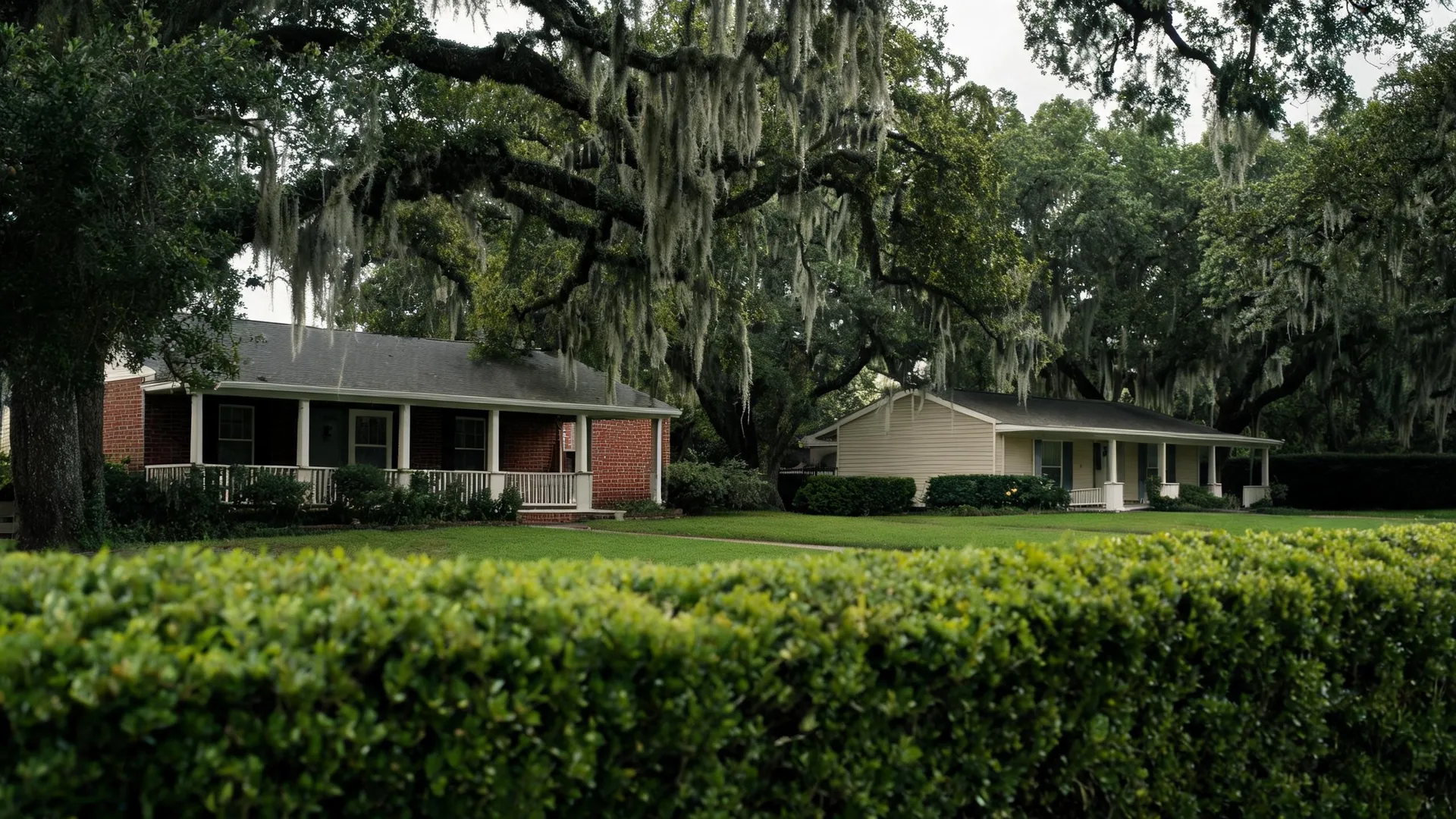
Two single-story houses, one of red brick with a white-columned porch and one with pale siding, sit behind a mown lawn and a trimmed hedge, beneath large moss-draped oak trees.

AC Repair in Farmerville, LA

Tell us about the job

Takes about a minute. No obligation.

RepairCentral ACUnion Parish, LA
Step 1 of 2

What ZIP code is the job in?

174 severe weather events between 2015 and 2024

Union Parish recorded 112 damaging wind events, 37 hail events, and 15 tornadoes in that span, along with 3 tropical storms or hurricanes and 7 winter storms. The outdoor unit sits through all of it, in the yard, uncovered.


Hail and wind reach the condenser

The outdoor unit takes the brunt of a storm. Hail dents the coil fins and bends them shut, and wind-blown debris gets into the fan and the coil. A unit can keep running after a storm like that and still be worse off than before it.

5 months
May through September, your air conditioner is on duty
92°F
the average summer afternoon it cools against
37 hail events
in ten years, and hail bends the fins on outdoor coils
112 wind events
in ten years, and wind drives debris into outdoor units
Isometric cutaway illustration of a house interior showing ducted air handling equipment and duct runs through rooms, connected by piping to an outdoor condenser unit on a pad outside the wall.
Your air conditioner works hardest from June through September.

NOAA nClimDiv, 1991–2020 normals

Cooling runs May through September here.

April is the month to get the AC checked, before the first hot stretch finds the weak part.

Five months of 92 degree afternoons wears a system down

Cooling runs May through September
Summer afternoons average 92°F
Power here costs 12.10 cents per kilowatt-hour

Half the homes in Union Parish were built in 1987 or earlier. That puts a lot of the AC systems here well past the age where repairs start to add up. A system that came with a house that old has likely already had a compressor or condenser replaced once, maybe twice, and whatever is in the yard now may be on borrowed time. Mobile homes make up over a third of the housing here too, and the ductwork and equipment in those often wears faster than in a site-built house. None of that means your system is done. It means the question worth asking isn't just what's wrong this time, but how many more times it's worth fixing.

If the last storm reached your unit, get it looked at

A dented coil or a fan that picked up debris does not always stop the system from running. It just means the system is running worse than it should. If your unit sat through wind or hail this year, worth having someone check it before the next hot stretch leans on it.

Find a contractor
A man in a gray rolled-sleeve shirt and brown pants, seen from behind, carries a worn canvas tool bag up concrete steps toward a green front door of a shingle-clad house, with a potted shrub beside the entry.
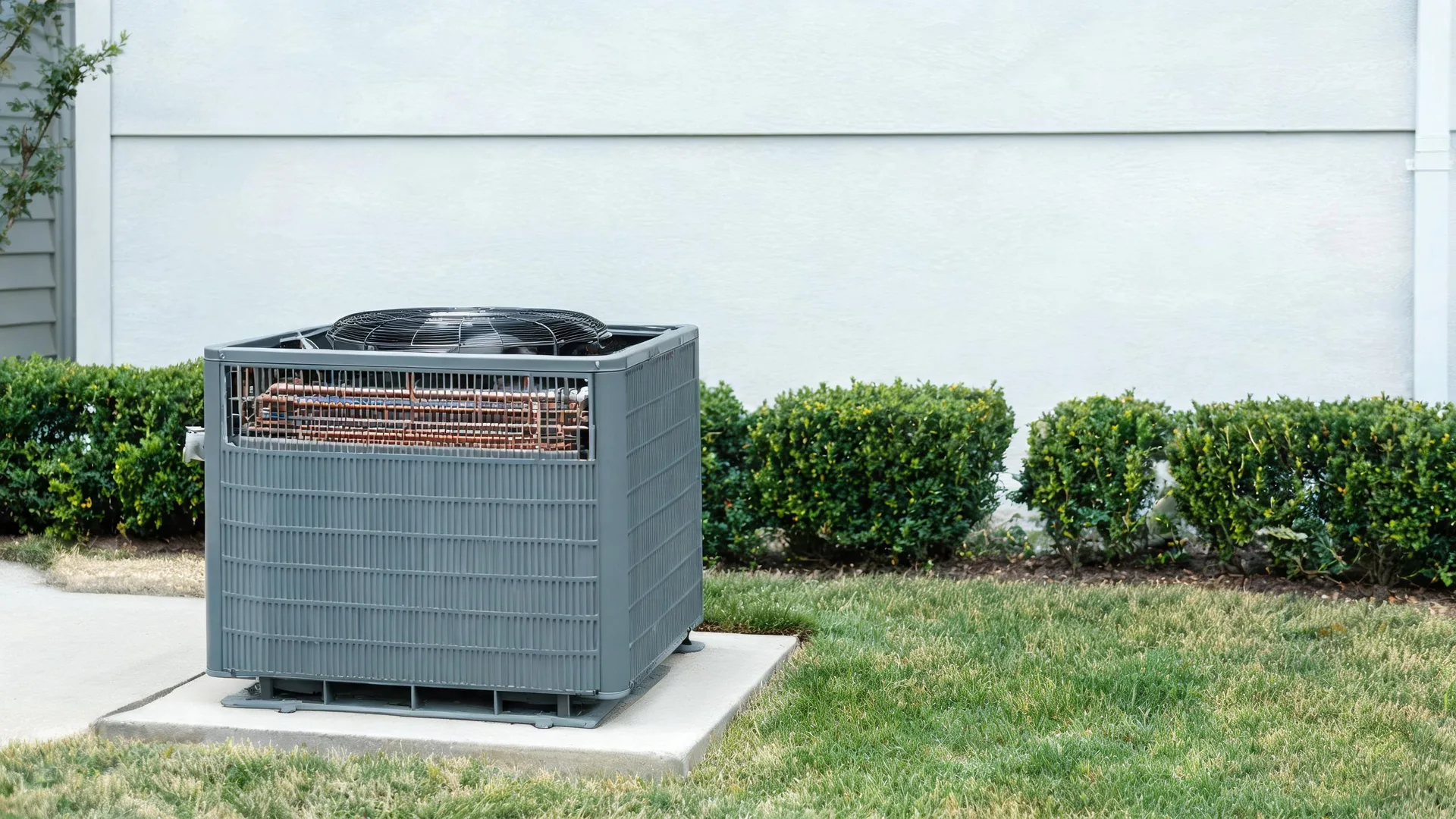
A gray cylindrical air conditioning condenser unit mounted on a concrete pad next to a light-colored vinyl-sided house exterior.

What's broken, and what's just worn

Get the actual problem named before it's fixed, not after. A system that has run five summers of 92 degree afternoons has parts wearing on a schedule a newer one doesn't. A capacitor or a contactor that's been through that kind of heat for years is a different repair than the same part failing in a system half that age. Ask whatever contractor comes out what's wearing, not just what broke.

Check the breaker before anything else

If the air conditioner won't come on at all, look at the breaker panel first. A tripped breaker or a breaker that's warm to the touch is worth knowing before a technician gets there. Also check that the thermostat has power and the batteries aren't dead if it runs on them. None of this costs anything to check and it rules out the simplest cause.

Look at the outdoor unit and the vents

Walk out to the condenser and see if the fan on top is spinning and if anything is blocking the sides, leaves, grass clippings, a fence panel too close. Inside, check that supply vents aren't closed or blocked by furniture, and that the return air grille isn't covered. A system starved of airflow on either end will run weak or freeze up, and that's something to notice before the technician arrives, not something to fix yourself.

Overhead view of a gray residential air conditioning condenser unit mounted on a concrete pad beside a house with asphalt shingle roofing.

A new air conditioner would cut about $60 a year off cooling for a typical Union Parish home.

  • A new one at the federal minimum, 14.3 SEER2$380 a year
  • An older air conditioner$440 a year

Estimates for a typical Union Parish home, compared with an older unit built to the previous federal minimum, from EIA household energy data, Louisiana fuel prices and NOAA climate normals. Your home will differ.

Repair makes sense when a part like a capacitor or contactor has failed.

Replacement makes sense when the compressor has failed or the system uses R-22 refrigerant, which is no longer made.

A repair decision really comes down to what broke and what it sits next to. A capacitor or a contactor is a small, inexpensive part, and swapping it out tells you nothing bad about the rest of the system. A compressor is different. That's the part that actually moves refrigerant, it costs the most to replace, and when it fails the honest question is whether to put that money into a system that's already old rather than a new one. Ask what the failed part was doing to the rest of the system before it quit. A bad capacitor can make a compressor work harder than it should for weeks before it's caught, and a compressor that's been strained like that is more likely to be next. The part that broke matters less than what else has been under strain because of it.