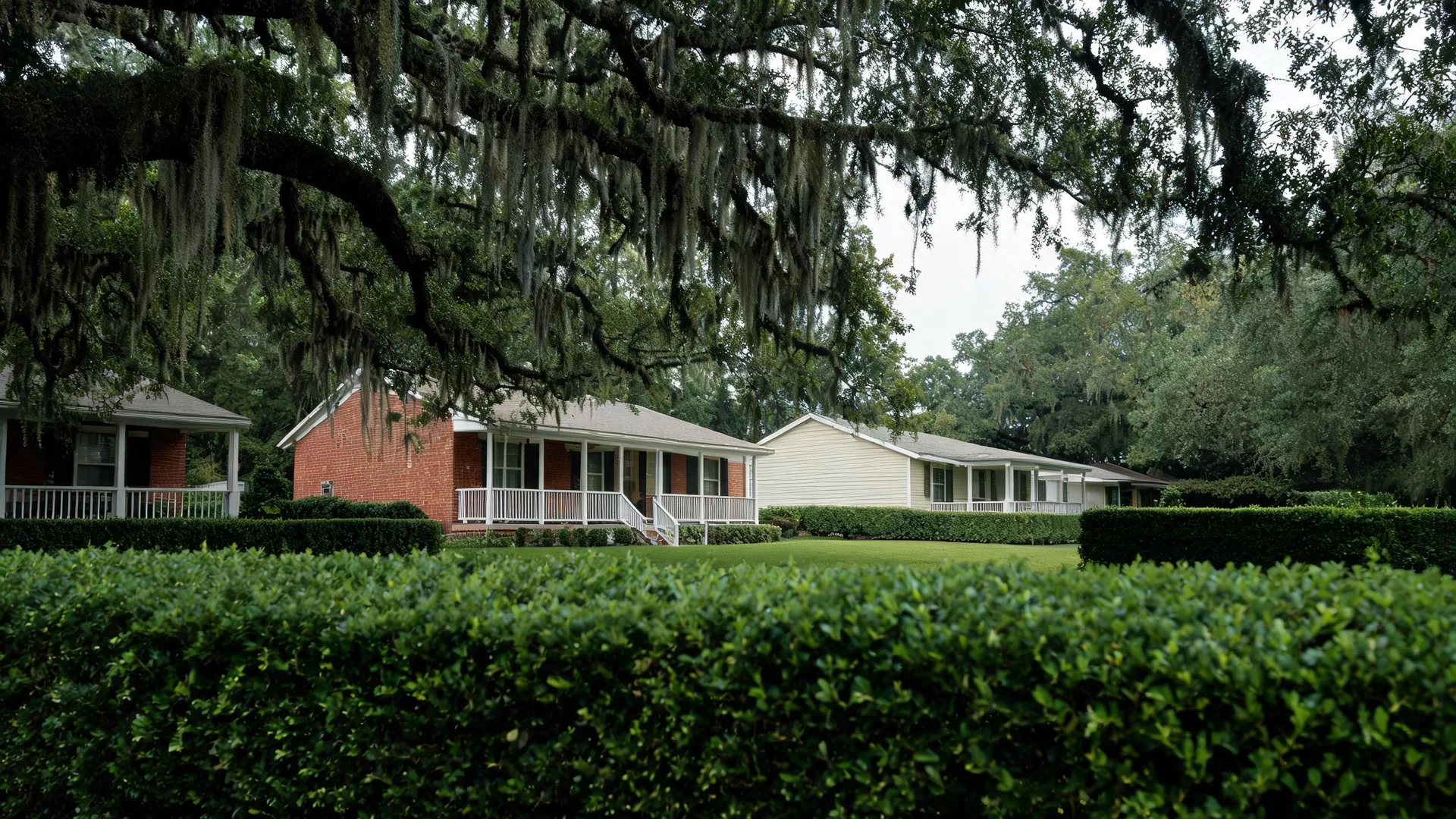
Single-story brick and white-sided buildings with covered porches behind a trimmed hedge and lawn, framed by overhanging oak branches draped with Spanish moss.

AC Repair in Morgan City, LA

Tell us about the job

Takes about a minute. No obligation.

RepairCentral ACSt. Mary Parish, LA
Step 1 of 2

What ZIP code is the job in?

Seven months of run time

An air conditioner here runs from April through October. Afternoon highs average 90°F through June, July and August, and the dew point sits around 74°F those same months, heavier than most of the country feels. The compressor and fan motor spend most of the year working against that, not just the hottest weeks of summer.


What that means for the repair

A system under that kind of load wears parts sooner than one in a milder climate, and small issues show up earlier than you'd expect. The problem you're seeing now is likely tied to that long stretch of hard running, not a fluke. Worth having someone diagnose it properly rather than just patch the symptom.

7 months
April through October, your air conditioner is on duty
90°F
the average summer afternoon it cools against
6 hail events
in ten years, and hail bends the fins on outdoor coils
16 wind events
in ten years, and wind drives debris into outdoor units
Isometric line illustration of a cutaway house showing interior rooms with furniture, ceiling ductwork, an indoor air handler, and an outdoor condenser unit connected by lines.
Your air conditioner works hardest from May through September.

NOAA nClimDiv, 1991–2020 normals

Electricity here runs 12.64 cents a kilowatt-hour, cheaper than most of the country.

That low rate still adds up to real money when a struggling AC runs most of the year to keep up.

Storms here are hard on the unit sitting outside

29 severe weather events from 2015 to 2024
49% of homes statewide lost power a day or more in 2024
16 damaging wind events from 2015 to 2024
March Is When to Get It CheckedCooling starts up again in April here, and a weak part usually gives out in those first weeks of real load.

If your unit took a hit in one of these storms, it may not show it right away. Hail dents the fan grille or bends the coil fins, and a bent fin blocks airflow without stopping the fan from turning. A branch or flying debris can knock the fan out of balance or crack the housing. The unit might still start up and blow cold air for weeks before the real strain shows up as a seized motor or a refrigerant leak. If you've been through wind, hail or a named storm recently, it's worth having the outdoor unit looked at now, even if nothing seems wrong yet.

Get the real cause, not just a quick fix

Seven months of cooling a year doesn't leave much downtime for a system to rest or hide a problem. Whatever's going on with yours now has likely been building under that load. A proper diagnosis gets at the actual cause, so the fix holds instead of coming back in a few weeks.

Find a contractor
A gray cylindrical air conditioning condenser unit mounted on a concrete pad next to a light-colored vinyl-sided house exterior.

What actually wears out

A capacitor is usually the first thing to go. It holds a charge that kick-starts the compressor and the fan motor, and that charge weakens over time until one day there isn't enough left to get them moving. You'll hear the unit hum and then nothing. The contactor is next, the switch that sends power to the compressor. Its contacts pit and burn from opening and closing every cycle, until one day they don't make contact at all. Fan motor bearings wear out from the motor just plain running, and a motor working on worn bearings pulls harder and runs hotter until it seizes. Low refrigerant almost always means a leak, usually at a joint or a coil, and a system low on charge makes the compressor work harder to do the same job. Run it low long enough and the compressor itself is what fails, which costs a lot more than fixing the leak would have. None of these show up overnight. They build cycle after cycle, season after season, until the part finally gives out at the moment you need it least.

Before you call, check these

Look at the thermostat first. Make sure it's set to cool and set below room temperature, and check the batteries if it has a screen that's dim or blank. Go to the breaker box and see if the AC breaker has tripped. It happens, and resetting it once is reasonable. Check the outdoor unit for anything blocking it, leaves, grass clippings, a fallen branch against the fan grille. Look at the indoor vents and make sure none are closed or blocked by furniture. Pull the air filter and hold it up to a light. If you can't see light through it, swap it out.

What tells you to stop and wait for a tech

If the outdoor unit won't turn on at all after a breaker reset, don't keep resetting it. A breaker that trips again is protecting something, usually the compressor. If you see ice on the indoor coil or the refrigerant line, shut the system off at the thermostat and let it thaw completely before anyone touches it, running it iced up only makes the damage worse. Water pooling around the indoor unit means the condensate drain is clogged or the pan is full, and that's not something to run while you wait. Any burning smell means shut it off and call, that's not a checklist item.

An outdoor air conditioning condenser unit on a concrete pad next to the gray vinyl siding of a residential home.

A new air conditioner would cut about $70 a year off cooling for a typical St. Mary Parish home.

  • A new one at the federal minimum, 14.3 SEER2$500 a year
  • An older air conditioner$570 a year

Estimates for a typical St. Mary Parish home, compared with an older unit built to the previous federal minimum, from EIA household energy data, Louisiana fuel prices and NOAA climate normals. Your home will differ.

Repair makes sense when a part like a capacitor or contactor has failed.

Replacement makes sense when the compressor has failed or the system uses R-22 refrigerant, which is no longer made.

A struggling system pulls more power to do the same job. A capacitor that's weakening makes the compressor work harder to start. A motor on worn bearings pulls harder to keep spinning. Low refrigerant makes the compressor run longer to cool the same house. None of that shows up as a repair bill right away. It shows up on the power bill, month after month, for as long as the part stays bad. Fixing the actual fault stops that extra draw instead of just living with it.