






Overhead view of an outdoor AC condenser unit on a concrete pad next to a house with a dark shingle roof.

AC Repair in New Iberia, LA

Tell us about the job

Takes about a minute. No obligation.

RepairCentral ACIberia Parish, LA
Step 1 of 2

What ZIP code is the job in?

Your AC runs about seven months a year here, April through October. For three of those months the afternoon high averages 90°F, and the air holds a dew point near 74°F, which is heavy even by Louisiana standards. That combination keeps the compressor cycling on for longer stretches than it would almost anywhere else in the country. A capacitor, a contactor, a run of refrigerant line all take that strain every day of summer. When something finally gives out, it's usually not bad luck. It's a part that's been working harder than it was built for, for longer than most units ever see.

7 months
April through October, your air conditioner is on duty
90°F
the average summer afternoon it cools against
8 hail events
in ten years, and hail bends the fins on outdoor coils
25 wind events
in ten years, and wind drives debris into outdoor units
Isometric cutaway illustration of a single-story house showing interior rooms with furniture, overhead ductwork, an indoor air handler unit, and an outdoor condenser unit connected by lines at the side of the building.
Your air conditioner works hardest from May through September.

NOAA nClimDiv, 1991–2020 normals

March is the last quiet month before your AC starts carrying the summer load.

A part that came through last summer weakened usually fails once April's load hits it, not later.

Cheap power doesn't stay cheap when the AC is struggling

Power here costs 12.86 cents per kilowatt-hour
Climate zone 2A
Cooling runs April through October

Iberia Parish recorded 40 severe weather events between 2015 and 2024. Damaging wind came through 25 times in that stretch, hail hit 8 times, and tornadoes touched down 3 times. Any one of those can knock debris into an outdoor unit or dent the coil fins without stopping it from running. A unit that still turns on after a storm hasn't necessarily come through clean. Power loss is the other half of it. Close to half of Louisiana households went at least 24 hours without power in 2024, and a system coming back on after an outage that long is worth a look, especially if it was already due for service. If your outdoor unit has taken a hit this year, or the power's been out for a stretch, have someone check it even while it's still cooling fine.

Have it diagnosed now, so the repair lasts through next summer too

A part that's been straining through seven months of cooling a year doesn't fix itself when the weather eases up. Get it looked at and repaired properly now, so the fix holds through the next stretch of 90 degree afternoons instead of giving out partway through it.

Find a contractor
A man in a dark shirt and tan work pants, seen from behind, carries a canvas tool bag up wooden porch steps toward a green front door of a shingled house with a potted shrub beside it.
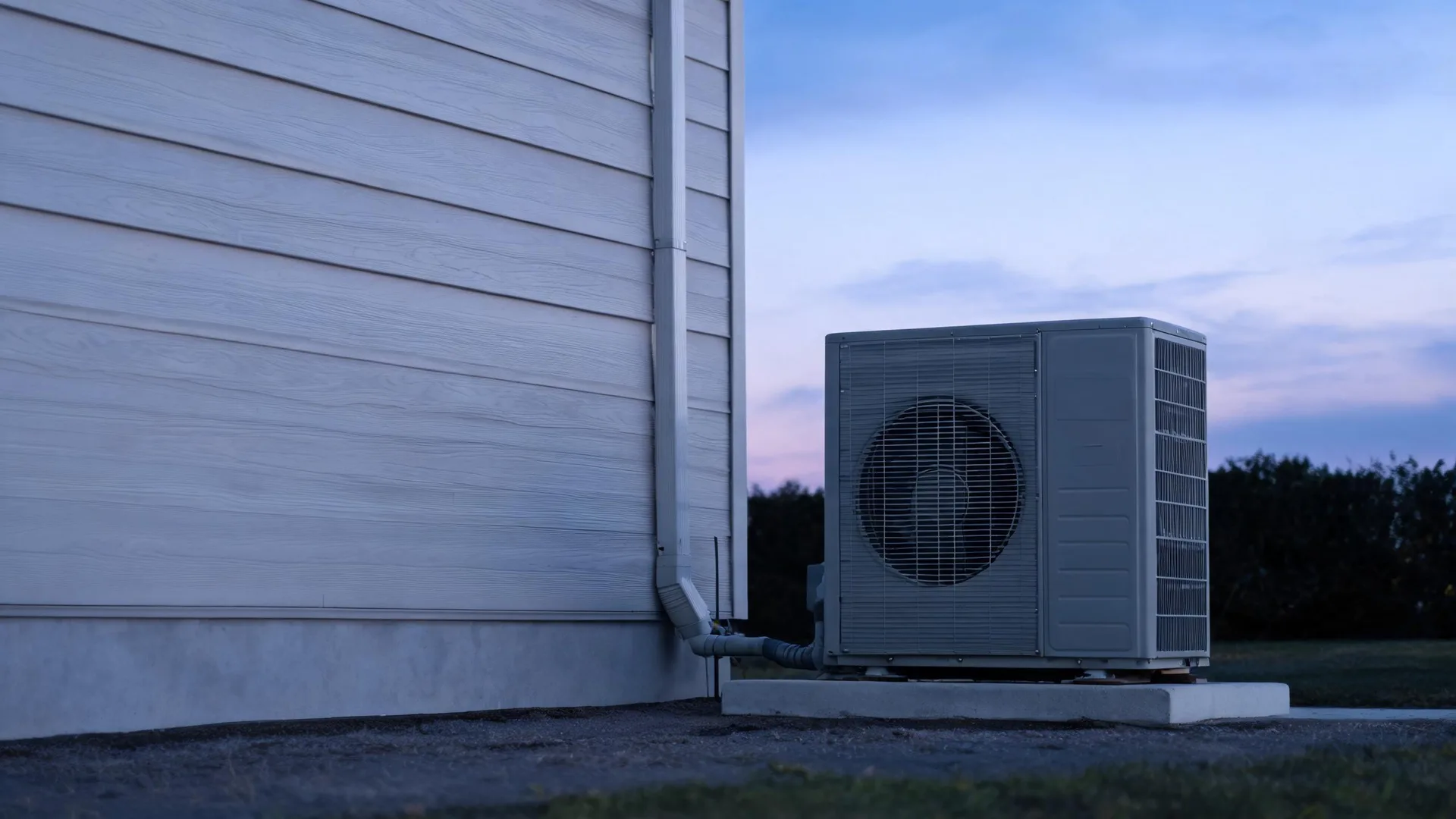
An outdoor air conditioning condenser unit mounted on a concrete pad surrounded by gravel, photographed against a partly cloudy blue sky.

Running it longer doesn't buy time. It uses it up.

A system that's struggling doesn't fix itself by staying on. If the airflow is choked by a dirty filter or a blocked coil, every extra hour of runtime pushes the compressor to work against that restriction instead of away from it. Heat that should move outside backs up in the coil, and a coil that stays too cold too long starts icing over, which blocks airflow even further. That's how a small problem turns into a frozen line or a compressor that trips its overload protection. A refrigerant leak behaves the same way. A system low on charge still runs, but it runs longer to hit the same temperature, and the compressor pumps harder than it was built to on every one of those cycles. Electrical parts fail on their own timeline too. A capacitor that's starting to go will make the compressor or fan motor draw more current to start up, and every extra start wears it down a little more until it doesn't start at all. None of these get better with more runtime. They get worse, and usually faster than people expect.

Most failures start small and electrical

A capacitor loses its charge a little at a time. A contactor's points pit and burn with every cycle. Neither one gives much warning. The compressor or fan motor just stops starting reliably, or stops starting at all, and what looks like a sudden breakdown is really the last step of a slow wear that's been going on for a while.

What that means for the fix

Replacing a worn capacitor or contactor is a small job if it's caught before it takes something else down with it. A compressor that keeps trying to start without enough power behind it can burn out its windings, and that's a different repair entirely. Catching the small part early is what keeps the job small.

Aerial view of a residential air conditioning condenser unit mounted on a concrete pad next to a house with vinyl siding and a sliding glass door.

A new air conditioner would cut about $70 a year off cooling for a typical Iberia Parish home.

  • A new one at the federal minimum, 14.3 SEER2$490 a year
  • An older air conditioner$560 a year

Estimates for a typical Iberia Parish home, compared with an older unit built to the previous federal minimum, from EIA household energy data, Louisiana fuel prices and NOAA climate normals. Your home will differ.

Repair makes sense when a part like a capacitor or contactor has failed.

Replacement makes sense when the compressor has failed or the system uses R-22 refrigerant, which is no longer made.

Low power prices make it easy to miss a unit that's struggling, because the bill looks small either way. A healthy AC and a dying one both show up as a number you glance at and forget. The difference is underneath it: a failing capacitor or a system low on refrigerant makes the compressor work harder to hit the same temperature, cycle after cycle. That extra work costs you every month the machine runs this way, not just the month it finally quits. Catching the part now, while the fix is still small, is what keeps that cost from climbing through the rest of the summer.