Two illuminated white Southern-style houses with wraparound porches and staircases, framed by a Spanish moss-draped tree on a quiet street at night.

Heat Pump Repair in Monroe, LA

Tell us about the job

Takes about a minute. No obligation.

RepairHeat PumpOuachita Parish, LA
Step 1 of 2

What ZIP code is the job in?

A small fault can take out a bigger part

A heat pump that's low on refrigerant will keep trying to reach the temperature on the thermostat. The compressor keeps working against a charge it can't make up, and that strain is what ends up failing it. A failing capacitor causes the same kind of problem. It makes the motor it feeds strain on every start, and a strained motor burns out early.


Ice and water don't stay put

A heat pump that's frosting over in the cold months has something stopping it from defrosting on schedule. Run it anyway and the ice spreads across the coil, which blocks airflow and makes the unit work harder for less heat. Left alone, that same coil can stay wet long enough to rust. Once a coil is leaking, there's no patching it.

5 months
November through March, your system heats
6 months
May through October, it cools
37°F
the average winter night it heats against
92°F
the average summer afternoon it cools against
Isometric cutaway illustration of a small house showing interior rooms with furniture, an indoor air handler with ductwork, and lines running to an outdoor condenser unit beside the building.
Your system heats November through March and cools May through October.

NOAA nClimDiv, 1991–2020 normals

Half the homes in Ouachita Parish were built in 1983 or later.

A heat pump that came with a newer house still has working life in it, and that's usually a reason to repair it rather than replace it.

Heat pumps break the first cold snap in November, not in March

Cooling runs May through October
Heat runs November through March
Power costs 11.73 cents a kWh statewide

A diagnostic call starts outside at the unit, not at the thermostat. The tech checks the refrigerant charge, the pressures on both sides, and whether the compressor is pulling the current it should. From there it's the reversing valve, since that's the part that decides whether you get heat or air conditioning, and a stuck one will leave you with neither. Indoors, they'll pull the filter and look at the coil for ice or dirt, both of which choke airflow the same way. Most calls end with one part named as the cause, not a list of maybes, because the readings either point somewhere or they don't.

Fix it while it still has years left in it

If the heat pump in question came with a newer house, repair is usually worth doing before replacement enters the conversation. Get a tech out to look at it and find out what's actually wrong.

Find a contractor
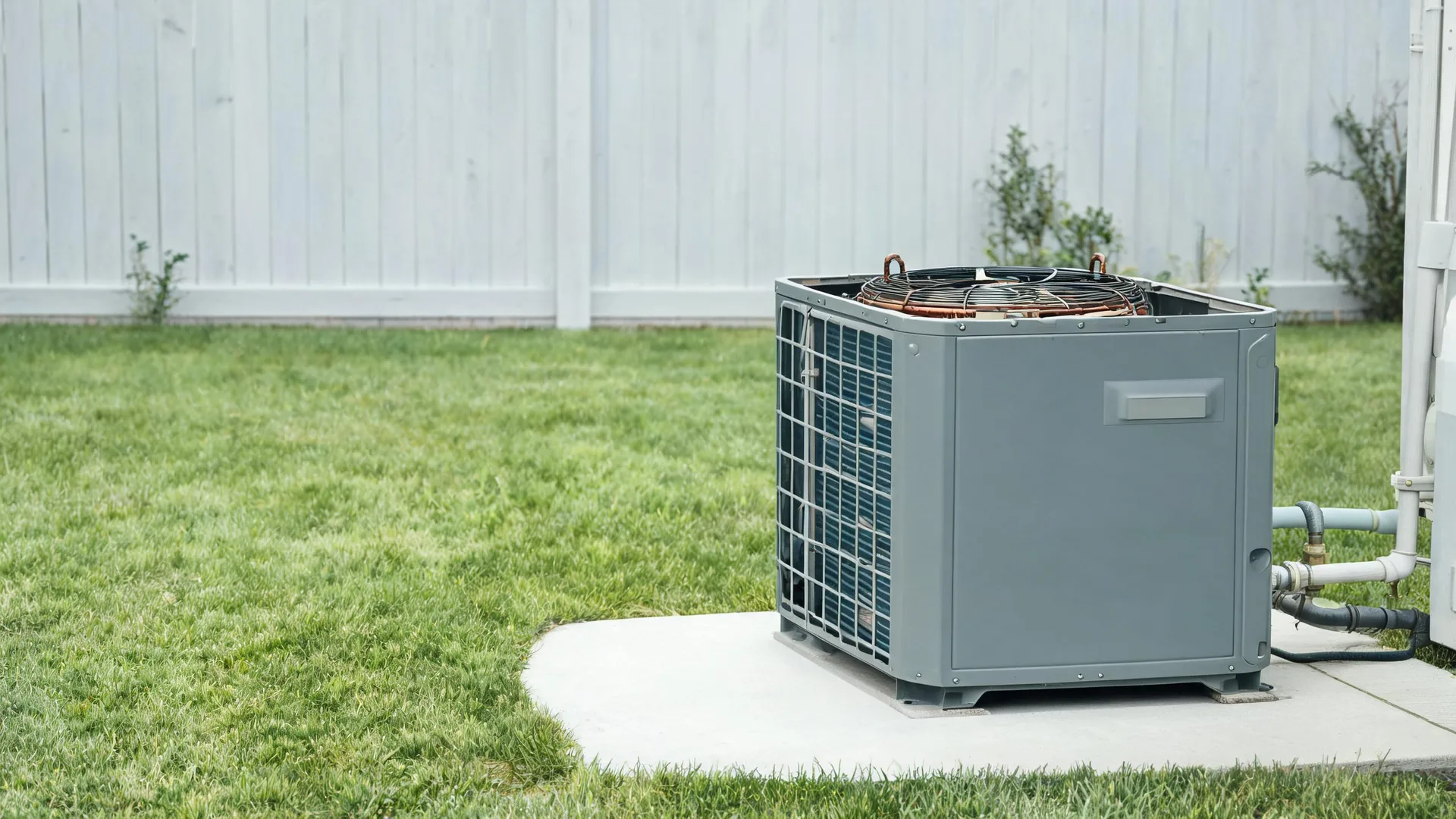
A gray heat pump outdoor unit mounted on a concrete pad next to a residential house with lap siding and stone accents.

It never gets a season off

A heat pump runs in both directions, all year, so it never gets the long rest a furnace or an air conditioner gets. The reversing valve switches with every change between heat and cooling, and the seals and contacts inside it wear from the switching itself, not just from age. The outdoor coil sits exposed through every season, picking up dirt and grit the whole time, and it carries the load of defrost cycles that a straight cooling unit never sees. None of that means a given unit is worn out. It means the parts that fail, fail from use, so a unit that hasn't logged many years can still have a lot of cycles on the reversing valve and the compressor contactor. Wear shows up in specific parts, not in the unit as a whole, which is why one bad component can be the whole story.

What you can check at the thermostat

Make sure it's set to heat and the set temperature is actually above room temperature. Check the batteries if it has a screen that's dim or blank. If it has an emergency heat setting, see whether switching to it changes anything, since that tells you if the problem is the heat pump itself or the backup heat.

What you can check at the unit

Look at the outdoor unit for ice covering the coil or snow piled against it. Check that nothing is blocking airflow around it, like leaves, a cover, or anything stacked nearby. Go inside and pull the filter out to see if it's clogged, since a dirty filter chokes airflow at both the indoor and outdoor coil. None of this calls for taking anything apart or touching electrical connections.

A heat pump in trouble usually says so before it quits outright. It might run long stretches without hitting the set temperature, or blow air that feels barely warm even though the unit is running. Short cycling, where it starts and stops over and over instead of running a steady stretch, points to a problem forcing it to shut down early. A hard knock or rattle at startup is often a motor or compressor straining against something it shouldn't have to. Any burning smell or a breaker that trips when it kicks on means stop running it and get it looked at, since that's electrical strain, not a minor glitch.

A tech weighing repair against replacement is looking at what broke, not just that something did. A capacitor or a contactor is a small, inexpensive part to swap, and replacing one doesn't say anything bad about the rest of the system. A compressor is a different question, since it's sealed inside the unit and failure there usually means the refrigerant circuit itself is done. Age matters less than what's actually failed and what else is starting to go with it. A unit that keeps coming back for a different repair each time it's looked at is telling you something a single bad part isn't. The honest version of this call names the failed part, says what fixing it involves, and lets you decide from there.