White two-story houses with wraparound porches and Spanish moss-draped oak trees photographed along a residential street at night.

Mini Split Installation in Baton Rouge, LA

Tell us about the job

Takes about a minute. No obligation.

New system or replacementMini-splitEast Baton Rouge Parish, LA
Step 1 of 2

What ZIP code is the job in?

Storms come through this parish often

East Baton Rouge Parish recorded 150 severe weather events between 2015 and 2024. That includes 100 damaging wind events, 27 hail events, 8 tornadoes and 4 tropical storms or hurricanes. Almost half of Louisiana households lost power for 24 hours or more in 2024.

An outdoor unit sits in the open

A mini-split's outdoor unit hangs on a wall or sits on a pad outside, exposed to whatever wind and hail pass through. An outage also stops it cold, along with anything else running on electricity in the house, including the water heater if it's electric.

5 months
November through March, your system heats
7 months
April through October, it cools
42°F
the average winter night it heats against
91°F
the average summer afternoon it cools against
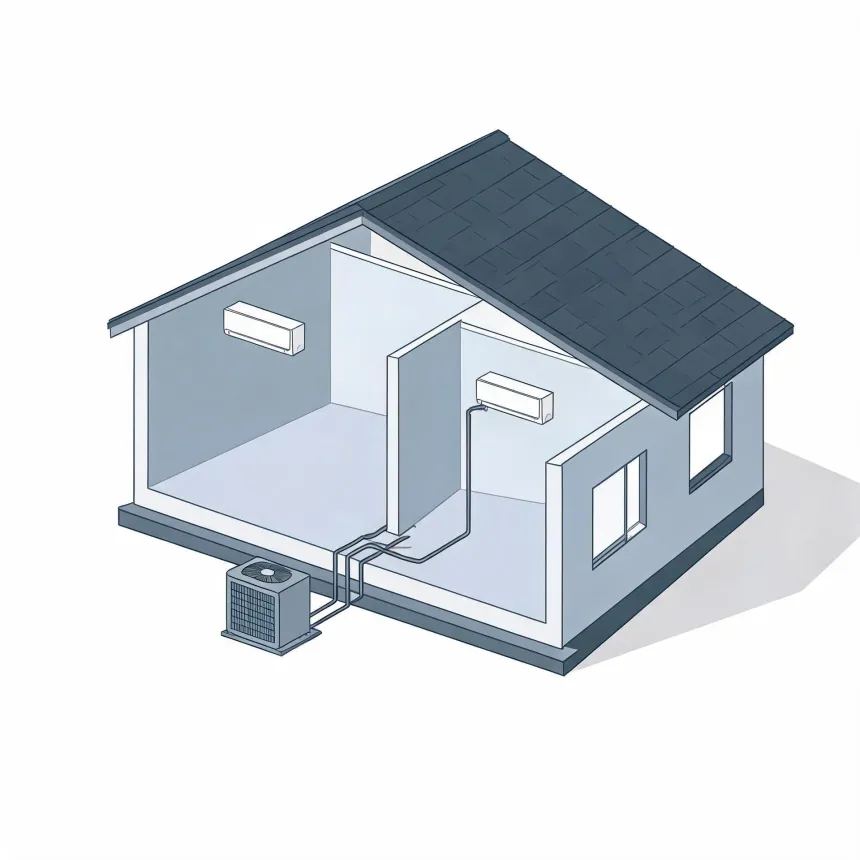
Isometric cutaway illustration of a small house with a dark shingled roof, showing two wall-mounted indoor units connected by lines running to an outdoor condenser unit beside the building.
Your system heats November through March and cools April through October.

NOAA nClimDiv, 1991–2020 normals

Your mini-split will run cooling seven months a year here, April through October.

A system sized or installed wrong won't just cost more, it'll struggle through summers that run 91 degrees with a 73 degree dew point.

Cooling starts in April, so get it in before April

Cooling runs April through October
Summer afternoons average 91°F
Power here costs 12.50 cents per kilowatt-hour

East Baton Rouge Parish falls under climate zone 2A, a hot and humid zone where cooling drives most of the year's energy use. That puts a floor under what can be installed. A mini-split here is a split-system heat pump under federal rules, and any unit built from January 1, 2023 onward has to remove at least 14.3 Btu of heat per watt-hour of electricity it uses in cooling mode, with a minimum of 7.5 Btu per watt-hour for heating. There's no separate, lower bar for ductless systems. A contractor quoting a unit below that rating isn't offering a deal, they're offering something that can't legally go into this parish. Beyond the floor, a system that clears the minimum by more will cost less to run through the long cooling months. There's also a federal tax credit for qualifying high-efficiency equipment, worth checking against whatever unit ends up on the quote.

Plan for the outage before the install, not after

Where the outdoor unit goes and how it's mounted is part of this installation, not an afterthought. A pad or bracket that holds up through wind and hail beats one picked for convenience. If the power here goes out, the mini-split stops until it's back, and so does an electric water heater. Worth asking what backup options make sense for this house before the crew shows up.

Find a contractor
A man in a cap, dark long-sleeved shirt and worn brown work pants walks up porch steps toward a green front door, carrying a canvas tool bag in his right hand, with a potted plant beside the door.
A white outdoor air conditioner condenser unit mounted on metal wall brackets against gray horizontal siding, with a blue sky and white clouds behind it.

Seven months of work, every year

Seven months of cooling a year adds up to a lot of hours on the compressor. Get the sizing right at install and that workload stays steady instead of climbing. A unit that's too small runs flat out all summer trying to keep up. One that's too big cycles on and off more than it should, and that short cycling wears on parts faster than steady running does. Either mistake shows up as higher bills first, then as repairs. The fix is at the install, matching the unit to this house, not after it's already running.

The old equipment doesn't just get unplugged

A central system being replaced has a line set and sometimes ductwork tied into it, along with a condensate drain and an electrical disconnect. Each of those gets dealt with before the new mini-split goes in, not worked around. Any refrigerant left in the old lines has to be recovered properly, never vented, since that's both bad practice and against the law.

What's worth keeping gets reused, not replaced

A disconnect box, a dedicated circuit, or a condensate line that's in good shape can often serve the new system too. A contractor worth hiring checks what's usable before tearing it all out. Replacing everything from scratch when half of it still works just adds cost without adding anything to how the new unit runs.

Sizing a mini-split comes down to a room by room load calculation, not a guess based on square footage. A contractor measures the space, checks window area and orientation, looks at insulation and ceiling height, and counts how many people and appliances add heat to the room. That calculation points to a specific capacity, and the indoor and outdoor units get matched to it. Oversize it and the unit cools the air fast without ever running long enough to pull the moisture out, so the room feels cold and damp at once. Undersize it and the compressor runs constantly, straining to hit a setpoint it can't reach on the hottest days. Both mistakes trace back to the same cause: someone skipped the calculation and picked a unit off a chart instead.

Electricity here runs 12.50 cents per kilowatt-hour on average, cheaper than most of the country. That helps, but cooling this house most of the year still turns into one of the biggest draws on the bill. Efficiency decides how much that draw costs. A unit that clears the federal minimum by a wide margin pulls less power to do the same job as one that barely squeaks by. That difference shows up on every bill, not just the ones in the worst heat.