






Two illuminated white Southern-style houses with wraparound porches and staircases, framed by a Spanish moss-draped tree on a quiet street at night.

Mini Split Installation in Monroe, LA

Tell us about the job

Takes about a minute. No obligation.

New system or replacementMini-splitOuachita Parish, LA
Step 1 of 2

What ZIP code is the job in?

Ouachita Parish saw 140 severe weather events between 2015 and 2024. Most of that was wind, 86 events, with 39 hail events mixed in and 8 tornadoes touching down. A mini split's outdoor unit sits outside through all of it, exposed to hail and flying debris in a way a furnace or water heater tucked inside never is. Power is what ties it together. Statewide, 49% of Louisiana households lost power for 24 hours or more in 2024, and when that happens here it takes the heat or the cooling with it, along with hot water if that runs on electricity too. Where the outdoor unit goes and what protects it matters more here than it would somewhere with calmer weather.

5 months
November through March, your system heats
6 months
May through October, it cools
37°F
the average winter night it heats against
92°F
the average summer afternoon it cools against
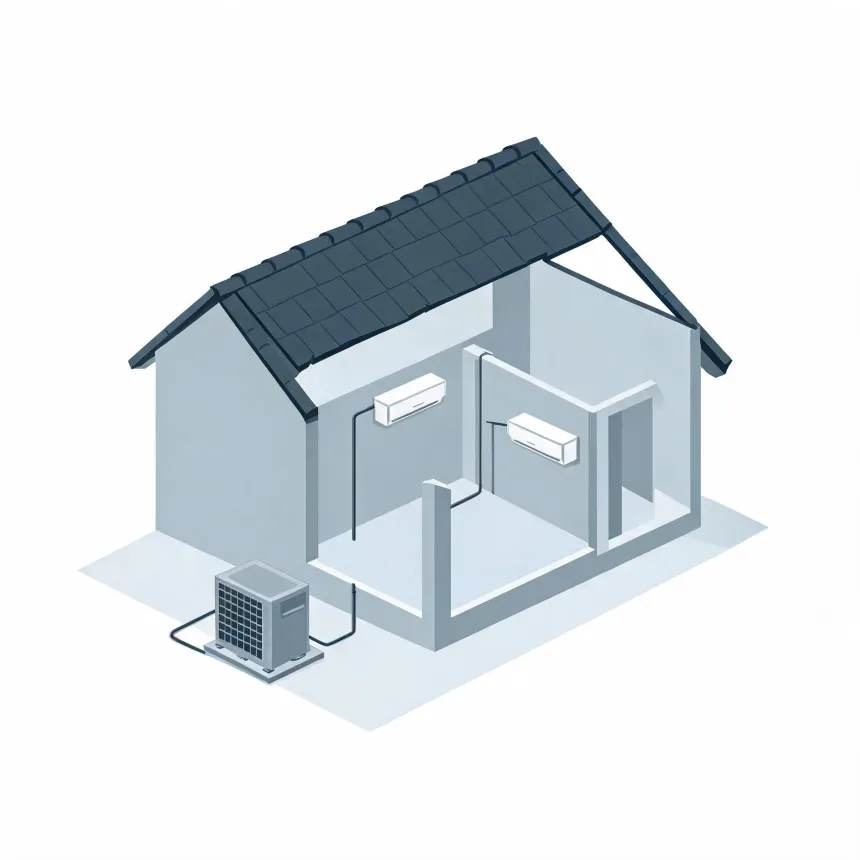
Isometric illustration of a cutaway house with a dark tiled gable roof, showing two wall-mounted indoor split air conditioning units connected by lines to an outdoor condenser unit on the ground outside.
Your system heats November through March and cools May through October.

NOAA nClimDiv, 1991–2020 normals

Your mini split will run six months straight, May through October, with afternoon highs averaging 92°F and a dew point around 70°F.

A system sized for an easier climate will struggle here. This one needs to be sized for what Ouachita Parish summers actually demand.

Two in three homes here already run on electricity

66.5% of homes heat with electricity
Climate zone 3A
Power here costs 12.03 cents per kilowatt-hour
Get it in before MayCooling runs May through October here, six months straight.

Ouachita Parish falls in climate zone 3A, warm and humid with a long cooling season. A mini split sold here has to clear the federal minimum for that kind of system: at least 14.3 Btu of cooling for every watt-hour it draws over the summer, and at least 7.5 Btu of heat for every watt-hour over the winter. That standard applies to any split-system heat pump built from January 2023 on, ductless units included. It sets the floor. A contractor sizing the system for this parish's summers will generally land on equipment well above that minimum anyway, but it cannot legally come in under it.

Install it with the next outage in mind

Plan the outdoor unit's spot before install day. A pad or bracket away from falling limbs, with clear drainage, holds up better than a corner picked for convenience. Ask about surge protection too, since the unit sits outside through wind and hail that a furnace never has to face. If the power goes out for a day, as it did for about half of Louisiana households last year, you'll want to know ahead of time how the system comes back on.

Find a contractor
A man in a cap, gray T-shirt and tan work pants carries a canvas tool bag up porch steps toward a green front door of a lap-sided house, with a potted shrub to the right.
A white outdoor air conditioner condenser unit mounted on metal wall brackets against gray horizontal siding, with a blue sky and white clouds behind it.

Six months a year, this unit earns its keep

Six months of cooling means the compressor is working hard most of the year, not just on the worst days of August. Have the contractor size it for this parish's summers specifically, not for a milder zone. A unit that's right for here will cycle properly instead of running flat out trying to keep up, and that's what keeps parts from wearing down before their time.

The line set and the wall run the price up or down

A mini split needs a line set run between the outdoor unit and each indoor head, along with a drain line and a power circuit. The farther apart they sit, and the more walls or floors that run has to cross, the more labor and material it takes. A straight shot through one exterior wall costs less than a run that has to snake through an attic or drop down from a second floor. Multi-zone systems multiply this, since each indoor head needs its own line set back to the same outdoor unit.
The outdoor unit's mounting changes what the crew has to build

An outdoor unit can sit on a ground pad, on a wall bracket, or up on a stand, and each option takes different work. A pad needs level ground and drainage so water doesn't pool against the unit. A wall bracket has to anchor into something solid enough to hold the unit's weight without vibrating loose over time. Ground clearance matters too, since an outdoor unit set too low can pull in debris or sit in standing water after heavy rain.

Sizing a mini split starts with a load calculation, not a square footage chart. A contractor measures the room or the home, counts windows and their orientation, checks insulation, and figures out how much heat actually moves through that space on the hottest and coldest days. That number tells them how much capacity each indoor head needs, and it varies room to room even in the same house. Too big and the unit short cycles, cooling the air fast then shutting off before it pulls the moisture out, which leaves the room feeling clammy even at the right temperature. Too small and it runs flat out all day without ever catching up. Getting the size right is what lets the compressor modulate the way it's designed to, instead of slamming between full blast and off.

Installation day starts with the outdoor unit placement and the line set path, since everything else follows from those two decisions. The crew runs the line set, a drain line, and a dedicated power circuit between the outdoor unit and each indoor head, then they pressure test the line set to check for leaks before any refrigerant moves through it. Once that holds, they pull a vacuum on the lines to clear out moisture and air, because either one left inside will foul the system later. The indoor head goes up next, mounted to a plate secured into studs or blocking so it can't work loose. After the outdoor unit is set and wired in, the crew charges the system, checks refrigerant levels against the manufacturer's spec, and tests both heating and cooling before they call the job done. A good installer also walks the condensate drain line to make sure it actually slopes toward the outlet, since a flat or backward run will back water up into the indoor unit.