Two white Southern-style homes with wraparound porches lit by landscape lighting at night, flanked by live oak trees hung with Spanish moss.

Mini Split Installation in Slidell, LA

Tell us about the job

Takes about a minute. No obligation.

New system or replacementMini-splitSt. Tammany Parish, LA
Step 1 of 2

What ZIP code is the job in?

St. Tammany sees more than its share of storms

St. Tammany Parish recorded 146 severe weather events between 2015 and 2024. That includes 88 damaging wind events, 24 hail events, 25 tornadoes, and 5 tropical storms or hurricanes. An outdoor condenser sits exposed to all of it.

The power doesn't always hold

Nearly half of Louisiana households, 49%, went at least 24 hours without power in 2024. A mini split needs electricity to heat or cool a room, so an outage here is worth planning around before the install, not after.

5 months
November through March, your system heats
7 months
April through October, it cools
43°F
the average winter night it heats against
91°F
the average summer afternoon it cools against
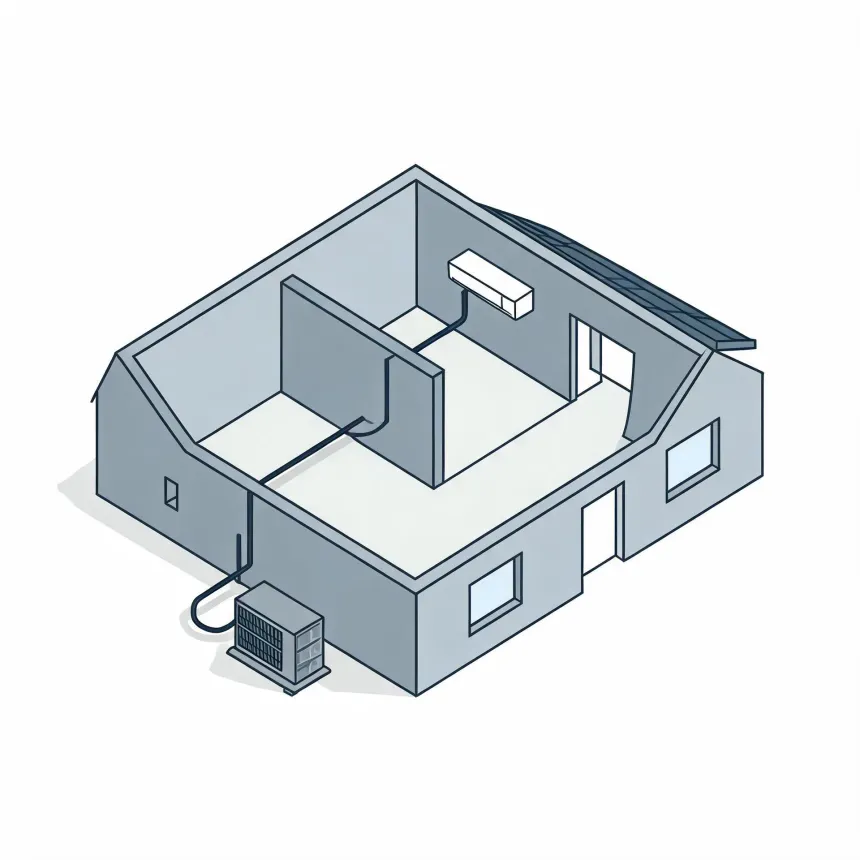
Isometric line illustration of a cutaway house showing an interior wall-mounted air conditioning unit connected by a line to an outdoor condenser beside the exterior wall.
Your system heats November through March and cools April through October.

NOAA nClimDiv, 1991–2020 normals

The condenser runs seven months a year here, April through October, with afternoon highs averaging 91°F in June, July and August.

A mini split sized for a mild climate will fall behind fast in a Slidell summer.

Most of St. Tammany heats with electricity, and a mini split fits right into that

61.9% of homes heat with electricity
Cooling runs April through October
Summer afternoons average 91°F
Electricity here costs less, but a mini split still has to earn its keepSt. Tammany Parish homes paid 12.80 cents per kilowatt-hour in 2025, below most of the country

March is worth marking on the calendar. Cooling starts in April and runs seven months, through October, so a install finished in March means the system is tested and running before the first hot stretch instead of during it. Scheduling after the weather turns means finding a slot during the busiest months for every contractor in the parish, often with a window unit or box fans getting a home through the wait. A spring install also gives time to work around any outage once hurricane season starts, rather than figuring out backup power while a storm is on the way. Getting it done in March puts the timing in your hands instead of the weather's.

Plan the install around the weather it has to survive

Where the installer puts the outdoor unit, and what's around it, is worth deciding before the install rather than after a storm. Ask about a disconnect switch and a mount that keeps the unit clear of flying debris. If the power goes out, a mini split won't heat or cool until it's back, so it's worth asking what backup options exist for the room that matters most.

Find a contractor
A white outdoor air conditioner condenser unit mounted on metal wall brackets against gray horizontal siding, with a blue sky and white clouds behind it.

Seven months of runtime, every year

That runtime adds up fast against a 91 degree afternoon, and it's the compressor that carries the load. Ask the installer what size they're recommending for the room and why. A correctly sized unit run this hard still wears faster than one in a milder climate, and small problems, a weak capacitor, a dirty coil, tend to show up sooner here than they would somewhere with a shorter summer. Worth asking what the maintenance schedule looks like before the first season, not after.

Ask what happens if one zone fails

A mini split system can run several indoor heads off one outdoor unit, or just one head off its own unit. Ask what happens to the rest of the house if a single indoor head needs a board or a sensor replaced. On some systems the other zones keep running fine. On others, especially anything tied into a single shared control, one failed part can take down more than the room it's in.

Ask who services the brand locally

Every mini split needs its outdoor coil cleaned and its refrigerant charge checked over the years it runs. Parts and refrigerant type vary by manufacturer, and not every contractor stocks every brand. Before buying on price or features alone, ask whether the installer services that brand regularly, because a system nobody nearby knows how to work on turns a small repair into a long wait.

Whatever is heating or cooling the house now has to come out before the new system goes in, and that part of the job matters more than it sounds. If the old system is ducted, the installer is only removing the furnace, coil and condenser, not the ductwork, so there's usually no patch work needed on the walls or ceiling. If it's a window unit or an older through-wall unit, there's a hole to deal with, and that gets sealed and finished as part of the swap, not left for later. Refrigerant in the old condenser has to be recovered properly, not vented, so factor that step into the timeline. Any old line set gets pulled or capped, since reusing it with a new system usually isn't worth the risk of a leak at an old joint. None of this is hard, but it's work, and a contractor who walks the old equipment out the door before walking the new equipment in is doing the job in the right order.

St. Tammany Parish falls under zone 2A in the 2021 energy code, a hot, humid zone where cooling carries most of the load. That classification sets the floor for what can be installed here. Mini splits fall under the federal split-system heat pump standard, and any unit built from January 2023 onward has to remove at least 14.3 Btu of heat per watt-hour of electricity over summer and deliver at least 7.5 Btu per watt-hour over winter. That's not a target, it's the minimum allowed on the market now. Beyond that floor, a system installed here also qualifies for the federal energy efficiency tax credit, which covers a share of the equipment and installation cost for qualifying heat pumps.