

Running the way it should
This is a mini split keeping up on a cold morning, warm air moving steady out of the vents until the room catches up. No odd noise, no ice on the outdoor unit, just heat where you want it.
Send the request today and stop worrying about who to call.
Send it todayCold snaps here don't last long, but when one hits, you expect your mini split to keep up. Instead it's blowing air that feels room temperature or barely warm, and the house isn't catching up no matter how long it runs. In a mild climate like this, a mini split doesn't get pushed hard most of the year, so when it does struggle on a cold morning, it stands out fast.
A mini split heats by pulling warmth from the outside air, even when it's cold, and moving it inside. If the outdoor coil is caked with dirt or iced over, it can't absorb enough heat to send anything warm through the indoor unit. A low refrigerant charge from a leak cuts that capacity further, and a defrost control that isn't cycling right can leave the coil frozen for long stretches. Winters in St. Tammany Parish are mild, so the unit isn't built to work against hard freezes, which makes it less forgiving when something inside it isn't working right. Running the system harder won't fix any of these. It needs a technician to find which one it is.
This is a mini split keeping up on a cold morning, warm air moving steady out of the vents until the room catches up. No odd noise, no ice on the outdoor unit, just heat where you want it.

A coil and vents this dusty can't move heat the way they're built to. Airflow drops, the unit runs longer to do less, and in a cold snap it may not keep up at all.
Cooling runs April through October
Cooling runs April through October, so your mini split spends most of the year moving heat out of the house, not in. Heating is the smaller job, which is why a failure in winter catches people off guard.
Heat runs November through March
Heat runs November through March, the five months your mini split has to reverse itself and pull warmth from outside air. That switch is where a weak system shows its problems first.
Power here costs 12.80 cents per kilowatt-hour
Power here costs 12.80 cents per kilowatt-hour, so running a mini split on heat doesn't cost much even when it has to work harder on a cold morning. A system that's actually broken won't fix itself by running longer.
NOAA nClimDiv 1991-2020 · EIA-861 2025

The unit sits clean on the wall, vents clear, and warm air reaches the room without a fight. No staining above it, no grime on the housing. Whatever's inside is doing its job out of sight, the way it should.

Dirt coats the face of this one, and the wall above it has gone dark. Buildup like that blocks airflow and points to a coil or filter that hasn't been cleaned in a long time, which can keep a mini split from heating right.
You've probably got the thermostat set higher than usual, waiting for the room to catch up, and it just isn't happening. The air coming out feels lukewarm at best. You might hear the outdoor unit cycling on and off more than it should, or notice it running constantly without much to show for it. Some homeowners find ice on the outdoor unit even when it's not that cold out. Rooms farther from the indoor unit stay noticeably cooler than the one it's mounted in. Left alone, a mini split that won't heat properly can freeze up its own coil or strain the compressor, turning a repair into a bigger one.






A mini split doesn't make heat the way a furnace does. It moves heat that's already sitting in the outside air, even cold air, and pushes it inside through the refrigerant line. That's the reverse of what it does all summer, and the switch happens at a part called the reversing valve. When the thermostat calls for heat, the valve redirects refrigerant flow so the indoor coil gives off heat instead of pulling it out of the room.
On a cold morning, the outdoor coil can pick up frost, the same way a glass sweats in reverse. The system clears it with a defrost cycle, and during that cycle you'll feel cool air for a few minutes even though nothing's wrong. That's normal. What's not normal is the system staying stuck that way, which happens if the reversing valve itself sticks partway and won't fully switch over to heating.
Airflow matters as much as refrigerant. If the outdoor coil is caked in dirt or leaves, or the indoor vents are blocked, the unit can't draw enough heat from the outside air to keep up, no matter how hard it runs. And if refrigerant has leaked out, the system's capacity to move heat drops, so it falls behind fastest on the coldest mornings, right when you need it most. Any of these can leave a mini split blowing air that never quite gets warm.



Explain the mini split problem once instead of to every shop in St. Tammany Parish.
Send it once and finding someone is no longer on you.
No charge to send it. You decide if you hire them.
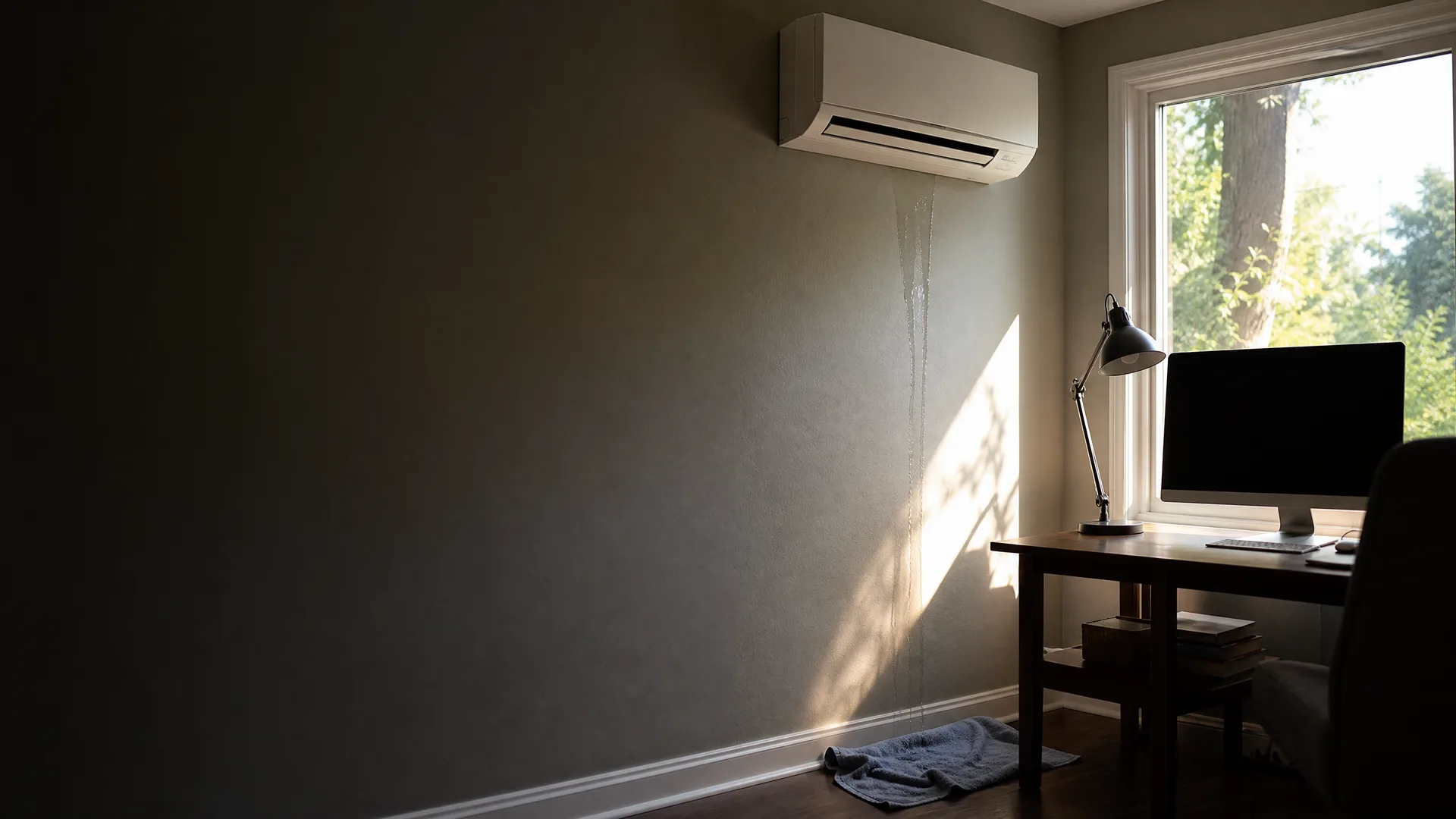
You're at your desk working through a slow afternoon when you notice the wall looks wrong under the indoor unit. A wet streak has run down from the housing, dark against the paint, pooling at the baseboard. You grab a towel and press it against the drywall, then look up at the unit still running, air coming out barely warm. Outside the sky is bright and it's warmer than it should feel this time of year for anyone expecting a real winter. You check the towel again a few minutes later. It's soaked through already, and the streak is still spreading.

Your mini split is likely still the only heat in that room. Space heaters draw a lot on one outlet, and running one for hours is not something you want to rely on through a cold night. If the unit keeps cycling without catching up, the room it serves will keep losing the race, especially after dark when the temperature drops the most.
Left alone, a mini split that won't heat usually doesn't fix itself. The part behind it, whether that's the reversing valve, the outdoor sensor, or something in the refrigerant charge, needs someone to look at it directly. That's the part you can hand off. Once you send the form, you're done calling around, done explaining the same problem to a third company, done comparing quotes against each other. Someone qualified gets in touch, and the rest of the evening is yours again.

The indoor coil senses demand and the reversing valve shifts position
Refrigerant pulls heat from the outside air even when it's cold out
Compressor pressurizes the refrigerant so it releases that heat indoors
Indoor fan pushes air across the hot coil and into the room



That mugginess doesn't go away just because the cold snap did. St. Tammany Parish holds a summer dew point around 73°F, and all that moisture in the air works its way into your mini split's coil and filter over months of cooling. By the time winter asks the system to reverse and push heat instead, it's trying to move air through a coil that's been caked since July. A clean coil pulls heat efficiently. A dirty one chokes the airflow, and that's often why the air coming out feels barely warm instead of hot.
NASA POWER T2MDEW
A mini split that won't heat usually comes down to a refrigerant problem, a reversing valve stuck in the wrong position, or a coil too dirty to pull heat from the air, and a contractor can tell you which one yours has after a look at the outdoor unit and the lines. You don't have to be the one who figures out which it is. That's the part that goes away once you send the form: no pulling up a list of contractors and guessing which ones actually work on mini splits, no calling three or four and explaining the same cold room and the same lukewarm air each time, no sitting with quotes side by side trying to tell a fair price from a markup. Someone who works on these every winter takes it from here. Your house is mild in winter, but mild still means mornings in the 40s and a room that won't catch up without help. The unit on your wall is supposed to handle that. Right now it isn't, and that's worth getting looked at before the next cold morning, not after.
Stop chasing a mini split pro