Why your mini split freezes up in Louisiana

RepairMini-splitLouisiana
Step 1 of 2

What ZIP code is the job in?

Why does my mini split keep freezing up?

Ice on the coil or on the lines running outside usually means something's blocking airflow or the system is low on refrigerant. In a Louisiana summer, with the unit running most of the day to keep up with the humidity, a mini split that's struggling doesn't just run less well, it can ice over completely and stop cooling right when you need it most.

A dirty filter or a low refrigerant charge is almost always the cause

When airflow across the indoor coil drops, usually from a clogged filter or blower, the coil gets too cold and the moisture in the air freezes onto it instead of draining away. A low refrigerant charge does the same thing by dropping the coil's temperature below where it should run. Louisiana's humidity makes this worse, since there's more moisture in the air to freeze once something goes wrong. Once ice builds up, it blocks airflow even further, so the problem feeds itself until the unit is cooling less and less. A mini split that's iced over needs the ice thawed and the actual cause, dirty filter, blocked coil, or low charge, found before it's turned back on.

A woman in a cream turtleneck sweater stands beside a large window with snow outside, looking to the side, in a dimly lit living room with a sofa, lamps, candles and framed artwork.
A woman in a light gray cable-knit turtleneck sweater stands by a window looking outside at snow, with a living room behind her containing a stone fireplace, lit lamp, framed pictures, and a sofa with a plaid throw.
A woman in a dark gray turtleneck sweater stands by a window with snow visible outside, in a dimly lit living room with a gray sofa, lamp, framed painting, and dark-framed glass door.
A woman in a cream turtleneck sweater stands by a window looking out at falling snow and snow-covered trees, with a dimly lit living room containing a sofa, lamp and fireplace behind her.

Your mini split cools by running warm room air across the evaporator coil, where the refrigerant inside pulls out the heat. That only works if air moves across the coil the way it's supposed to. A clogged filter or a blower that's lost strength slows that airflow down, and the coil gets colder than it should. Once it drops below freezing, moisture in the air starts icing up on the coil itself. That ice blocks more airflow, so the coil gets colder still, and the ice spreads down toward the line set. A refrigerant leak causes the same result through a different path: lower pressure in the coil lets the refrigerant run colder than normal, cold enough to freeze the moisture it meets. Through all of this, the thermostat only knows the room temperature. It has no way to see ice forming on the coil, so it keeps calling for cooling. With Louisiana's humidity feeding the coil extra moisture all summer, a system that's lost airflow or refrigerant can ice over faster than it would somewhere drier.

How a Mini Split Freezes

  • Warm indoor air has to pass over the evaporator coil for the refrigerant inside it to absorb heat the way it's designed to.
  • A dirty filter or a blower pulling weak airflow drops the coil's surface temperature below freezing instead of the usual cool running temperature.
  • Once ice forms on the coil, it blocks even more airflow, so the problem feeds itself and spreads down the line set.
  • A refrigerant leak drops the pressure in the coil, and low pressure lets the remaining refrigerant get cold enough to freeze moisture from the air.
  • The system still calls for cooling because the thermostat only reads room temperature, not what's happening at the coil, so it keeps running while ice builds.
  • Outdoor humidity gives the coil more moisture to pull from the air than a drier climate would, so ice can build faster once airflow drops.
A white wall-mounted mini-split indoor unit high on a beige interior wall, with a potted olive-like tree at right and an armchair and window visible through a doorway at left.
Clean filter, clear airflow, the coil stays cold but not frozen even running all day in the heat.
A wall-mounted mini-split air conditioner indoor unit with visible dust and staining, installed on a beige interior wall below white crown molding.
Dust caked over the vents chokes airflow until the coil underneath drops below freezing.
  1. Airflow drops or refrigerant runs low, and the coil starts cooling unevenly.

  2. Moisture in the air passing over the coil condenses on its surface.

  3. That moisture freezes because the coil has dropped below 32 degrees.

  4. Ice builds layer over layer, blocking airflow across the coil even more.

A dusty, stained white wall-mounted mini-split air conditioner indoor unit installed high on a plain off-white interior wall near the ceiling.
Before you get your mini split repair
A white wall-mounted mini-split air conditioner unit installed high on a beige interior wall below white crown molding, with a window and woven shade at the left edge showing green foliage outside.
After you get your mini split repair
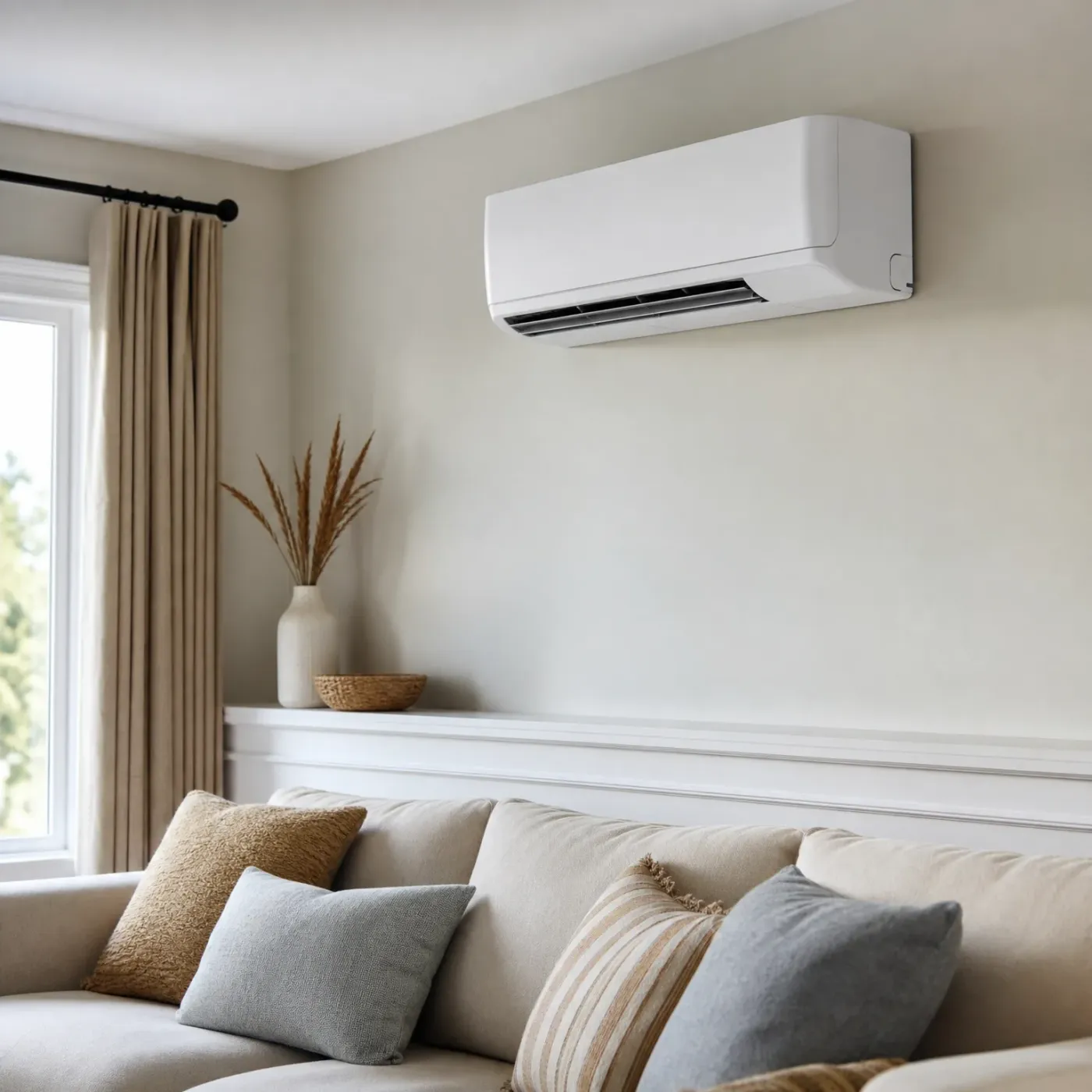
A white wall-mounted mini-split air conditioner on a pale wall above a beige sofa with assorted cushions, beside a window with long curtains and a shelf holding a vase of dried grasses and a woven bowl.

The right pro for this job

Describe what your mini split is doing once, in one form.

A local pro who knows mini splits gets your details and gets in touch.

Find a mini split pro

No fee to send it, and nothing to sign.

Airflow Freeze or Refrigerant Freeze

Airflow freeze

  • A filter clogged with dust or pet hair is the most common cause and the easiest for you to check yourself.
  • Furniture or curtains blocking the indoor unit's intake can starve the coil of warm air just as badly as a dirty filter.
  • A blower wheel caked with grime spins but moves less air than it should, so the coil still runs too cold.
  • Closed or blocked vents on a ducted system cut off the return air the coil needs to stay above freezing.
  • Clearing the blockage usually stops new ice from forming, though any ice already on the coil has to melt off first.

Refrigerant freeze

  • A slow leak in the line set lets the charge drop over months, and ice tends to show up gradually rather than all at once.
  • Low refrigerant drops pressure in the coil enough to freeze moisture even with the filter clean and airflow normal.
  • A leak needs to be found and sealed before adding refrigerant does any lasting good.
  • Ice from a refrigerant problem often forms on the outdoor line or the outdoor unit, not just the indoor coil.
  • This kind of freeze keeps coming back every few weeks until the leak itself is fixed, not just topped off.
A white wall-mounted mini-split air conditioner on a beige interior wall, with a window at left showing trees and a wooden fence, and dark wood flooring below.

Running clean

Air moves through the vents without resistance and the coil stays cold but not frozen, even with the unit running most of a Louisiana afternoon. You'll feel steady cool air and see no ice anywhere on the indoor unit or the lines outside.

A white wall-mounted mini-split air conditioner indoor unit with dark louvered vents, installed near the ceiling on a beige wall below white crown molding.

Running blocked

Dust has built up over the casing and the louvered outlet, and the air coming out feels weaker than it used to. Left alone, the coil behind that dust keeps losing airflow until it drops below freezing and starts icing over.

What are you seeing on your own unit right now

Look at the indoor unit during the hottest part of the day. Ice on the coil behind the front panel, water pooling under it, or the line set outside sweating and frosted are the signs that matter. You might notice the air coming out feels weak or barely cool even though the unit is running. Some households catch it early, turn the system off, and let it thaw before anything else happens. Left running, a frozen coil pushes the compressor to work against ice instead of refrigerant, and that strain is what turns a clogged filter into a compressor repair. If water has started dripping onto the wall or floor below the indoor unit, that's worth noting too.

A dim room with a wall-mounted mini-split air conditioner above a faint vertical stain running down the wall, a folded grey towel on the wood floor at the baseboard, and a desk with monitor, lamp, small plant and office chair by a window.

You're at the desk by the window, working through the afternoon, when you notice the wall under the mini split looks dark. You get up and find a wet streak running down the drywall, tracking toward the baseboard. The carpet underneath is already damp. You grab a towel from the hall bathroom and press it against the wall, then lay it along the floor to catch what's still coming. The unit above is still running, still blowing, but you can see a thin line of water beading at the bottom edge of the indoor unit where it meets the wall. Outside, the afternoon is thick with the kind of heat that's kept this system working since morning.


Power costs 12.52 cents per kilowatt-hour statewide

At 12.52 cents per kilowatt-hour, running your mini split hard all summer doesn't punish your bill the way it would in a lot of other states. That's worth knowing before you ice it over trying to force more cooling out of a unit that's already struggling with a dirty filter or low refrigerant.

EIA-861 2025 statewide residential average

A bearded man in a red and dark plaid flannel shirt looks out a frost-edged window at a snow-covered yard, with a gray mug on the sill in the foreground.
A bearded man in a navy t-shirt sits on a beige sofa, laughing while looking toward a laptop screen visible in the lower foreground, with a houseplant, shelves, and a framed picture behind him.

A mini split ices up for one of two reasons: something is blocking the airflow across the coil, or the system is running low on refrigerant. Either one drops the coil below freezing, and the moisture in your Louisiana air takes care of the rest. You've already checked the filter and looked at the line set outside, so you know where things stand on your unit. What you don't have to do is start hunting for someone qualified to fix it: calling around, explaining the ice and the water stain and the model number over and over to different shops, then sitting with a stack of quotes trying to figure out which one actually knows this equipment. That part ends when you ask for help here. You get matched with a contractor who takes it from there and reaches out to you, so the next call you make is the only one you need to make.

Interior living room with a white wall-mounted mini-split air conditioner high on a beige wall, a light gray sofa with cushions, a potted small tree, a stacked-stone fireplace with wood mantel and mounted TV, and a cable railing at left.

Matched to your mini split job

Get a local pro

Describe your mini split job once, to one pro.

Sending the form costs nothing.