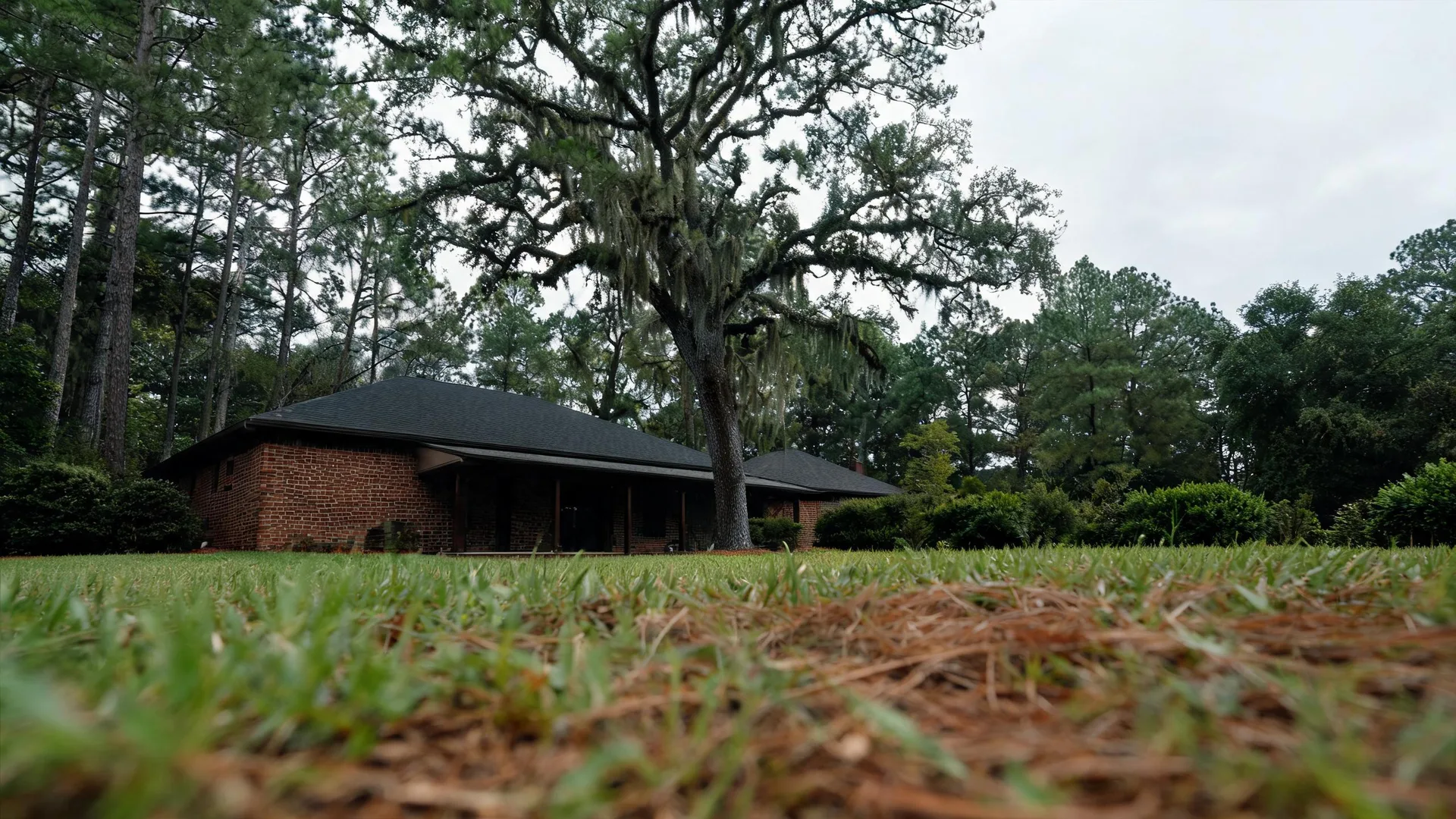





Low ground-level view across a lawn toward a single-story brick house with a dark shingled roof, framed by a large moss-draped oak and tall pine trees under an overcast sky.

AC Maintenance in Bastrop, LA

Tell us about the job

Takes about a minute. No obligation.

Tune-up, service, or cleaningCentral ACMorehouse Parish, LA
Step 1 of 2

What ZIP code is the job in?

A dirty filter is behind most service calls that could have been avoided. When airflow drops because the filter is clogged, the indoor coil can get cold enough to ice over. Once that happens the system stops cooling the house at all. The outdoor coil has its own job. It has to shed the heat pulled from inside, and when it's caked with dirt or grass clippings it can't let go of that heat the way it should, so the compressor works harder and runs longer to do the same job. The drain line is the quiet one. It carries away the water the coil pulls out of the air, and when it clogs with algae that water backs up into the pan and can shut the system down or spill out where it shouldn't. None of these fail dramatically. They just quietly make the system work harder until something gives.

5 months
May through September, your air conditioner is on duty
92°F
the average summer afternoon it cools against
17 hail events
in ten years, and hail bends the fins on outdoor coils
76 wind events
in ten years, and wind drives debris into outdoor units
Isometric cutaway illustration of a single-story house showing interior rooms with ductwork and an air handler, connected by refrigerant lines to an outdoor condenser unit on the left.
Your air conditioner works hardest from June through September.

NOAA nClimDiv, 1991–2020 normals

A system that never gets serviced doesn't break down right away, it just loses capacity a little at a time.

An AC in that state can run all day and the house still ends up warmer than the thermostat says it should be.

May is already summer here. Get the check done in April.

Cooling runs May through September
Summer afternoons average 92°F
Power costs 11.73 cents a kWh statewide

Check the filter once a month and swap it when it looks gray or matted. Hold it up to a light. If you can't see light through it, it's past due. Keep the area around the outdoor unit clear too. Give it a couple feet of space from bushes, fence lines or anything stacked against it, so air can move through the coil. After storms, clear leaves and grass clippings off the top and sides by hand. You can also rinse the outdoor coil with a garden hose, spraying from the inside out, as long as the power to the unit is off first. Inside, keep an eye on the vents and make sure furniture or rugs aren't blocking them. None of this replaces a real inspection, but it keeps the system from working harder than it has to between visits.

Summer here doesn't wait for the AC to catch up

Five months of cooling a year, with afternoons averaging 92 through June, July and August, leaves little room for a worn part to go unnoticed. Once the heat sets in, whatever was already struggling gets found fast.

Find a contractor
A gray residential air conditioner condenser unit mounted on a concrete pad in an open grass field.

Get ahead of it before the heat does

Get the inspection done before May turns into June. A technician can check the capacitor and refrigerant charge while the system is still idling along in the cooler months, not after it's been running flat out in 92 degree afternoons. A weak part found early is a quiet fix. The same part found in July is a no-cool call on the hottest day of the week.

The capacitor doesn't announce itself

A weak capacitor still starts the compressor most of the time, just slower, with more strain on the motor each time. A technician checks it with a meter and reads the actual value against what the unit calls for. There's no way to know that number by looking at the unit run.

Refrigerant charge is not a top-off

A system low on refrigerant doesn't show it anywhere a homeowner can see. It just cools less and makes the compressor work harder to get there. Checking the charge means reading pressures and temperatures at the lines, and finding out if the system is holding what it was built to hold.

An outdoor air conditioning condenser unit positioned beside a blue-sided house at sunset.

Book your AC tune-up in April, before homes here start needing cooling in May.

  1. Jan
  2. Feb
  3. Mar
  4. Apr
  5. May
  6. Jun
  7. Jul
  8. Aug
  9. Sep
  10. Oct
  11. Nov
  12. Dec

A tune-up checks the refrigerant charge, cleans the coils, tests the capacitor and tightens the electrical connections.

A real tune-up means hands on the system, not just a glance at the thermostat. A technician checks the capacitor under load and reads the refrigerant charge with gauges, not by guessing from how cold the air feels. They check the contactor too, since burnt or pitted contacts make the compressor work harder to turn on. The blower motor and wheel get inspected for wear and for dust buildup that throws off airflow even when the filter is clean. Electrical connections get tightened, because a loose wire under load creates heat that breaks parts down early. The condensate drain gets checked for flow so it can't back up later and shut the system off on its own.