Aerial view of a gray outdoor air conditioning condenser unit mounted on a concrete pad next to a house with vinyl siding.

AC Maintenance in Ruston, LA

Tell us about the job

Takes about a minute. No obligation.

Tune-up, service, or cleaningCentral ACLincoln Parish, LA
Step 1 of 2

What ZIP code is the job in?

Change the filter yourself

A dirty filter is the one thing a homeowner can check without any tools. Pull it out and hold it up to a light. If you can't see through it, swap it. A clogged filter starves the coil of airflow and makes the whole system work harder than it should.

Leave the rest to the contractor

The refrigerant charge, the capacitor, the condenser coil and the electrical connections need a gauge set and some training to check safely. Opening the outdoor unit or poking at wiring without that training can damage the compressor or cause a shock. Keep the area around the outdoor unit clear of leaves, grass clippings and anything that blocks airflow, and leave the rest to a technician.

5 months
May through September, your air conditioner is on duty
92°F
the average summer afternoon it cools against
16 hail events
in ten years, and hail bends the fins on outdoor coils
51 wind events
in ten years, and wind drives debris into outdoor units
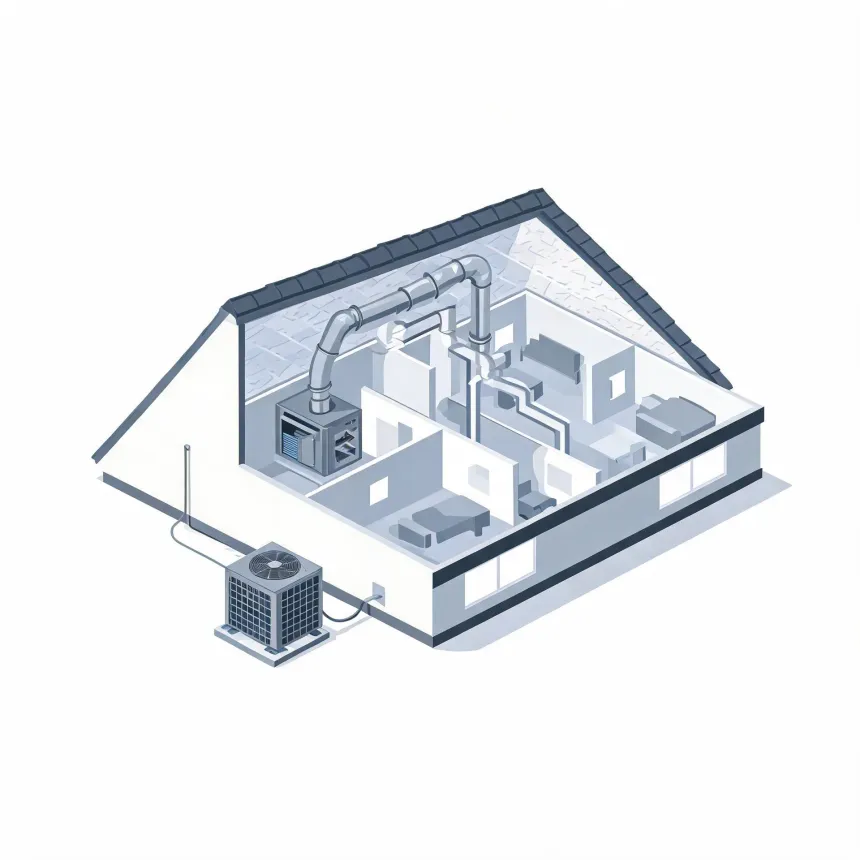
Isometric illustration of a cutaway house showing interior rooms, an attic furnace with large ducts, and an outdoor condenser unit connected by a line set, on a white background.
Your air conditioner works hardest from June through September.

NOAA nClimDiv, 1991–2020 normals

A dirty coil can't shed heat, so the compressor runs longer to reach the same temperature.

A clogged drain backs up and spills water right where the air handler sits.

May is month one, not warm-up. Have it checked in April.

Cooling runs May through September
Climate zone 3A
Power costs 11.73 cents a kWh statewide

Your AC runs about five months straight here, May through September, with afternoon highs averaging 92 in June, July and August. That's not a few hot afternoons. It's a long stretch where the system can't just coast. A worn capacitor or a weak contactor that might hold on through a mild season starts showing up fast once the compressor is running that hard, that often. Parts don't fail on a schedule, but they fail sooner under that kind of load.

Your system is young. Keep it that way.

Half the homes in Lincoln Parish were built in 1984 or later, so there's a good chance your system still has plenty of working life left in it. A yearly check before the heat sets in is what keeps it that way.

Find a contractor
A man in a cap, dark shirt and tan work pants walks up porch steps toward a green front door, carrying a canvas tool bag at his side, with a potted shrub beside the entry.
An outdoor air conditioning condenser unit mounted on a concrete pad beside a house, with electrical conduit running to a wall-mounted disconnect box.

Get ahead of a season that doesn't let up

Five months of that kind of load adds up. A capacitor or contactor checked before May is one a technician can catch before it lets go. Waiting until the unit is already struggling in July or August means a service call during the stretch you need the system working most.

Small problems don't stay small

A refrigerant charge that's a little low doesn't fix itself. The compressor keeps working against it, drawing more current than it should, and the strain wears it down faster. What would have been a quick adjustment turns into a compressor replacement, and the compressor is the part the whole system depends on.

The breakdown always comes at the worst time

A system that's neglected tends to fail under load, not sitting idle. That means the afternoon it's working hardest is the afternoon a weak part finally gives out. A yearly check catches a capacitor or contactor losing strength before it leaves the system down on the day it's needed most.

Aerial view of a gray central air conditioning condenser unit on a concrete pad next to a house with vinyl siding.

Book your AC tune-up in April, before homes here start needing cooling in May.

  1. Jan
  2. Feb
  3. Mar
  4. Apr
  5. May
  6. Jun
  7. Jul
  8. Aug
  9. Sep
  10. Oct
  11. Nov
  12. Dec

A tune-up checks the refrigerant charge, cleans the coils, tests the capacitor and tightens the electrical connections.

A tune-up starts with the coils. The condenser coil outside and the evaporator coil inside both need to be clean, because a coil coated in dust or grime can't move heat the way it's supposed to, and that makes the compressor run longer for the same result. From there it's the refrigerant charge, checked against the manufacturer's spec with gauges, since too little or too much both make the compressor work harder than it should. The capacitor and contactor get tested under load, not just looked at, because a capacitor can read fine sitting still and still be too weak to start the compressor reliably. The condensate drain gets cleared so it isn't sitting there waiting to clog the first humid week. Electrical connections get checked for corrosion and tightened, since a loose connection is what turns into a burnt wire later. None of this takes long when the system's healthy. It takes longer, and matters more, on a system that's been running hard without it.