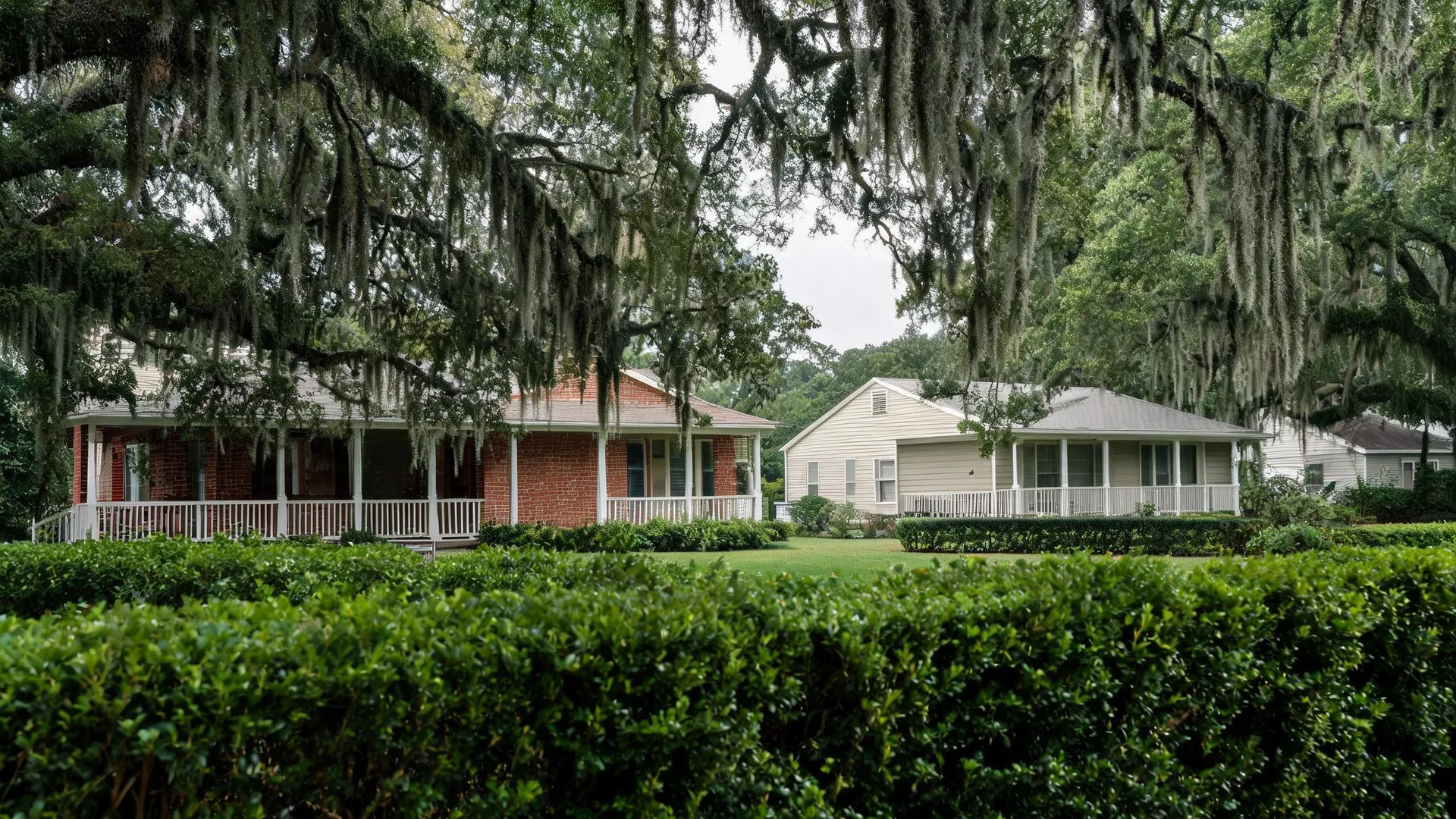
A single-story brick house with a white-columned wraparound porch and a neighboring light-colored siding house, seen across a lawn behind a trimmed hedge, under oak branches draped with Spanish moss.

AC Repair in Slidell, LA

Tell us about the job

Takes about a minute. No obligation.

RepairCentral ACSt. Tammany Parish, LA
Step 1 of 2

What ZIP code is the job in?

Seven months of runtime

Air conditioners in St. Tammany Parish run from April through October, with afternoon highs averaging 91°F in June, July and August. The dew point averages 73°F those same months, higher than most US counties get. A system here doesn't get much of a break, and all that runtime adds up on the compressor, the fan motor and every part that cycles with them.


What that means for the repair

When a part wears out faster than it should, the heavy runtime is usually part of the reason why. A proper diagnosis finds what actually failed and why, not just the symptom you're noticing. That's what makes the fix hold up through the next stretch of summer instead of failing again in a month.

7 months
April through October, your air conditioner is on duty
91°F
the average summer afternoon it cools against
24 hail events
in ten years, and hail bends the fins on outdoor coils
88 wind events
in ten years, and wind drives debris into outdoor units
Isometric line illustration of a cutaway single-story house showing interior rooms, ceiling ductwork and an air handler, connected to an outdoor condenser unit on a pad beside the building.
Your air conditioner works hardest from May through September.

NOAA nClimDiv, 1991–2020 normals

Half the homes in St. Tammany Parish were built in 1995 or later.

A system that came with a newer house usually hasn't logged enough hours to be worn out, so repair is the right call before anyone talks about replacing it.

Storms come through here more than most places, and they leave the outdoor unit exposed

146 severe weather events from 2015 to 2024
49% of homes statewide lost power a day or more in 2024
88 damaging wind events from 2015 to 2024
A Broken AC Costs You Every Day It Runs WrongElectricity here runs 12.80 cents per kilowatt-hour, cheap for the country, but a system struggling through the summer still runs up the bill every day it's not fixed.

March is worth paying attention to. Cooling starts up in April and runs through October, seven months straight. A part that was already weak at the end of last season has just been sitting since, and sitting doesn't fix anything. Once the first real heat hits, the compressor and fan motor take the load right away, and that's usually when a weak part gives out. Getting the system looked at in March, before that first stretch of heat, catches the problem while it's still just a problem.

Get it diagnosed right, and the fix will hold

Get the system checked now and a tech can find what's actually worn before it fails outright. A repair done on a correct diagnosis holds up. One done on a guess usually doesn't.

Find a contractor
A man in a cap, dark long-sleeve shirt and tan work pants carries a leather tool bag up porch steps toward a green front door, with a potted flowering plant beside him.
A gray metal air conditioning condenser unit mounted on a concrete pad in a flat grassy field under a partly cloudy sky.

Running it longer doesn't buy you time

A refrigerant leak doesn't stay small on its own. Low refrigerant means the compressor runs low on lubrication too, since the oil travels with it through the lines. Run it that way for a week and it's a worn compressor. Run it for a month and it can be a dead one. A failing capacitor works the same way in a different direction. Once it weakens, the compressor draws harder to start and harder to keep running, and that extra strain doesn't undo itself overnight. A dirty coil ices over, and a system running on a frozen coil pushes warm air while the compressor keeps trying to do its job behind it. Every one of these starts as a single part. None of them stay that way if the system keeps cycling on a schedule it can't actually meet.

What a struggling system sounds and feels like

Warm air out of the vents, short cycling, or the unit running nonstop without catching up are the usual complaints. Sometimes it's a smell when the system kicks on, or a hissing or grinding noise that wasn't there before. A puddle under the indoor unit usually means a clogged drain line or a frozen coil that's now thawing. None of these mean the same thing every time, but each one points a tech toward a specific part before they ever pull a panel off.

Why waiting costs more than the repair itself

A compressor straining against a bad capacitor doesn't stop, it just works harder and pulls more current doing it. A refrigerant leak left alone lets the compressor run low on lubrication, which wears it out faster. Most of what starts as a single worn part stays a single worn part if it gets caught. Left running, that same part can take the compressor down with it, and the compressor is the most expensive thing in the unit.

Overhead view of an air conditioning condenser unit on a concrete pad next to a house with asphalt shingle roofing and vinyl siding.

A new air conditioner would cut about $70 a year off cooling for a typical St. Tammany Parish home.

  • A new one at the federal minimum, 14.3 SEER2$450 a year
  • An older air conditioner$520 a year

Estimates for a typical St. Tammany Parish home, compared with an older unit built to the previous federal minimum, from EIA household energy data, Louisiana fuel prices and NOAA climate normals. Your home will differ.

Repair makes sense when a part like a capacitor or contactor has failed.

Replacement makes sense when the compressor has failed or the system uses R-22 refrigerant, which is no longer made.

Repair versus replacement comes down to what actually failed and what else is left in the unit. A capacitor, a contactor, a blower motor, these fail on their own without taking anything else down with them, and swapping the part solves it. The compressor is different. It's sealed, it's expensive, and when it fails the usual cause is something else that went wrong first and ran too long before anyone caught it. So the question isn't just what broke, it's whether what broke damaged anything around it on the way down. A tech checks refrigerant levels, electrical draw, and how the rest of the system responds before calling it one part or the whole unit. If the compressor's still healthy, you're fixing a part. If it's not, replacing the part alone won't hold.