



Two illuminated white colonial-style houses with wrap-around porches, flanked by oak trees draped in Spanish moss, photographed at night.

Heat Pump Repair in Abbeville, LA

Tell us about the job

Takes about a minute. No obligation.

RepairHeat PumpVermilion Parish, LA
Step 1 of 2

What ZIP code is the job in?

Vermilion Parish saw 36 severe weather events between 2015 and 2024. Most of that was damaging wind, 22 times in that span, with 8 hail events and 3 tornadoes mixed in. The outdoor unit sits outside through all of it, taking whatever the wind throws at the coil and cabinet. A unit can take a hit and keep running for months before the real problem shows up. If yours came through a storm with debris around it or dents on the cabinet, that's worth having looked at even while it's still blowing cold air.

5 months
November through March, your system heats
7 months
April through October, it cools
46°F
the average winter night it heats against
90°F
the average summer afternoon it cools against
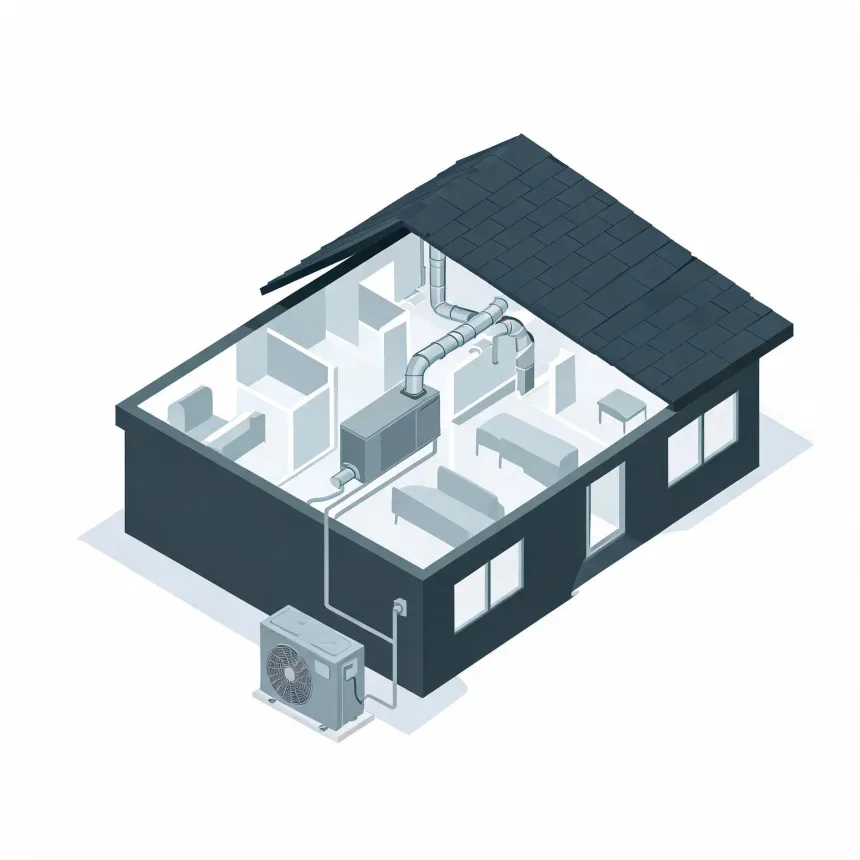
Isometric cutaway illustration of a single-story house showing interior rooms, ceiling ductwork connected to an air handler, and an outdoor condenser unit linked by a line set.
Your system heats November through March and cools April through October.

NOAA nClimDiv, 1991–2020 normals

The dew point here averages 74 degrees all through June, July and August.

A heat pump pulling that much moisture out of the air all summer wears sooner than one working a dry climate.

Built to Take a Hit, Then Keep RunningHeat runs here from November through March, and most repair calls come in the first cold snap.

Call someone who will actually check the coil and the refrigerant charge rather than guessing from a service truck checklist. A system running that hard all summer to keep up with the humidity can lose efficiency slowly, and a tech who only glances at it might miss a charge that's a little low or a coil that's starting to foul. Ask what they found, not just what they did. If the diagnosis makes sense given how much moisture this unit has pulled out of the air, the fix is more likely to hold.

Storm-Damaged Unit Still Running? Get It Checked

If your outdoor unit came through a storm with dents in the cabinet or debris packed around the coil, get it looked at now, even if it's still running. Damage like that doesn't always show up as a problem right away.

Find a contractor
A man in a cap, gray shirt and jeans, seen from behind, carries a canvas tool bag up porch steps toward a green front door flanked by potted shrubs.
A gray heat pump outdoor unit mounted on a concrete pad next to a residential house with lap siding and stone accents.

What Actually Wears Out

A heat pump runs in both directions, so its parts wear in both directions too. The reversing valve is the one piece that's unique to this machine, and it's also a common point of failure. It can stick partway through a switch, or fail to seat fully, and when it does the system may blow air that's not as hot or cold as it should be, or it may run and run without catching up. The compressor is the heart of the system, and most compressor failures trace back to something else going wrong first, low refrigerant, a failing capacitor, or restricted airflow that makes it work harder than it was built to. The outdoor fan motor and the capacitor that starts it wear from heat cycling on and off thousands of times a year, and a weak capacitor often announces itself as a fan that hums but won't spin, or spins slow and struggles. Refrigerant doesn't get used up, so if a system runs low it's because it's leaking somewhere, usually at a coil joint or a fitting, and that loss shows up first as weaker heating or cooling, then as ice forming on the outdoor coil. That coil itself can also just get dirty enough to choke airflow, and a coil caked with debris makes the whole system work harder to move the same amount of heat. None of these fail on a set schedule. They fail when a part finally gives out after enough hours of running, and a system that runs more hours a year simply reaches that point sooner.

What a Failing Heat Pump Sounds and Feels Like

Air coming from the vents that's lukewarm instead of hot or cold is the first thing most people notice, especially if the system runs longer than it used to without catching up. A clicking sound at the outdoor unit when it tries to start, then quiet, usually means a capacitor isn't giving the motor the push it needs. Ice on the outdoor coil in any season means something is wrong, not just in winter. A hissing or bubbling sound near the lines can mean refrigerant escaping at a fitting. Short cycling, where the system kicks on and off every few minutes instead of running a full cycle, puts extra wear on the compressor every time it happens.
What's Worth a Call and What Can Wait

A system still blowing air, even if it's weaker than it should be, can usually wait a day or two for a scheduled visit. A system that won't start at all, trips a breaker repeatedly, or smells burnt at the vents needs attention now, before a small failure turns into a compressor replacement. Weak airflow alone is often just a dirty filter or a blocked outdoor coil, cheap to fix if caught early. The same weak airflow left alone forces the compressor to work past what it was built for, and that's the part nobody wants to replace.

Age matters more than any single symptom. A heat pump that's ten or more years in usually has a cabinet full of original parts, all of them worn down together, so fixing the one that just failed often means the next one is close behind. A system a few years old with one bad part is a different case. A failed capacitor or a stuck reversing valve on a younger unit is a repair, not a reason to start over. The compressor is the line that matters most. If a contractor tells you the compressor itself is failing, get a second opinion on replacement cost before fixing it, since a compressor swap on an old system can run close to what a new system costs. Ask how many repairs that unit has needed in the past couple years. A system that keeps coming back for different reasons is telling you something a single repair bill won't.