





Single-story houses with beige siding and a brick building set on a mown lawn behind a trimmed hedge, framed by large oak branches draped with Spanish moss.

Heat Pump Repair in Houma, LA

Tell us about the job

Takes about a minute. No obligation.

RepairHeat PumpTerrebonne Parish, LA
Step 1 of 2

What ZIP code is the job in?

A heat pump in Terrebonne Parish switches over to heat in November and runs that way through February. March does the same job in reverse, the month before cooling starts in April. Whichever changeover is coming next, that first cold snap or first hot stretch puts load on parts that sat idle a while. A weak capacitor or a contactor that was already marginal tends to fail right then, not in the middle of the season. If your heat pump is acting up as the weather turns, that timing is probably not a coincidence.

4 months
November through February, your system heats
7 months
April through October, it cools
48°F
the average winter night it heats against
90°F
the average summer afternoon it cools against
Isometric cutaway illustration of a small house showing interior rooms with furniture, an indoor air handler with flexible ducting, and refrigerant lines running to an outdoor condenser unit beside the building.
Your system heats November through February and cools April through October.

NOAA nClimDiv, 1991–2020 normals

Half the homes in Terrebonne Parish were built in 1983 or later.

A heat pump that came with a newer house still has working life left in it, and that favors fixing what's wrong over replacing it.

Terrebonne Parish sees storms most places don't, and the outdoor unit is sitting outside for all of it.

53 severe weather events from 2015 to 2024
49% of homes statewide lost power a day or more in 2024
28 damaging wind events from 2015 to 2024

A heat pump that's struggling still moves heat, so it's easy to let it run while you wait and see. That's usually the wrong call. A refrigerant leak gets worse under continued operation, and running low charge through the compressor wears it in a way that doesn't reverse. A failing capacitor makes the compressor draw harder on startup each time it cycles, and every cycle brings it closer to taking the compressor out with it. Ice on the outdoor coil blocks airflow, and a unit forced to run against that ice puts more strain on the compressor than if it had been shut off and let thaw. None of this means panic over every odd noise, but a system that's clearly off should get looked at before the next heat or cool cycle runs it harder.

Storm damage to a heat pump doesn't always stop it. It just sets up the next failure.

If your outdoor unit has been through a storm this year, hail or flying debris can bend the fins or nick the coil without stopping the system outright. It'll keep running, worse, until something else gives. Worth having it looked at now, before the next cold snap or hot stretch puts load on whatever got weakened.

Find a contractor
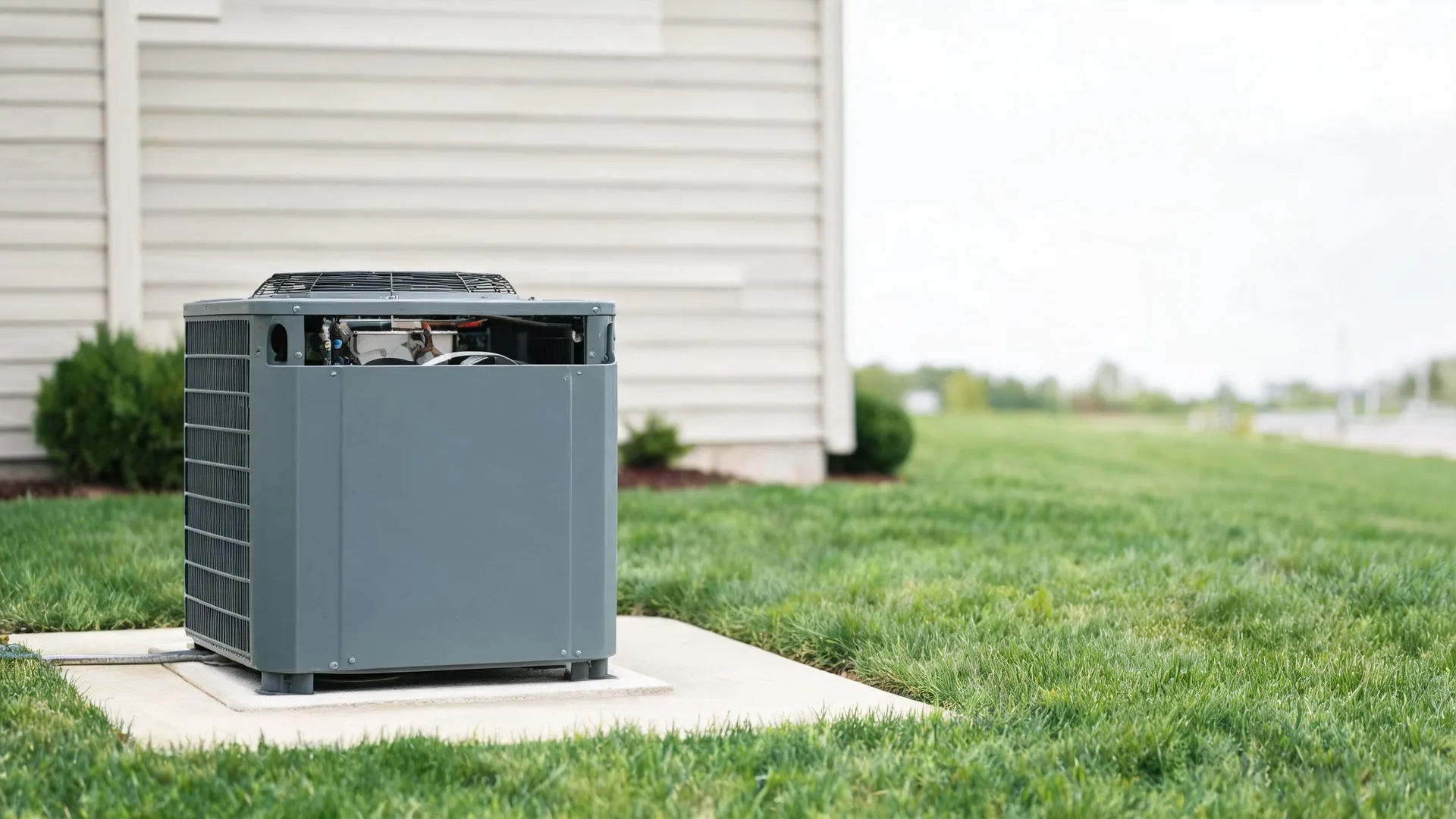
A gray outdoor HVAC unit mounted on a concrete pad beside a house with gray lap siding and a stone foundation.

What to check before the call

Before you call anyone, walk outside and look at the unit. Check that the outdoor fan spins freely and isn't rubbing or grinding. Look at the coil for anything blocking it, leaves, grass clippings, a tarp, ice that didn't melt off between cycles. Inside, pull the filter and hold it up to a light. If you can't see light through it, that's airflow the system isn't getting, and it'll run harder because of it. Check the thermostat batteries and make sure it's actually set to call for heat or cool, not sitting in some mode it got bumped into. Look at the breaker panel for anything tripped. None of this fixes a bad capacitor or a refrigerant leak, but it rules out the easy stuff before a technician gets there, and it gives them a clearer picture of what the unit was doing when it started acting up.

It's blowing air that isn't the right temperature

A heat pump that runs but puts out air close to room temperature, or even a little cool on a heat call, is usually stuck partway through a cycle, low on charge, or stuck in defrost and not switching back over. The fan moving air doesn't mean the system is actually heating or cooling it.
It's short cycling or won't stop running

A unit that kicks on and off every few minutes is tripping a safety switch somewhere, often on high pressure or an overheating compressor. One that runs constantly without ever satisfying the thermostat is losing the fight against a leak or a frozen coil. Either pattern means a part is already failing, not about to.

Most heat pump failures trace back to a handful of parts, and they fail for ordinary reasons that have nothing to do with how old the house is. The reversing valve is the one part that's unique to a heat pump, and when it sticks, the system keeps blowing air but stops switching between heat and cool. Capacitors weaken with age and heat cycling until they can't kick the compressor or fan motor over, so starts get harder until one doesn't take. Contactors pit and burn from the arcing that happens every time they open and close, and eventually they stop making contact at all. The compressor itself usually isn't the first thing to fail. It's the thing that fails after something else was ignored, a low charge, a bad capacitor, restricted airflow, for long enough. None of these show up as one obvious symptom. They show up as the system working harder, running longer, or doing part of its job and not the rest, and a part going bad this way is usually worth replacing on its own rather than a reason to replace the whole unit.

A diagnostic visit starts outside at the unit itself, not with a clipboard. A technician checks refrigerant pressures, because that number says more about what's wrong than anything the system is doing visibly. They'll test the capacitor under load rather than just looking at it, since a capacitor can look fine and still be weak. Electrical connections get checked at the contactor, because a connection that's pitted or loose shows up as a symptom somewhere else entirely, like a compressor that hums but doesn't start. Airflow gets checked too, across the coil and through the filter, since a system can have good refrigerant charge and still underperform if it isn't moving enough air. The point of all this is to find the part that's actually failing, not just the part that's making noise about it.