





A tall red brick wall with a row of shrubs runs along the left side of a mown lawn, with a single-story light-colored house and tall pine trees in the background under an overcast sky.

Heat Pump Repair in Laplace, LA

Tell us about the job

Takes about a minute. No obligation.

RepairHeat PumpSt. John the Baptist Parish, LA
Step 1 of 2

What ZIP code is the job in?

St. John the Baptist Parish saw 22 severe weather events between 2015 and 2024. Most of that was wind and tropical systems, with 10 damaging wind events and 6 tropical storms or hurricanes in that stretch, plus 5 tornadoes. The outdoor unit sits outside through all of it, taking whatever gets thrown at it. Hail is rare here, just 1 event in ten years, but wind-driven debris is not. A bent fin or a cracked fan blade does not always stop a heat pump from running, so it can keep working for weeks while it struggles to move air. If a storm has come through, have the unit looked at even if it still turns on.

5 months
November through March, your system heats
7 months
April through October, it cools
44°F
the average winter night it heats against
91°F
the average summer afternoon it cools against
Isometric cutaway illustration of a single-story house showing interior rooms with furniture, an attic duct network connected to a furnace or air handler, and an outdoor condenser unit linked by lines outside the wall.
Your system heats November through March and cools April through October.

NOAA nClimDiv, 1991–2020 normals

Half the homes in St. John the Baptist Parish were built in 1984 or later.

A heat pump that came with a newer house still has working life in it, and that's worth repairing.

That dew point means your heat pump barely gets a break

Climate zone 2A
Power here costs 11.79 cents per kilowatt-hour
Cooling runs April through October

March is the month to get a heat pump looked at here. Homes in the parish start cooling in April and keep it running through October, seven months straight. Whatever strain the unit took over the summer and whatever weight it carried through winter nights near 44°F shows up the first hot week, not before. A weak part can sit quiet all through a mild winter and then fail the day the load jumps. If yours struggled last summer or has been off more than it's been on these past few months, have it checked before April, not after it quits on the first humid day.

After the storm passes, have the unit checked before you trust it

If a storm has come through since the unit last ran well, get it looked at before trusting it again. A bent fin or cracked blade won't always stop it from turning on, but it can run weeks like that. Outages matter too, with nearly half of Louisiana households going a day or more without power last year. A heat pump that's due for a check should get one before the next outage, not after.

Find a contractor
A man in a dark cap, navy long-sleeve shirt and tan work pants walks up porch steps toward a green front door, carrying a worn canvas tool bag in his right hand.
A dark gray heat pump unit mounted on a concrete pad next to a house with gray siding and a stone veneer wall.

The house being newer tells you something about the unit

If your heat pump came with the house, and the house is one of the newer ones here, there's no reason to think about replacing it when something goes wrong. A compressor or a coil doesn't wear out from one hard summer. What usually fails on a heat pump that age is a single part, a capacitor or a contactor or a fan motor, and swapping that part is a repair, not a reason to start over. Ask whoever comes out how old the unit actually is before you let anyone talk replacement.

What you can check yourself

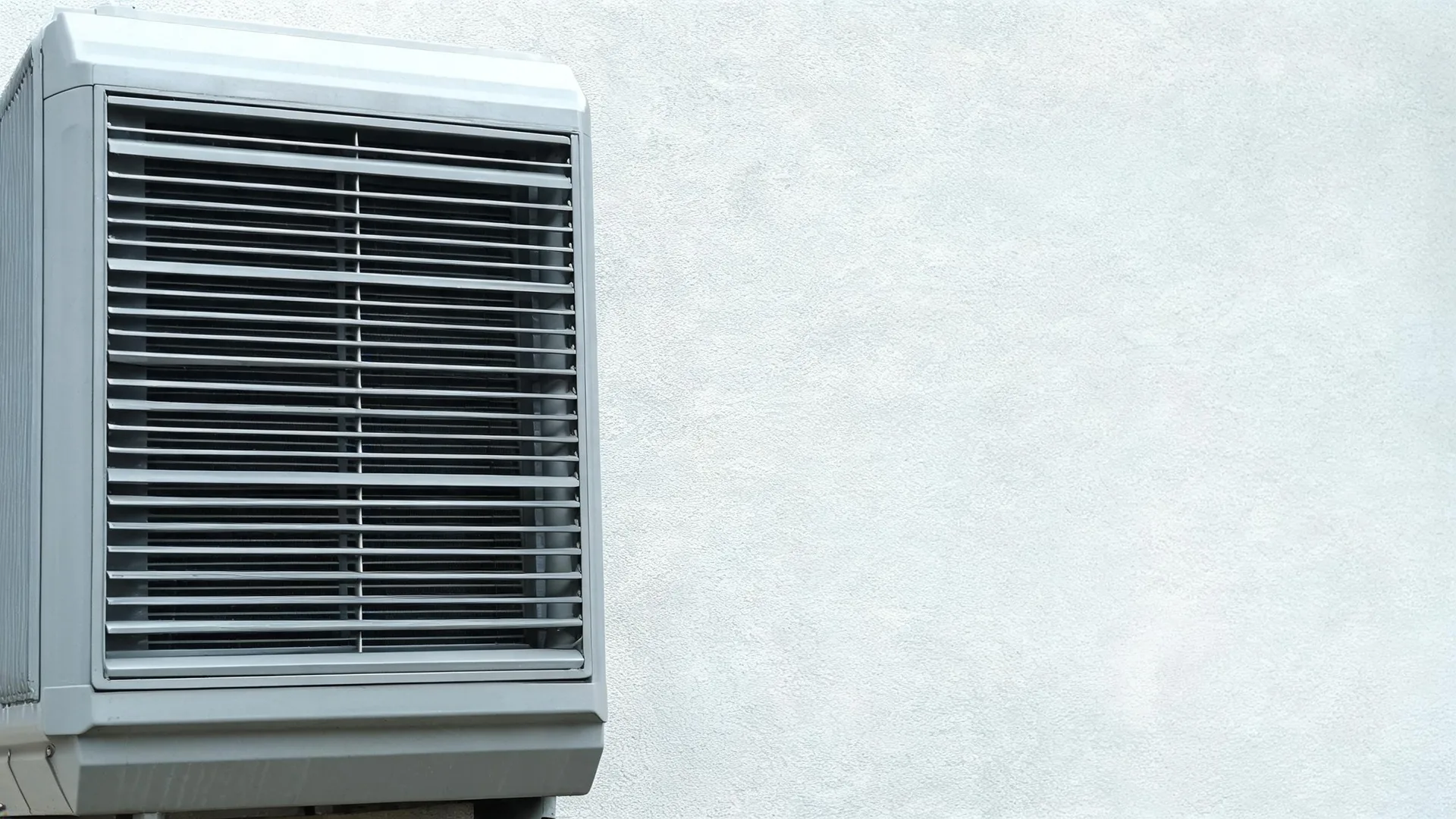
Look at the thermostat first. Make sure it's set to the mode you want and the temperature is actually calling for cooling or heat. Check the breaker for both the indoor air handler and the outdoor unit, since a tripped breaker will shut the whole system down with no other sign. Pull the air filter and hold it up to a light. If you can't see through it, that alone can make a heat pump run weak or freeze up. Walk outside and look at the unit. Leaves, grass clippings or a fallen branch sitting against the coil will block airflow, and clearing that space around it is safe to do yourself.
What to leave alone

If the outdoor unit is covered in ice, don't chip at it or run anything to force it off. Switch the thermostat to fan only and let it thaw, since digging at a frozen coil can bend fins or puncture the lines behind them. Don't open the electrical panel on the unit or touch the wiring inside it. A heat pump holds a charge in its capacitor even with the power off. If the system is making a grinding or screeching noise, turn it off at the thermostat and leave it off. Running a bad motor or bearing to see what happens usually turns a repair into a replacement.

A heat pump works in both directions all year, and that's what wears it differently from a straight air conditioner. The reversing valve is the part unique to this machine, and it's often the first thing to act up, sticking in one position so the system blows the wrong temperature air or won't switch over at all. The outdoor coil earns its keep too, since it has to shed frost in heating mode and reject heat in cooling mode, and a defrost control board that fails leaves the coil iced over and the unit struggling to do either. Capacitors wear out on a schedule of their own, weakening slowly until the compressor or fan motor can't start on a hot or cold morning. A contactor can also stick or burn its contacts from years of cycling, which either keeps the outdoor unit running when it shouldn't or stops it from starting at all. None of these are failures of the whole machine. Each one is a single part doing its job until it doesn't, and replacing that part is what brings the system back.

Your heat pump already runs harder here than a straight air conditioner would, since it's working the coil and the reversing valve in both directions all year. That's the wear this page keeps pointing at, and it's usually what's behind whatever brought you here. A part worn down that way doesn't always announce itself. The system can run weak for weeks, short cycle, or blow lukewarm air while still technically working. Have whoever comes out find the actual part before anything gets replaced. A capacitor or a contactor is a straightforward fix. Guessing at the problem, or replacing parts that aren't worn yet, is how a repair turns into money spent twice.