Night view of illuminated white Southern-style houses with wraparound porches beneath Spanish moss-draped oak trees.

Heat Pump Repair in Ruston, LA

Tell us about the job

Takes about a minute. No obligation.

RepairHeat PumpLincoln Parish, LA
Step 1 of 2

What ZIP code is the job in?

The reversing valve sticks or fails

A heat pump's reversing valve is what switches it between heating and cooling, and it takes a beating doing that job year after year. When it sticks, the system can get stuck in one mode, blow air that's not the right temperature, or run constantly without catching up. This part lives under real stress every time the system changes direction, so it's one of the first things a tech checks when a heat pump stops heating right.

The outdoor coil can't do its job

The outdoor coil has to shed heat or absorb it depending on the season, and anything coating it, from dirt to a layer of ice that won't clear, cuts it off from the air it needs. A failed defrost control or a bad sensor can leave frost built up with no way to melt off. Once that coil is blocked, the whole system struggles, and it shows up as weak heat, ice you can see, or a unit that runs without warming the house.

5 months
November through March, your system heats
5 months
May through September, it cools
37°F
the average winter night it heats against
92°F
the average summer afternoon it cools against
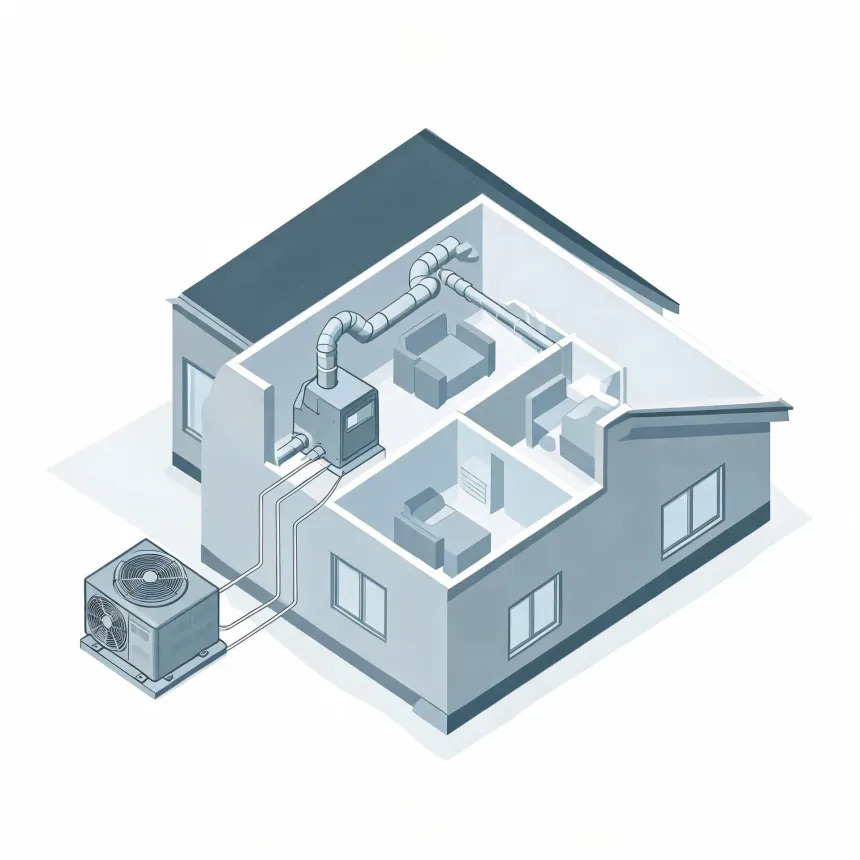
Isometric cutaway illustration of a two-room house showing an indoor air handler with ductwork connected by lines to an outdoor condenser unit on a pad.
Your system heats November through March and cools May through September.

NOAA nClimDiv, 1991–2020 normals

Heat pumps in Lincoln Parish switch over to heat in November.

A reversing valve or defrost control that was already weak usually gives out in the first cold weeks of November, not in the middle of winter.

Half the homes in Lincoln Parish were built in 1984 or later, so your heat pump likely still has years left in it

Half the homes here were built by 1984
Power costs 11.73 cents a kWh statewide
Climate zone 3A

A heat pump that's otherwise kept up is usually worth repairing. Most calls come down to one part failing, the reversing valve, the defrost board, a capacitor, and swapping that part brings the whole system back rather than just patching a symptom. What changes the math is the compressor. That's the part that actually moves the refrigerant and does the real work of heating and cooling, and it's sealed inside the unit rather than bolted on where a tech can swap it out easily. A compressor failure means the unit itself has reached the end of its working life, not just a part on it. So the question a tech is really answering isn't just what broke, it's whether what broke is a part the system depends on or the system itself.

Get the repair done, not a replacement quote

If your heat pump came with a newer house here, it's not a system near the end of its life. A stuck reversing valve or a bad defrost board is a repair, not a reason to replace the unit. Get a tech out to find the part that failed.

Find a contractor
A man in a dark T-shirt and tan work pants carries a canvas tool bag up wooden porch steps toward a green panelled front door, with a potted shrub beside the entry.

Warm air that isn't warm

A heat pump in trouble shows it fast. Air comes out of the vents feeling cool instead of warm, or the system runs without end and the house never catches up. Short cycling, where it kicks on and off in quick bursts, is another sign something's wrong rather than something to ride out.

Frost and noise worth mentioning

Ice on the outdoor unit that doesn't melt off, or a hard clunk when the system tries to switch between heating and cooling, both point to a specific part struggling to do its job. Telling a tech when it started and what it sounds or feels like helps narrow down whether it's the reversing valve, the defrost control, or something else.

Before calling anyone, check the thermostat is set to heat and the temperature you want is actually above room temperature. It sounds obvious, but a setting bumped by accident wastes a service call. Go outside and look at the unit itself. If the outdoor coil is caked in ice or buried under leaves and debris, that alone can stop it from heating right, and clearing loose debris away from the cabinet is safe to do yourself. Check the air filter too. A clogged filter starves the system of airflow and can mimic a much bigger problem. Walk around the house and check that vents aren't blocked by furniture or rugs. None of this fixes a bad reversing valve or a failed defrost board, but it rules out the simple stuff before a tech has to.

A tech starts outside, watching the unit run through a full cycle before touching anything. They'll check the pressures on the refrigerant lines, since a system low on charge or struggling to move refrigerant shows up right there on the gauges. From the thermostat, they can force a call for heat or defrost and watch whether the reversing valve actually throws when it's told to. If the outdoor coil has frost that isn't clearing, they're checking the defrost board and the sensor that tells it ice has built up, not just assuming the board is bad. Electrical readings on the capacitor and the compressor's start components come next, since a part can look fine and still be failing under load. By the time they're done, they're not guessing which part is the problem. They know, and they can show you the reading that proves it.