




A red brick single-story house with a covered porch and a nearby cream-colored house with a wraparound porch, seen across a lawn behind a trimmed hedge, framed by large moss-draped oak branches.

Heat Pump Repair in Shreveport, LA

Tell us about the job

Takes about a minute. No obligation.

RepairHeat PumpCaddo Parish, LA
Step 1 of 2

What ZIP code is the job in?

Caddo Parish saw 419 severe weather events between 2015 and 2024. That includes 279 cases of damaging wind and 101 hail events, along with 29 tornadoes. A heat pump's outdoor unit sits outside through all of it, with its coil and fan exposed to whatever blows through. Hail dents the coil fins and debris can bend them or crack the fan blade, and a unit can keep running for a while after taking that kind of hit. If yours has been through a storm, it's worth having someone look at it even if you haven't noticed a problem yet.

5 months
November through March, your system heats
6 months
May through October, it cools
38°F
the average winter night it heats against
93°F
the average summer afternoon it cools against
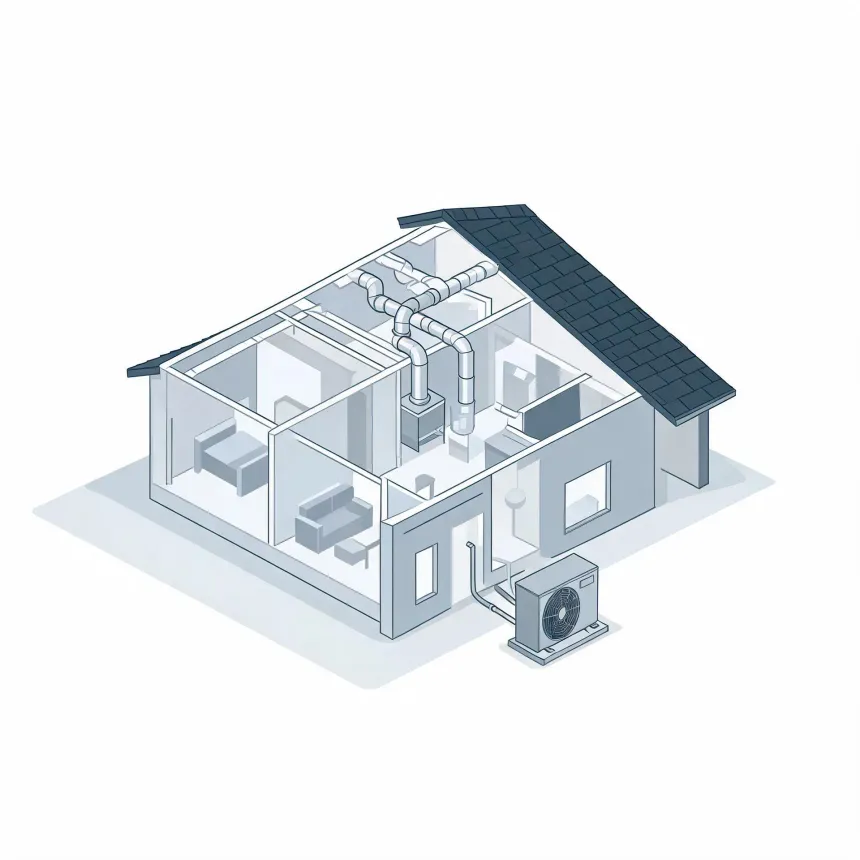
Isometric line illustration of a cutaway house showing interior rooms with furniture, ceiling ductwork connected to an indoor air handler, and an outdoor condenser unit linked by refrigerant lines.
Your system heats November through March and cools May through October.

NOAA nClimDiv, 1991–2020 normals

The dew point here runs 70°F through June, July and August, heavier than most of the country ever sees.

A heat pump pulling that moisture out of the air all summer is working harder than most units ever have to.

The first cold snap in November and the first hot stretch in May are when a weak heat pump quits.

Cooling runs May through October
Heat runs November through March
279 damaging wind events from 2015 to 2024

If your heat pump has been running rough, storm wear is a fair guess before anything else. Wind and hail have already been through here plenty of times, and a coil that took a hit a year ago can still be the reason it's short cycling now. A tech can check the coil fins, the fan blade, and the refrigerant charge to see if that's what's going on. Fixing the actual cause matters more than resetting the thermostat and hoping it holds. A unit that's been fighting bent fins or a slow leak all summer is already worn down more than one that hasn't, so the repair needs to account for that, not just patch the symptom.

Had storm damage? Get the heat pump checked before it fails you

If your outdoor unit took wind or hail in the last few years and nobody's inspected it, a rough patch now may be the same damage finally catching up. Louisiana households losing power for a day or more isn't rare either, so a unit that's struggling is one less thing you can count on when the weather turns.

Find a contractor
A white mini-split heat pump outdoor unit mounted on a concrete pad beside a gray-sided house, surrounded by gravel and green shrubs.

Running double duty, year round

A heat pump runs in both directions, all year, and that doubles up the parts that can wear out. The reversing valve is the one piece that's unique to a heat pump, and it's also a common failure point. It's what switches the system between heating and cooling, and if it sticks, the unit can get stuck blowing the wrong temperature air or stop switching modes at all. The compressor is the other big one. It's the heart of the system, and it's running across both seasons instead of sitting idle half the year like an air conditioner's does. That extra duty shows up as wear on the compressor windings and bearings over time. The outdoor coil takes a beating too, just from doing its job. It's either absorbing heat from outside air or dumping heat into it, depending on the season, and a dirty or damaged coil makes the whole system work harder to move the same amount of heat. Low refrigerant charge hits a heat pump harder than it hits an air conditioner, because the system depends on correct charge to work efficiently in both directions. A slow leak that an AC might tolerate for a season can leave a heat pump struggling to keep up in both summer and winter. The defrost cycle is another piece that's specific to heat pumps and specific to where things go wrong. In cold weather, frost builds up on the outdoor coil, and the system has to periodically reverse and melt it off. A bad defrost control board or a failed sensor means the unit either never defrosts, and ices over, or defrosts constantly, and can't keep the house warm. Capacitors and contactors wear out the way they do in any system, from the ordinary strain of starting and stopping the compressor and fans, and a heat pump cycles through that strain in both seasons instead of just one.

What you'll actually notice first

Air blowing from the vents that isn't warm enough or cool enough to match the thermostat setting is usually the earliest sign, since the system is still running but losing its grip on output. Short cycling, where the unit kicks on and off in quick bursts instead of running a full cycle, is another early one. Ice on the outdoor unit that doesn't clear during the defrost cycle is worth watching too. A little frost in cold weather is normal, but a coil that's fully iced over means something isn't resetting the way it should.
What it means for getting it fixed

None of these signs tell you on their own whether the fix is small or serious, because a stuck reversing valve and a failing compressor can look similar from inside the house. A system that's losing refrigerant acts a lot like one with a dirty coil at first glance. That's the reason to get a tech in once you notice a pattern, rather than waiting to see if it gets worse. A unit that's struggling already tends to keep running in that state for a while before it quits outright, and the parts carrying the extra strain in the meantime are the ones more likely to fail next.

A few things are safe to check before anyone comes out. Look at the thermostat first and make sure it's set to the mode you want, since a system left in the wrong mode will run but never satisfy you. Check the circuit breaker for the outdoor unit, because a tripped breaker will shut the whole thing down with no other warning. Walk outside and look at the unit itself. If the fan isn't turning but the unit is making noise, or if it's caked in leaves and debris, that's worth noting for the tech. Check the air filter too, since a clogged one chokes airflow and can mimic a bigger problem. Don't take the outdoor cabinet apart or touch any wiring. Past the filter and the breaker, everything else is a job for someone who works on these for a living.

A diagnostic visit starts outside at the unit itself. A tech checks the refrigerant charge with gauges, since that number alone rules in or out a whole category of problems. They'll test the capacitor and contactor for wear, run the system in both heating and cooling to see if the reversing valve actually switches when it's told to, and check the defrost control board if there's any sign of icing. Inside, they'll look at the air handler, the blower motor, and the filter, because restricted airflow can produce symptoms that look like a refrigerant problem but aren't. Electrical readings come next: amp draw on the compressor, voltage at the contactor, continuity on anything suspect. The goal is to find the one part actually causing the symptom, not to replace parts until something works.