






Two white Southern-style homes with wraparound porches lit by landscape lighting at night, flanked by live oak trees hung with Spanish moss.

Heat Pump Repair in Thibodaux, LA

Tell us about the job

Takes about a minute. No obligation.

RepairHeat PumpLafourche Parish, LA
Step 1 of 2

What ZIP code is the job in?

A heat pump here spends the summer pulling heavy, wet air down to something comfortable. The dew point averages 74°F across June, July and August, among the highest of any county in the country. That kind of moisture load means the system runs long hours just to keep up, not only on the hottest days but most of the season. All that runtime adds up on the parts doing the work, the compressor, the fan motor, the coil. When one of them is struggling, it usually shows up small first, weak cooling, a strange sound, a bill that creeps up, before it turns into a bigger failure.

4 months
November through February, your system heats
7 months
April through October, it cools
47°F
the average winter night it heats against
90°F
the average summer afternoon it cools against
Isometric line illustration of a cutaway house showing interior rooms with furniture, ceiling ductwork connected to an indoor air handler, and refrigerant lines running to an outdoor condenser unit on a pad.
Your system heats November through February and cools April through October.

NOAA nClimDiv, 1991–2020 normals

A refrigerant leak gets worse every hour the compressor keeps pulling on a low charge.

Shut it down and get someone out before a low-charge problem turns into a compressor replacement.

Lafourche Parish takes weather most places don't see

49 severe weather events from 2015 to 2024
49% of homes statewide lost power a day or more in 2024
16 damaging wind events from 2015 to 2024
Built for seven months of cooling a yearHeat pump repair in Thibodaux, LA

If your outdoor unit sat through a hailstorm or caught flying debris in the last few years, that matters even if the heat pump still runs. A bent fin or a cracked fan blade does not always stop the system right away. It just makes the compressor work around the damage, pulling more current than it should, until something gives. Lafourche Parish saw 16 hail events and 16 rounds of damaging wind between 2015 and 2024, so the odds that your unit took a hit at some point are real. If you remember a bad storm rolling through and haven't had the unit looked at since, that's worth mentioning to whoever comes out, even if the problem you're calling about seems unrelated.

Years of hard running wear a part down before it fails outright

The strange sound or the weak cooling you're noticing is usually a part that's been wearing down for a while, not something that broke overnight. Getting it diagnosed now means fixing what's actually worn, instead of waiting until it takes the compressor with it.

Find a contractor
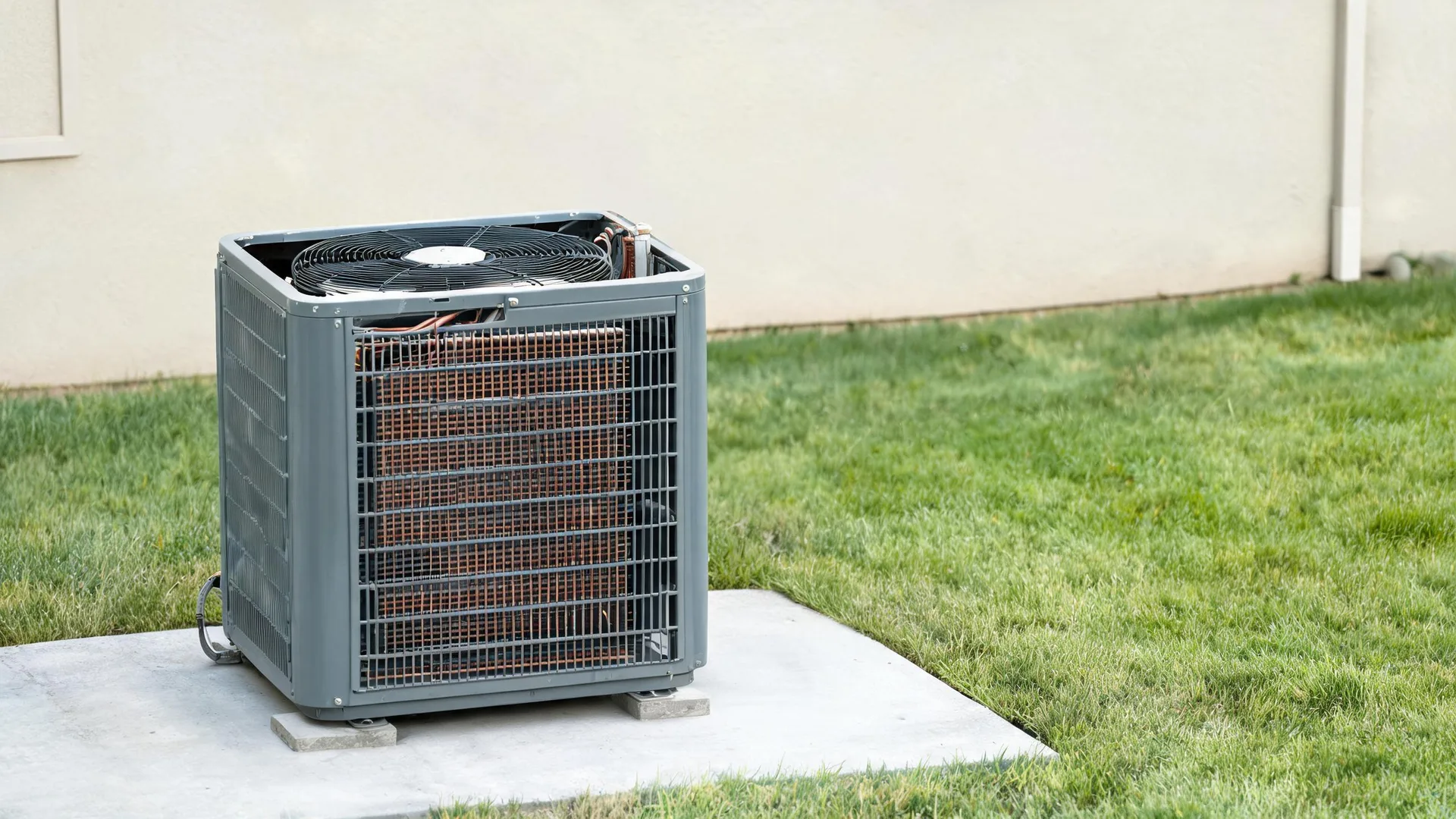
A gray outdoor HVAC unit mounted on a concrete pad beside a house with gray lap siding and a stone foundation.

What it sounds like before it quits

A heat pump that's working fine doesn't make itself known. You don't hear it, you don't think about it, the house just feels right. So when something changes, trust that you noticed. A system that used to keep the house steady and now runs long stretches without quite getting there has lost some capacity somewhere, in the compressor, the charge or the airflow across the coil. Short cycling, where it kicks on, runs a few minutes, and shuts off again, points a different direction, often to a thermostat issue or a unit that's oversized for the job and has been stressing its parts in a different way. A hissing or bubbling sound near the lines usually means refrigerant escaping somewhere it shouldn't. Ice on the outdoor coil in weather that shouldn't allow it means the system can't shed heat the way it needs to. None of these start as emergencies. They start as a sound or a feeling that something's slightly off, and they're worth calling in before the part that's struggling takes another part down with it.

What's safe to check yourself

Look at the thermostat first. Make sure it's set to the mode you want and the batteries aren't dying. Check the air filter and swap it if it's gray with dust, a clogged filter starves the coil of airflow and can make the whole system struggle. Walk outside and look at the outdoor unit. Clear away leaves, grass clippings or anything blocking the sides. Make sure nothing is stacked against it cutting off airflow. Check the breaker panel if the unit won't come on at all, a tripped breaker is something you can reset yourself.
What to leave alone

Don't open the outdoor unit's cabinet or touch anything inside it. Don't try to add refrigerant or track down a leak yourself, the lines carry pressure that needs the right tools and training to handle safely. If you see ice on the coil, don't chip it off, turn the system to fan only and let it melt on its own. If the breaker trips a second time after you reset it, leave it off and call someone, a breaker that keeps tripping is telling you about a problem that resetting won't fix.

A heat pump fails in a handful of predictable ways, and most of them trace back to one of a few parts. The compressor is the one nobody wants to hear about, because it's the most expensive to replace and the hardest to repair on its own. It usually doesn't fail out of nowhere. It fails because something fed it a bad diet for a long time, a low refrigerant charge, weak airflow, electrical strain from a failing capacitor, and it wore out trying to work around the problem. The reversing valve is the other part unique to a heat pump, the one that lets it switch between heating and cooling, and when it sticks, the system gets stuck blowing the wrong temperature air. Fan motors wear out from bearing failure, which usually announces itself as noise before it quits. Capacitors weaken slowly and then fail suddenly, so a unit that struggled to start last week might not start at all today. Keeping the outdoor coil clean and the airflow around it clear is the simplest thing that protects all of it, because a system fighting for airflow puts strain on every part downstream.

At some point whoever comes out to look at the heat pump is going to have to tell you whether it's worth fixing, and that depends on more than just what broke this time. A compressor or a reversing valve going bad on a unit already well into its years is a different conversation than a capacitor failing on a system that's otherwise been solid. Age matters because parts near the end of their life tend to fail together, not one at a time, so a repair today can turn into another one next month. How the unit has been running matters too. One that's needed a few small fixes over the years is in a different spot than one that just had its first real problem. None of that means older always means replace. It means the repair in front of you is worth weighing against what else on that unit is likely close behind it, and a tech who's looked at the whole system can tell you which situation you're actually in.