Storms come through often here
Caddo Parish logged 419 severe weather events between 2015 and 2024, including 279 damaging wind events, 101 hail events and 29 tornadoes. A mini-split's outdoor unit sits outside through all of it.
Takes about a minute. No obligation.
Caddo Parish logged 419 severe weather events between 2015 and 2024, including 279 damaging wind events, 101 hail events and 29 tornadoes. A mini-split's outdoor unit sits outside through all of it.
Nearly half of Louisiana households were without power for 24 hours or more at some point in 2024. When the grid goes down, so does a mini-split, along with whatever is heating or cooling the house.
NOAA nClimDiv, 1991–2020 normals
Electricity in Caddo Parish runs 13.67 cents a kilowatt-hour, cheaper than most of the country.
A mini-split that's sized and installed right turns that low rate into a low bill, every month it runs.




Caddo Parish falls under zone 3A in the 2021 energy code, built for places with a long cooling season and a short, humid winter. That rating sets a floor for any mini-split installed here. Under the federal standard, a split-system heat pump has to pull at least 14.3 Btu of heat for every watt-hour it uses over the summer, and deliver at least 7.5 Btu per watt-hour over the winter. Those numbers apply to any unit manufactured from January 1, 2023 on. A contractor sizing a system for this area has to work within that minimum, not under it.
A mini-split runs on the grid, and the grid here doesn't always hold. Ask where the outdoor unit will sit and what's nearby to hit it or fall on it. If heat or hot water matters in your house, talk through backup power before installation, not after the lines go down.
Find a contractor
Six months of cooling a year, from May through October. Afternoon highs average 93°F in June, July and August, and the dew point averages 70°F those same months, heavier than most of the country feels. That means the unit isn't just cooling the air, it's wringing the moisture out of it, the whole stretch. That's a long run for a compressor. Wind has hit this parish 279 times between 2015 and 2024, hail 101 times in that same stretch, and the outdoor unit sits outside through all of it. A system sized by guesswork or built for a milder climate won't hold up the same way here.
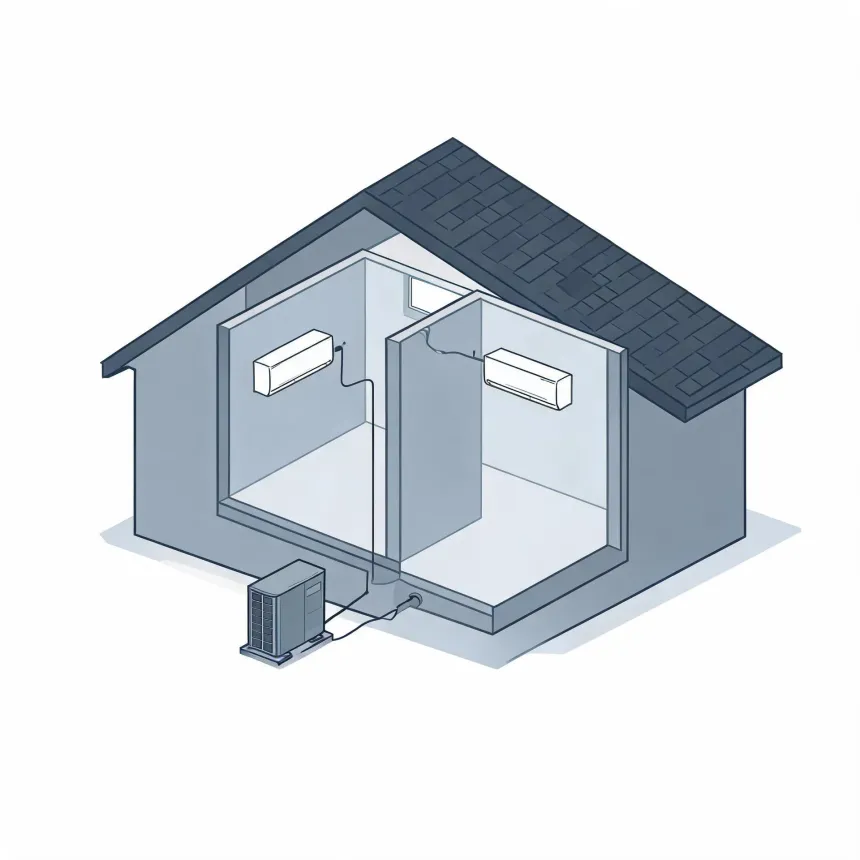
A mini-split needs a line set carrying refrigerant lines, power and a condensate drain between the outdoor unit and each indoor head. Running that line set through a brick wall costs more labor than running it through siding or framing. Longer runs between the indoor and outdoor units take more refrigerant and more time to insulate and seal. Every wall it crosses and every floor it climbs adds to the job.
A single-zone system cools or heats one room from one outdoor unit. A multi-zone system ties several indoor heads to one outdoor unit, and that outdoor unit has to be sized to carry all of them running at once. Each indoor head needs its own mounting, its own wiring and its own refrigerant connection back to the outdoor unit. More heads means more parts and more hours on the install, regardless of what the outdoor unit itself costs.
If this is replacing an old system, that equipment doesn't come out until the new one is ready to go in. A contractor recovers the refrigerant from the old unit first. It's against the law to vent it into the air, so it gets pulled out with a recovery machine and stored. After that, the old line set, the old indoor head and the old outdoor unit all come out. If the old line set ran through a wall the new system can reuse, a contractor may run new lines through it anyway rather than trust refrigerant lines that have been sitting for years. The old mounting bracket and pad usually get pulled too, since a new outdoor unit may not match the old footprint. None of that old equipment goes back in once it's out.
Given what hits this parish, sizing and installing this system right matters more than finding the lowest bid. A contractor who guesses at the load, or sets the outdoor unit somewhere exposed, is building in a problem for the first bad storm season. Ask how they're sizing the unit for this house, not a general rule of thumb. Ask where the outdoor unit will sit and whether it's shielded from the wind and whatever might come down on it. A system put in carefully holds up to the wind and hail here the same way year after year. One put in on the cheap doesn't get a second chance before the next storm finds it.