Aerial view of a residential air conditioning condenser unit mounted on a concrete pad next to a house with vinyl siding and a sliding glass door.

AC Installation in Ruston, LA

Tell us about the job

Takes about a minute. No obligation.

New system or replacementCentral ACLincoln Parish, LA
Step 1 of 2

What ZIP code is the job in?

Weather here does damage

Lincoln Parish recorded 80 severe weather events between 2015 and 2024. That includes 51 damaging wind events, 16 hail events, and 6 tornadoes. An outdoor condenser sits outside through all of it, exposed to wind-blown debris and hail.

The power goes out, too

Almost half of Louisiana households, 49%, went at least 24 hours without power in 2024. A new AC system runs on electricity no matter how efficient it is, and so does the fan or pump on most electric heat here.

5 months
May through September, your air conditioner is on duty
92°F
the average summer afternoon it cools against
16 hail events
in ten years, and hail bends the fins on outdoor coils
13.4 SEER2
the federal minimum any new unit must meet
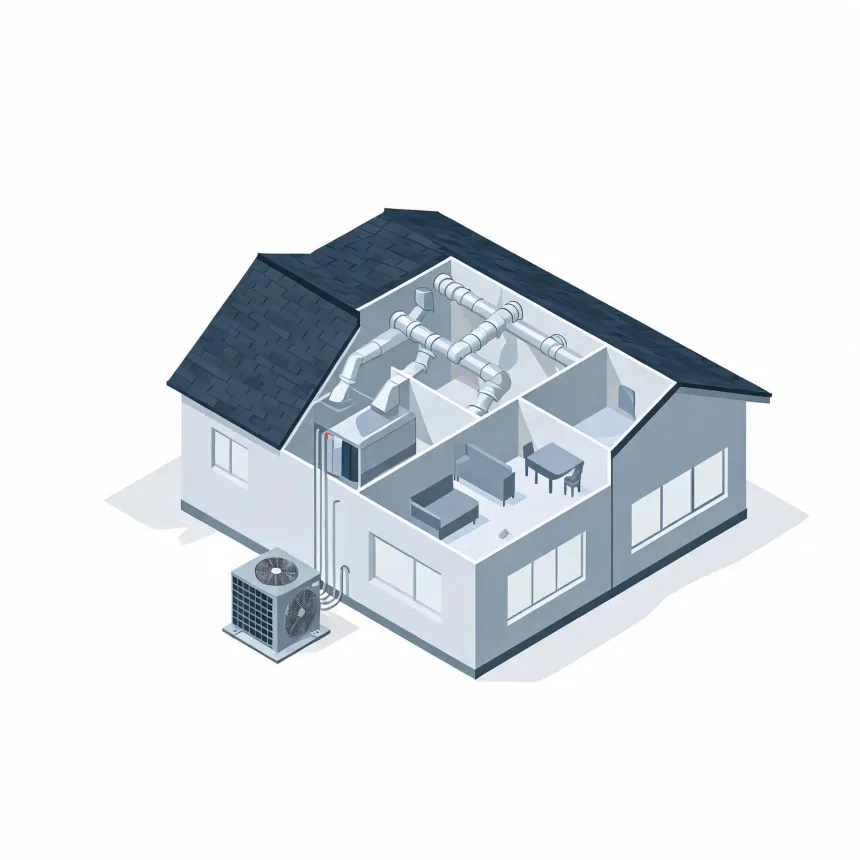
Isometric illustration of a cutaway single-story house showing attic ductwork, an indoor air handler, interior rooms with furniture, and an outdoor condenser unit connected by lines, on a white background.
Your air conditioner works hardest from June through September.

NOAA nClimDiv, 1991–2020 normals

More than half of homes in Lincoln Parish heat with electricity.

A straight swap, electric furnace or heat pump for the same, is usually the simplest install.

Five months of 92 degree afternoons, every year

Cooling runs May through September
Summer afternoons average 92°F
Power here costs 9.14 cents per kilowatt-hour
Have it ready before MayCooling here runs May through September. Get a new system in during April and it's working before the first hot day, not after it.

Lincoln Parish falls in zone 3A, a warm and humid climate under the 2021 energy code. Any split-system AC installed here has to meet the Southeast's minimum efficiency, which is higher than the national floor: 14.3 SEER2 for systems under 45,000 Btu/h, 13.8 SEER2 at or above that. That's most houses in Ruston. A federal tax credit is available for qualifying high-efficiency equipment installed in the home. The rule narrows what can legally go in, but it doesn't set a ceiling. A contractor can still size and spec the system around how the house holds up through a long cooling season, not just the minimum on paper.

Pick the install that can take a hit and keep running

Ask where the new condenser will sit and what will shield it from wind and hail. Ask what happens to heat and hot water if the power drops for a day. Settle both before the install, not after the next storm.

Find a contractor
A man in a dark cap, navy long-sleeve shirt and tan work pants walks up porch steps toward a green front door, carrying a worn canvas tool bag in his right hand.
A gray residential air conditioning condenser unit mounted on a concrete pad outdoors, surrounded by green grass under a partly cloudy blue sky.

Five months of this, every year, is what wears a system down

Five months of running every afternoon adds up to real hours on the compressor. That's the part that's going to show wear first if the system is undersized or if it's cutting on and off more than it should. Get the sizing right at install and the unit spends less time straining to catch up on the hottest days. Buying the cheapest system that clears the SEER2 minimum can cost more in the long run than one specified for a full Ruston summer.

The old unit has to come out whole

A condenser holds a charge of refrigerant, and code doesn't allow it to be vented into the air. Before the old outdoor unit is disconnected, that refrigerant gets recovered into a tank. The line set gets drained or replaced, and the old pad or mounting usually gets reused if it's still sound.

The indoor side changes too

Swapping the condenser outside almost always means swapping the coil in the attic or closet as well. The two are matched to work together, and an old coil paired with a new condenser rarely performs the way it should. Whoever installs the new system will pull the old coil at the same time, not leave it in place.

An outdoor air conditioning condenser unit installed beside the exterior wall of a blue vinyl-sided house at sunset.

Going above the federal minimum saves little here, about $20 a year.

  • A higher-efficiency unit$360 a year
  • A new unit at the federal minimum, 14.3 SEER2$380 a year

Estimates for a typical Lincoln Parish home, from EIA household energy data, Louisiana fuel prices and NOAA climate normals. Your home will differ.

Installation usually runs a full day, sometimes two if the ductwork needs rework. The crew starts by confirming the new equipment matches what was quoted, the condenser, the coil, and the air handler or furnace, before anything gets disconnected. Once the old refrigerant is recovered and the old unit is out, they set the new pad or confirm the old one still sits level, since a condenser that's tilted won't drain condensation the way it should. Line sets get run or reused, connections get brazed, and the system gets pressure tested before any refrigerant goes in, to catch a bad joint while it's still easy to fix. The last steps are the ones that decide how well it runs for years afterward: pulling a deep vacuum to clear moisture and air from the lines, charging it to the exact weight the manufacturer specifies, and checking airflow across the coil. A tech who skips the vacuum or eyeballs the charge is leaving a problem for the unit to work around all summer.